

[UPDATED 2025] A00-240 dumps Free Test Engine Verified By Certified Experts
Realistic A00-240 Accurate & Verified Answers As Experienced in the Actual Test!
NEW QUESTION # 21
Refer to the exhibit.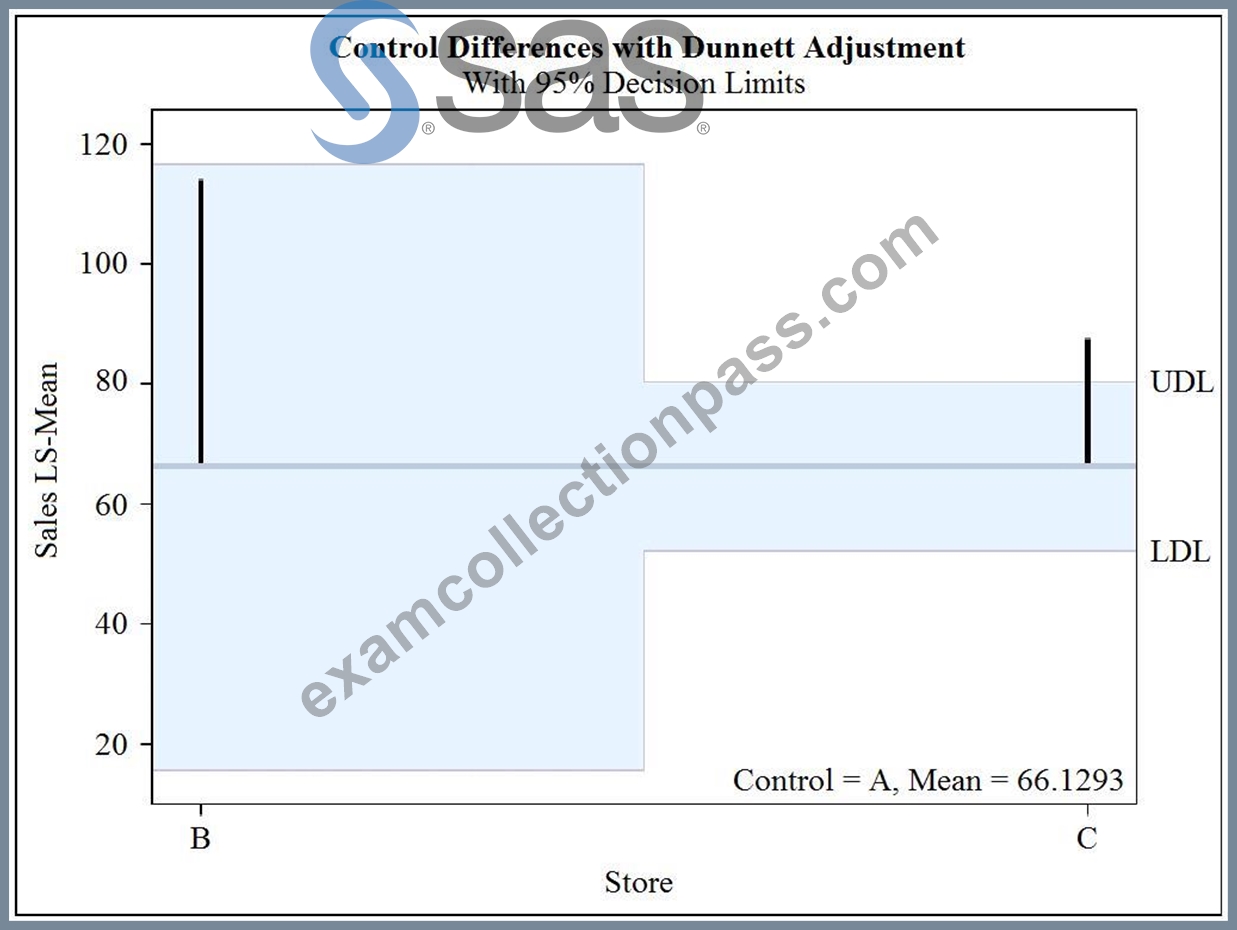
Which conclusion is justified concerning Sales, comparing stores A, B, and C?
- A. Store B is significantly different from store A.
- B. Store C is significantly different from Store A.
- C. Store B is significantly different from store C.
- D. There is no significant difference between stores.
Answer: A
NEW QUESTION # 22
Refer to the exhibit.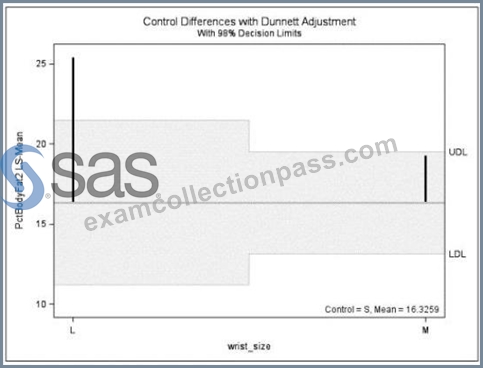
Given alpha=0.02, which conclusion is justified regarding percentage of body fat, comparing small (S),
medium (M), and large (L) wrist sizes?
- A. Large wrist size is significantly different than small wrist size.
- B. Large wrist size is significantly different than medium wrist size.
- C. There is no significant difference due to wrist size.
- D. Medium wrist size is significantly different than small wrist size.
Answer: A
NEW QUESTION # 23
This question will ask you to provide a missing option. Given the following SAS program:
What option must be added to the program to obtain a data set containing Pearson statistics?
- A. OUTSTAT=estimates
- B. OUTCORR=estimates
- C. OUTP=estimates
- D. OUTPUT=estimates
Answer: C
NEW QUESTION # 24
This question will ask you to provide a missing option. Given the following SAS program:
What option must be added to the program to obtain a data set containing Pearson statistics?
- A. OUTSTAT=estimates
- B. OUTCORR=estimates
- C. OUTP=estimates
- D. OUTPUT=estimates
Answer: C
NEW QUESTION # 25
Assume a $10 cost for soliciting a non-responder and a $200 profit for soliciting a responder. The logistic
regression model gives a probability score named P_R on a SAS data set called VALID. The VALID data
set contains the responder variable Pinch, a 1/0 variable coded as 1 for responder. Customers will be
solicited when their probability score is more than 0.05.
Which SAS program computes the profit for each customer in the data set VALID?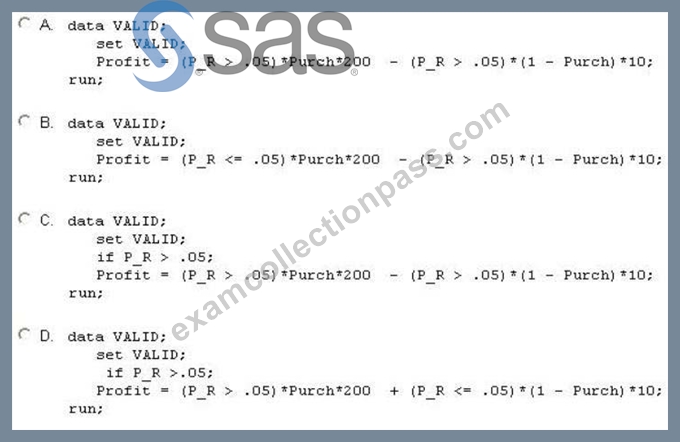
- A. Option B
- B. Option A
- C. Option D
- D. Option C
Answer: B
NEW QUESTION # 26
Refer to the exhibit: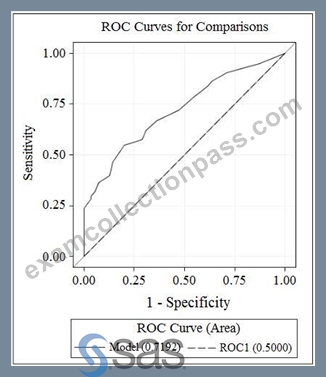
Which SAS program produced the graph?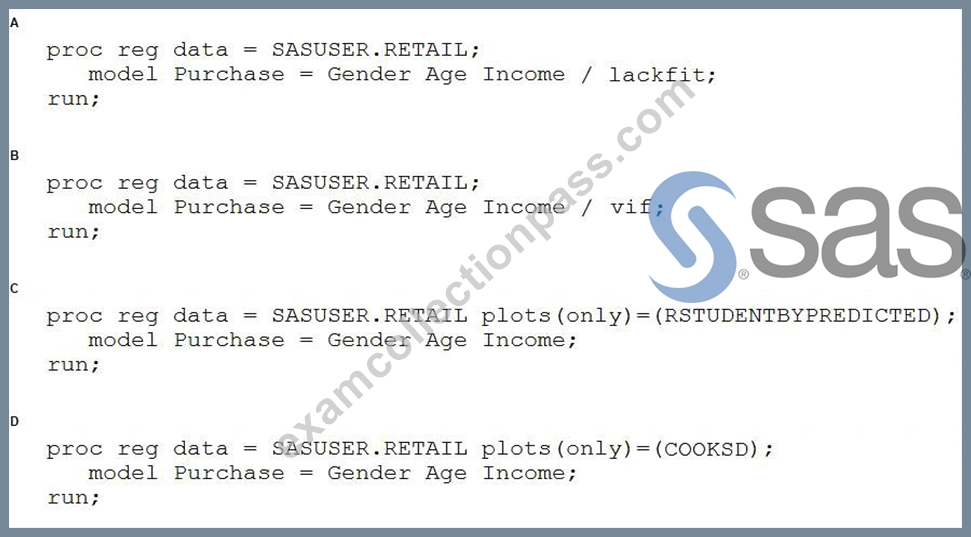
- A. Option A
- B. Option D
- C. Option B
- D. Option C
Answer: C
NEW QUESTION # 27
A non-contributing predictor variable (Pr > |t| =0.658) is added to an existing multiple linear regression
model.
What will be the result?
- A. No change in R-Square
- B. A decrease in R-Square
- C. A decrease in Mean Square Error
- D. An increase in R-Square
Answer: D
NEW QUESTION # 28
A financial services manager wants to assess the probability that certain clients will default on their Home Equity Line of Credit (HELOC). A former employee left the code listed below.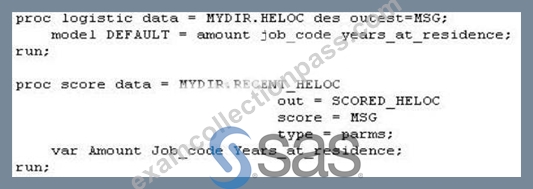
The training data set is named HELOC, while a similar data set of more recent clients is named RECENT_HELOC. Which SAS data steps will calculate the predicted probability of default on recent clients? (Choose two.)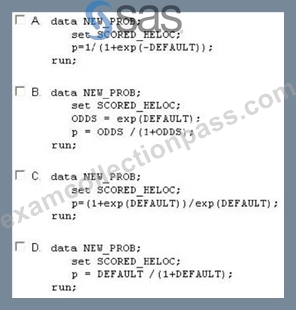
- A. Option A
- B. Option D
- C. Option B
- D. Option C
Answer: A,C
NEW QUESTION # 29
The standard form of a linear regression model is: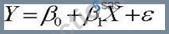
Which statement best summarizes the assumptions placed on the errors?
- A. The errors are correlated, normally distributed with zero mean and constant variance.
- B. The errors are independent, normally distributed with zero mean and constant variance.
- C. The errors are independent, normally distributed with constant mean and zero variance.
- D. The errors are correlated, normally distributed with constant mean and zero variance.
Answer: B
NEW QUESTION # 30
Refer to the ROC curve: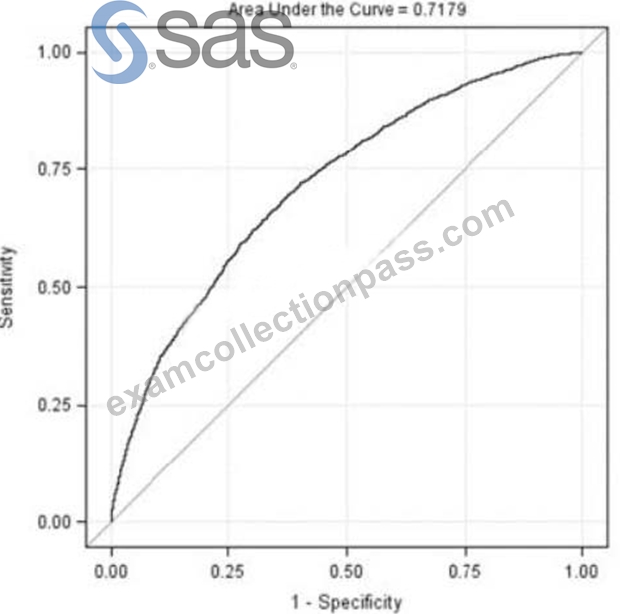
As you move along the curve, what changes?
- A. The probability cutoff for scoring
- B. The proportion of events in the training data
- C. The priors in the population
- D. The true negative rate in the population
Answer: A
NEW QUESTION # 31
A marketing campaign will send brochures describing an expensive product to a set of customers. The cost for mailing and production per customer is $50. The company makes $500 revenue for
each sale.
What is the profit matrix for a typical person in the population?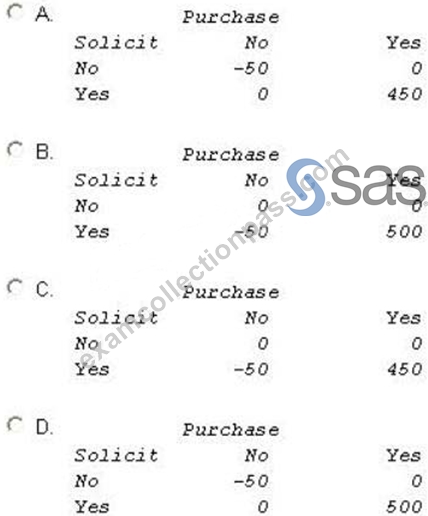
- A. Option B
- B. Option A
- C. Option D
- D. Option C
Answer: D
NEW QUESTION # 32
Refer to the confusion matrix: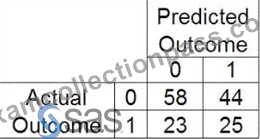
Calculate the accuracy and error rate (0 - negative outcome, 1 - positive outcome)
- A. Accuracy = 58/102, Error Rate = 23/48
- B. Accuracy = 83/102, Error Rate = 67/102
- C. Accuracy = 83/150, Error Rate = 67/150
- D. Accuracy = 25/150, Error Rate = 44/150
Answer: A
NEW QUESTION # 33
Refer to the exhibit.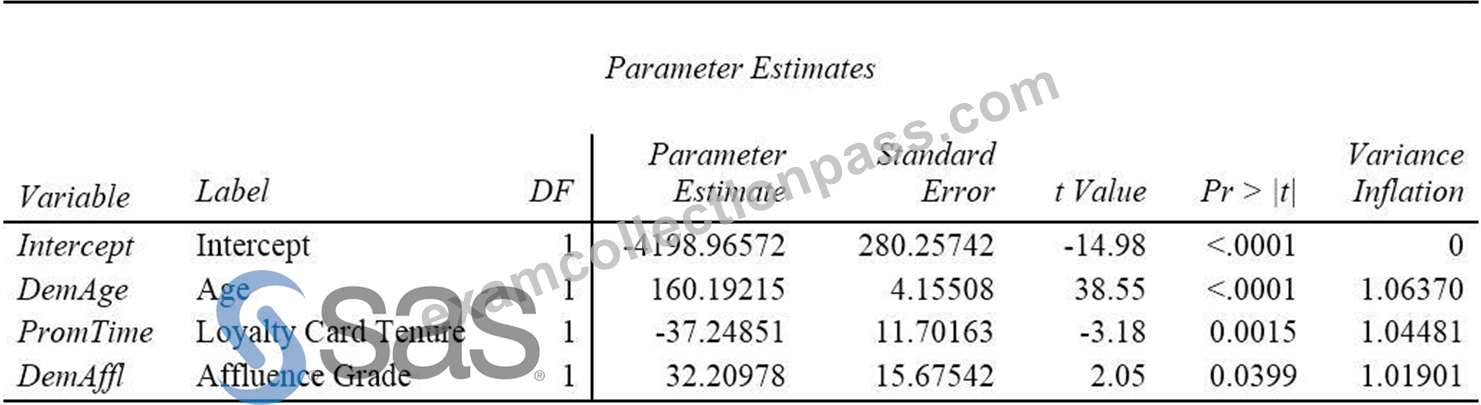
Output from a multiple linear regression analysis is shown.
What is the most appropriate statement concerning collinearity between the input variables?
- A. Collinearity is a problem since all variance inflation values are less than 10.
- B. Collinearity is a problem since all Pr>|t| values are less than 0.05.
- C. Collinearity is not a problem since all variance inflation values are less than 10.
- D. Collinearity is not a problem since all Pr>|t| values are less than 0.05.
Answer: D
NEW QUESTION # 34
An analyst fits a logistic regression model to predict whether or not a client will default on a loan. One of the predictors in the model is agent, and each agent serves 15-20 clients each. The model fails to converge. The analyst prints the summarized data, showing the number of defaulted loans per agent. See the partial output below: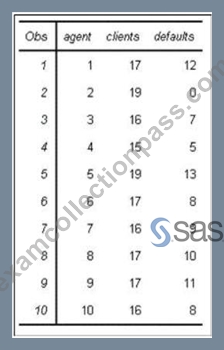
What is the most likely reason that the model fails to converge?
- A. There is quasi-complete separation in the data.
- B. There are missing values in the data.
- C. There is collinearity among the predictors.
- D. There are too many observations in the data.
Answer: A
NEW QUESTION # 35
What is a drawback to performing data cleansing (imputation, transformations, etc.) on raw data prior to partitioning the data for honest assessment as opposed to performing the data cleansing after partitioning the data?
- A. It violates assumptions of the model.
- B. It omits the training (and test) data sets from the benefits of the cleansing methods.
- C. There is no ability to compare the effectiveness of different cleansing methods.
- D. It requires extra computational effort and time.
Answer: C
NEW QUESTION # 36
This question will ask you to provide a missing option. Given the following SAS program:
What option must be added to the program to obtain a data set containing Pearson statistics?
- A. OUTSTAT=estimates
- B. OUTCORR=estimates
- C. OUTP=estimates
- D. OUTPUT=estimates
Answer: C
NEW QUESTION # 37
Which SAS program will divide the original data set into 60% training and 40% validation data sets, stratified by county?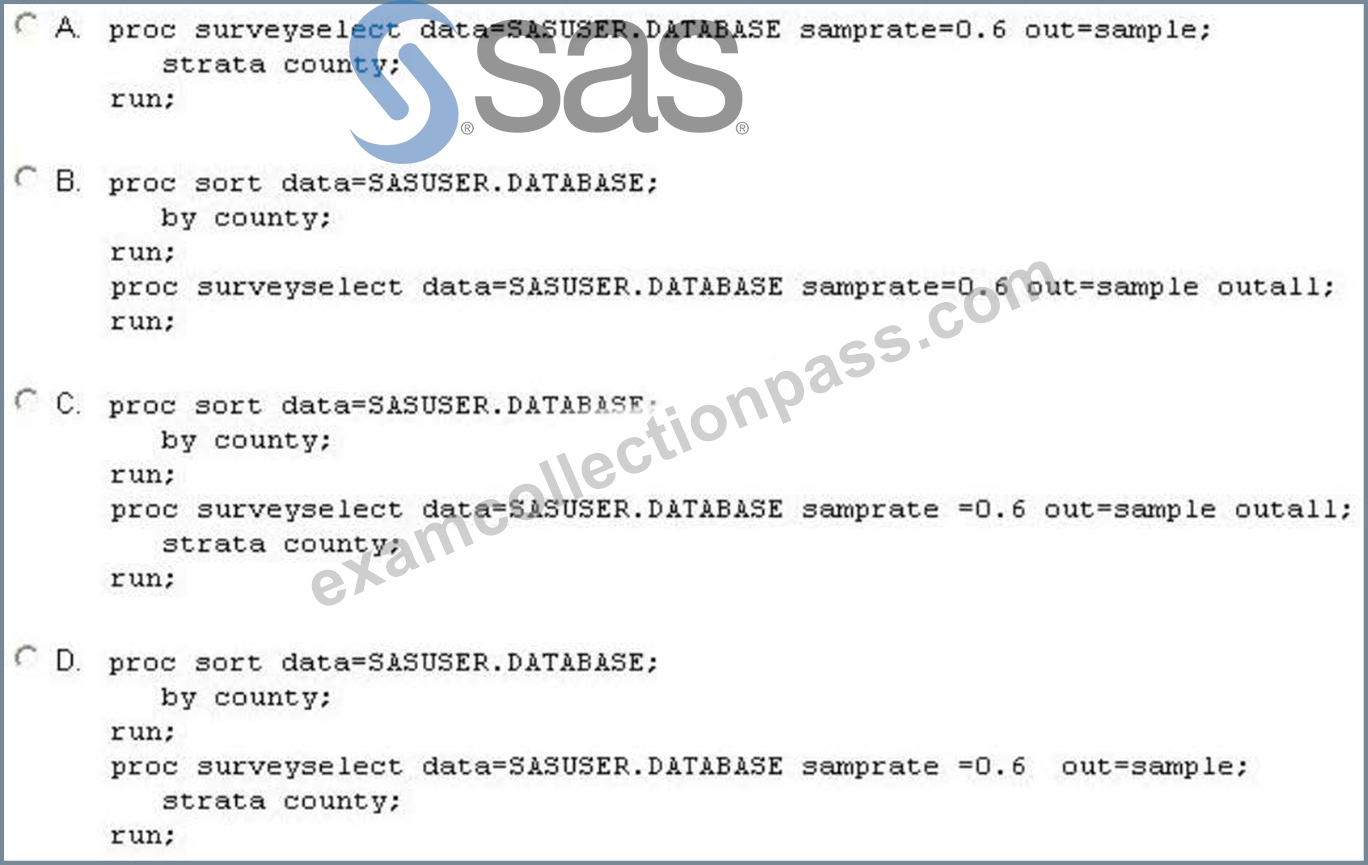
- A. Option B
- B. Option A
- C. Option D
- D. Option C
Answer: D
NEW QUESTION # 38
The question will ask you to provide a missing statement. Given the following SAS program:
Which SAS statement will complete the program to correctly score the data set NEW_DATA?
- A. Score data data=MYDIR.NEW_DATA output=scores;
- B. Score data=HYDIR.NEU_DATA output=scores;
- C. Score data data=MYDIR.NEW_DATA out=scores;
- D. Score data=MYDIR, NEW DATA out=scores;
Answer: D
NEW QUESTION # 39
Refer to the lift chart: At a depth of 0.1, Lift = 3.14. What does this mean?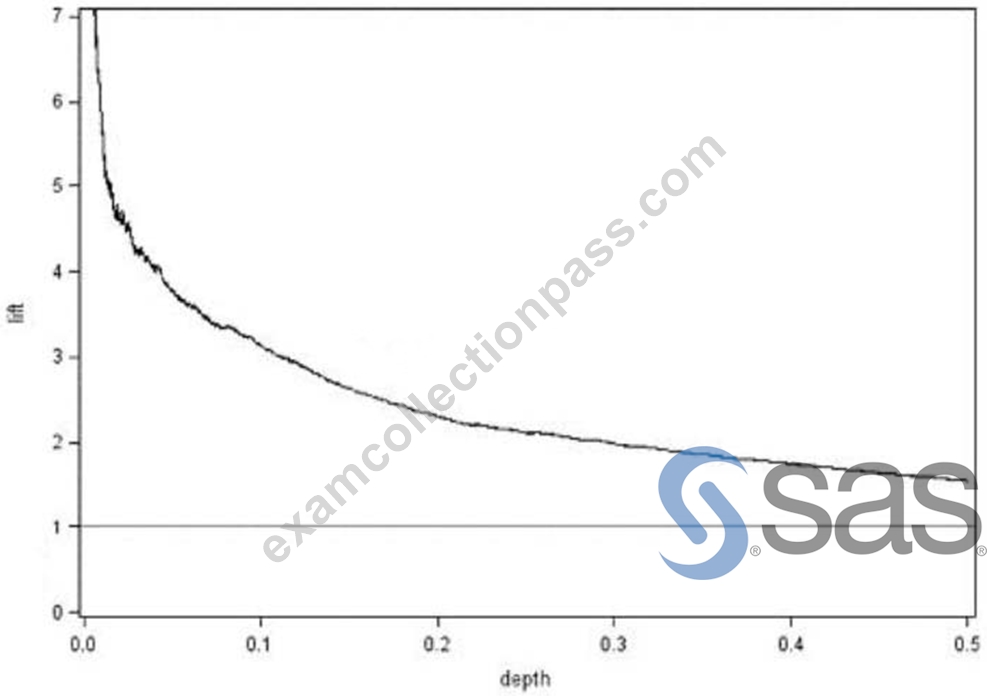
- A. Selecting the observations with a response probability of at least 10% should result in 3.14 times more events than a random draw of 10%.
- B. Selecting the top 10% of the population scored by the model should result in 3.14 times more events than a random draw of 10%.
- C. Selecting the top 10% of the population scored by the model should result in 3.14 timesgreater accuracy than a random draw of 10%.
- D. Selecting the observations with a response probability of atleast 10% should result in 3.14times greater accuracy than a random draw of 10%.
Answer: B
NEW QUESTION # 40
Which SAS program will detect collinearity in a multiple regression application?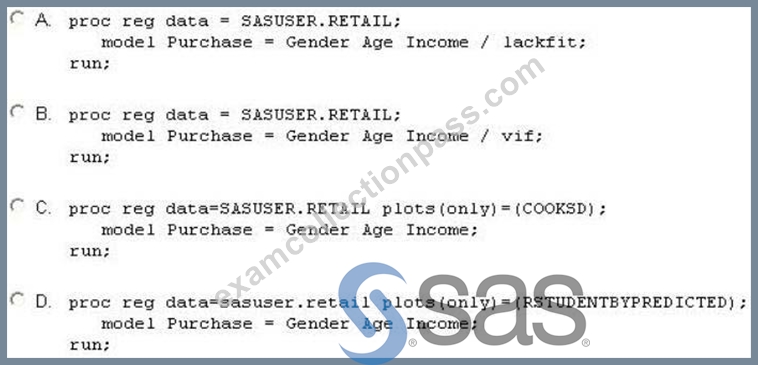
- A. Option A
- B. Option D
- C. Option B
- D. Option C
Answer: C
NEW QUESTION # 41
After performing an ANOVA test, an analyst has determined that a significant effect exists due to income. The analyst wants to compare each Income to all others and wants to control for experimentwise error.
Which GLM procedure statement would provide the most appropriate output?
- A. lsmeans Income / pdiff=all adjust=tukey;
- B. lsmeans Income / pdiff=all adjust=t;
- C. lsmeans Income / pdiff=control adjust=dunnett;
- D. lsmeans Income / pdiff=control adjust=t;
Answer: C
NEW QUESTION # 42
Refer to the exhibit: The plots represent two models, A and B, being fit to the same two data sets, training and validation.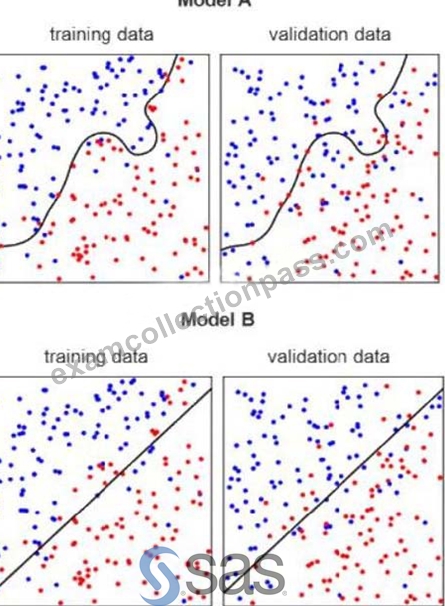
Model A is 90.5% accurate at distinguishing blue from red on the training data and 75.5% accurate at doing the same on validation data. Model B is 83% accurate at distinguishing blue from red on the training data and 78.3% accurate at doing the same on the validation data.
Which of the two models should be selected and why?
- A. Model A, It is more complex with a higher accuracy than model B on training data.
- B. Model B, It is simpler with a higher accuracy than model A on validation data.
- C. Model A, It performs better on the boundary for the training data.
- D. Model B, It is more complex with a higher accuracy than model A on validation data.
Answer: B
NEW QUESTION # 43
Refer to the exhibit: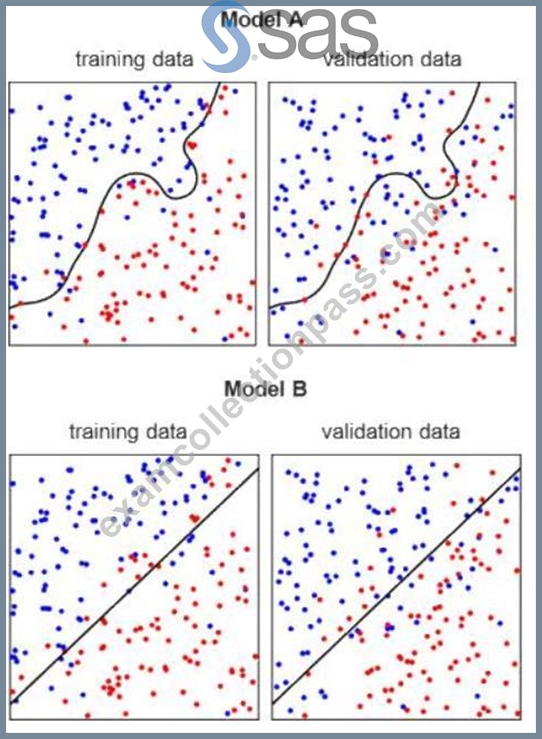
The plots represent two models, A and B, being fit to the same two data sets, training and validation.
Model A is 90.5% accurate at distinguishing blue from red on the training data and 75.5% accurate at doing the same on validation data. Model B is 83% accurate at distinguishing blue from red on the training data and 78.3% accurate at doing the same on the validation data.
Which of the two models should be selected and why?
- A. Model B. It is more complex with a higher accuracy than model A on validation data.
- B. Model B. It is simpler with a higher accuracy than model A on validation data.
- C. Model A. It performs better on the boundary for the training data.
- D. Model A. It is more complex with a higher accuracy than model B on training data.
Answer: B
NEW QUESTION # 44
......
Latest SASInstitute A00-240 Practice Test Questions: https://www.examcollectionpass.com/SASInstitute/A00-240-practice-exam-dumps.html