

[UPDATED 2023] Read AZ-204 Study Guide Cover to Cover as Literally
100% Real & Accurate AZ-204 Questions and Answers with Free and Fast Updates
Topics of AZ-204: Developing Solutions for Microsoft Azure Exam
Candidates should apprehend the examination topics before they begin of preparation. because it'll extremely facilitate them in touch the core. Our AZ-204 exam dumps will include the following topics:
1. Develop Azure compute solutions (25-30%)
Implement IaaS solutions
- Create container images for solutions
- Provision VMs
- Publish an image to the Azure Container Registry
- Create ARM templates
- Run containers by using Azure Container Instance
Create Azure App Service Web Apps
- Create an Azure App Service Web App
- Deploy code to a web app
- Implement autoscaling rules (schedule, operational/system metrics)
- Configure web app settings
- Enable diagnostics logging
Implement Azure functions
- Implement function triggers by using data operations, timers, and webhooks
- Implement input and output bindings for a function
- Implement Azure Durable Functions
2. Develop for Azure storage (10-15%)
Develop solutions that use Cosmos DB storage
- Set the appropriate consistency level for operations
- Select the appropriate API for your solution
- Interact with data using the appropriate SDK
- Create Cosmos DB containers
- Implement partitioning schemes
Develop solutions that use blob storage
- Set and retrieve properties and metadata
- Interact with data using the appropriate SDK
- Move items in Blob storage between storage accounts or containers
- Implement data archiving and retention
3. Implement Azure security (15-20%)
Implement user authentication and authorization
- Implement OAuth2 authentication
- Create and implement shared access signatures
- Register apps and use Azure Active Directory to authenticate users
Implement secure cloud solutions
- Implement Managed Identities for Azure resources
- Manage keys, secrets, and certificates by using the KeyVault API
- Secure app configuration data by using the App Configuration and KeyVault API
4. Monitor, troubleshoot, and optimize Azure solutions (10-15%)
Integrate caching and content delivery within solutions
- Store and retrieve data in Azure Redis cache
- Configure cache and expiration policies
- Develop code to implement CDN's in solutions
Instrument solutions to support monitoring and logging
- Configure instrumentation in an app or service by using Application Insights
- Analyze and troubleshoot solutions by using Azure Monitor
- Implement code that handles transient faults
- Implement Application Insights Web Test and Alerts
5. Connect to and consume Azure services and third-party services (25-30%)
Develop an App Service Logic App
- Create a custom template for Logic Apps
- Create a Logic App
- Create a custom connector for Logic Apps
Implement API management
- Create an APIM instance
- Configure authentication for APIs
- Define policies for APIs
Develop event-based solutions
- Implement solutions that use Azure Event Hub
- Implement solutions that use Azure Event Grid
- Implement solutions that use Azure Notification Hubs
Develop message-based solutions
- Implement solutions that use Azure Queue Storage queues
- Implement solutions that use Azure Service Bus
NEW QUESTION # 89
You need to implement the Log policy.
How should you complete the Azure Event Grid subscription? To answer, drag the appropriate JSON segments to the correct locations. Each JSON segment may be used once, more than once, or not at all. You may need to drag the split bar between panes to view content.
NOTE: Each correct selection is worth one point.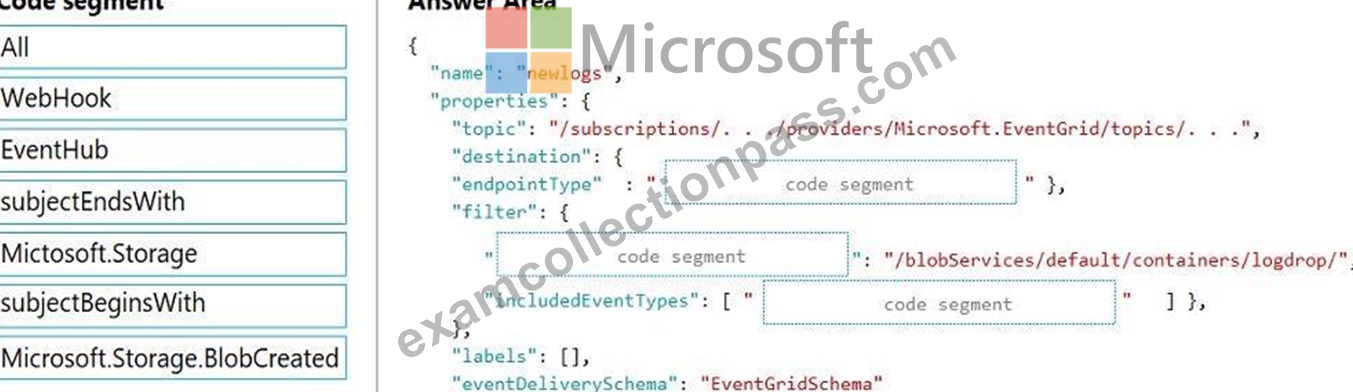
Answer:
Explanation: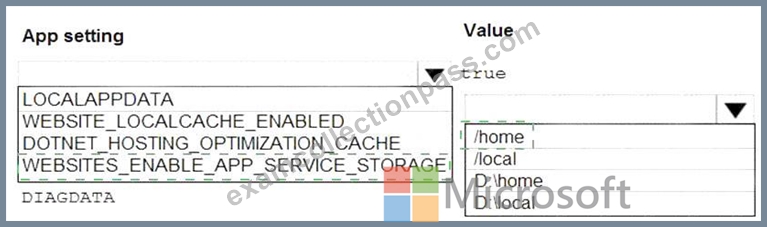
Explanation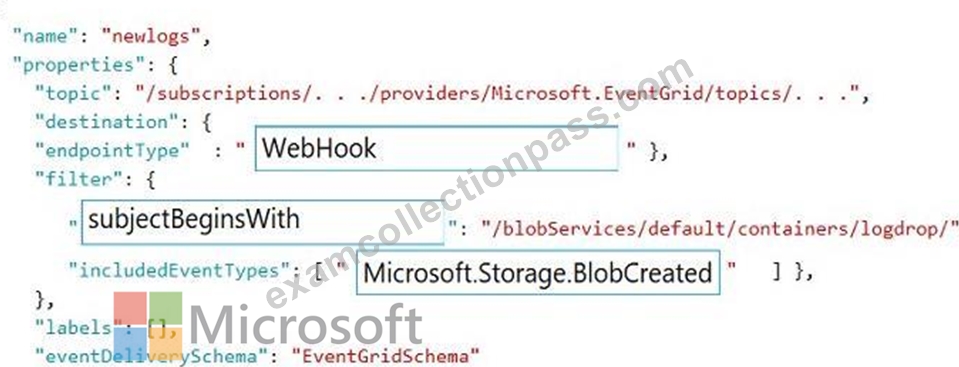
Box 1:WebHook
Scenario: If an anomaly is detected, an Azure Function that emails administrators is called by using an HTTP WebHook.
endpointType: The type of endpoint for the subscription (webhook/HTTP, Event Hub, or queue).
Box 2: SubjectBeginsWith
Box 3: Microsoft.Storage.BlobCreated
Scenario: Log Policy
All Azure App Service Web Apps must write logs to Azure Blob storage. All log files should be saved to a container named logdrop. Logs must remain in the container for 15 days.
Example subscription schema
{
"properties": {
"destination": {
"endpointType": "webhook",
"properties": {
"endpointUrl":
"https://example.azurewebsites.net/api/HttpTriggerCSharp1?code=VXbGWce53l48Mt8wuotr0GPmyJ/nDT4hgd
}
},
"filter": {
"includedEventTypes": [ "Microsoft.Storage.BlobCreated", "Microsoft.Storage.BlobDeleted" ],
"subjectBeginsWith": "blobServices/default/containers/mycontainer/log",
"subjectEndsWith": ".jpg",
"isSubjectCaseSensitive ": "true"
}
}
}
Reference:
https://docs.microsoft.com/en-us/azure/event-grid/subscription-creation-schema
NEW QUESTION # 90
Note: This question is part of a series of questions that present the same scenario. Each question in the series contains a unique solution that might meet the stated goals. Some question sets might have more than one correct solution, while others might not have a correct solution.
After you answer a question in this section, you will NOT be able to return to it. As a result, these questions will not appear in the review screen.
You are developing an Azure solution to collect point-of-sale (POS) device data from 2,000 stores located throughout the world. A single device can produce 2 megabytes (MB) of data every 24 hours. Each store location has one to five devices that send data.
You must store the device data in Azure Blob storage. Device data must be correlated based on a device identifier. Additional stores are expected to open in the future.
You need to implement a solution to receive the device data.
Solution: Provision an Azure Event Grid. Configure event filtering to evaluate the device identifier.
Does the solution meet the goal?
- A. No
- B. Yes
Answer: A
NEW QUESTION # 91
Your company is migrating applications to Azure. The IT department must allow internal developers to communicate with Microsoft support.
The service agents of the IT department must only have view resources and create support ticket permissions to all subscriptions. A new custom role must be created by reusing a default role definition and changing the permissions.
You need to create the custom role.
To answer, select the appropriate options in the answer area.
NOTE: Each correct selection is worth one point.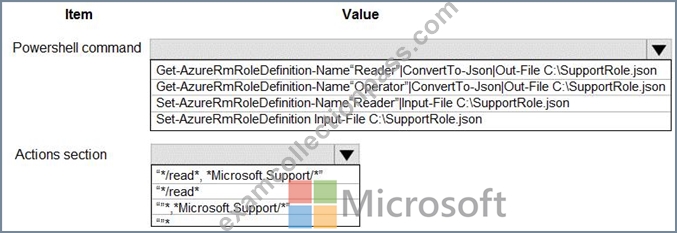
Answer:
Explanation: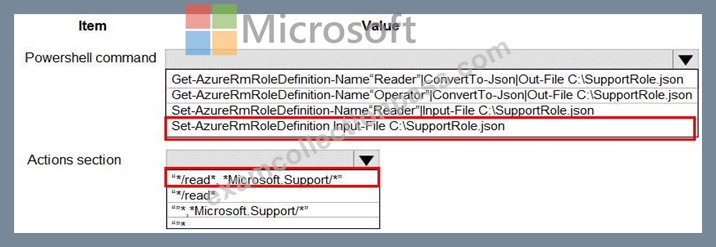
NEW QUESTION # 92
You are developing a back-end Azure App Service that scales based on the number of messages contained in a Service Bus queue.
A rule already exists to scale up the App Service when the average queue length of unprocessed and valid queue messages is greater than 1000.
You need to add a new rule that will continuously scale down the App Service as long as the scale up condition is not met.
How should you configure the Scale rule? To answer, select the appropriate options in the answer area.
NOTE: Each correct selection is worth one point.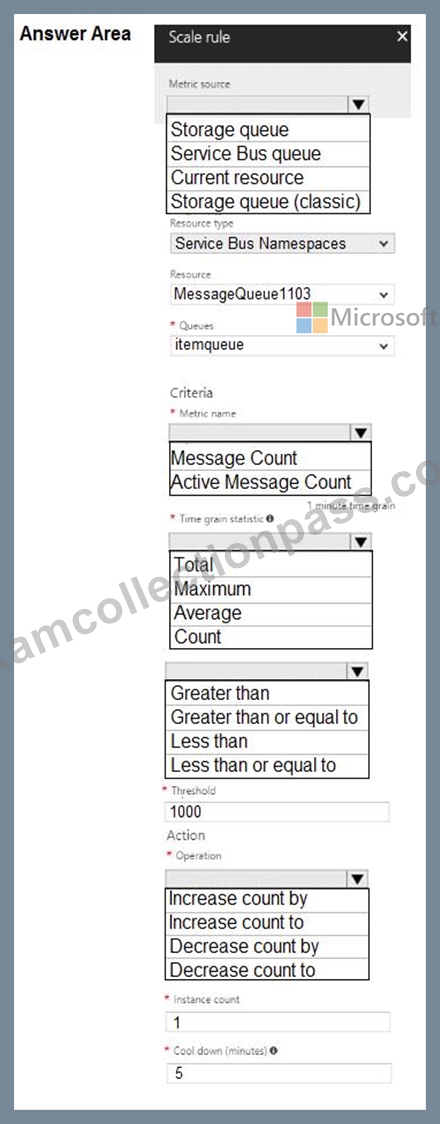
Answer:
Explanation: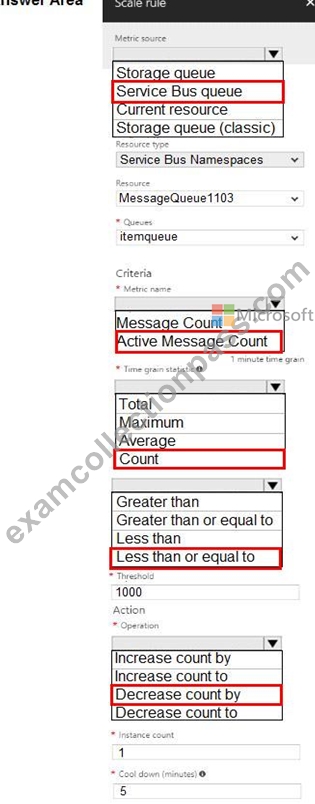
NEW QUESTION # 93
You need to ensure that PolicyLib requirements are met.
How should you complete the code segment? To answer, drag the appropriate code segments to the correct locations. Each code segment may be used once, more than once, or not at all. You may need to drag the split bar between panes or scroll to view content.
NOTE: Each correct selection is worth one point.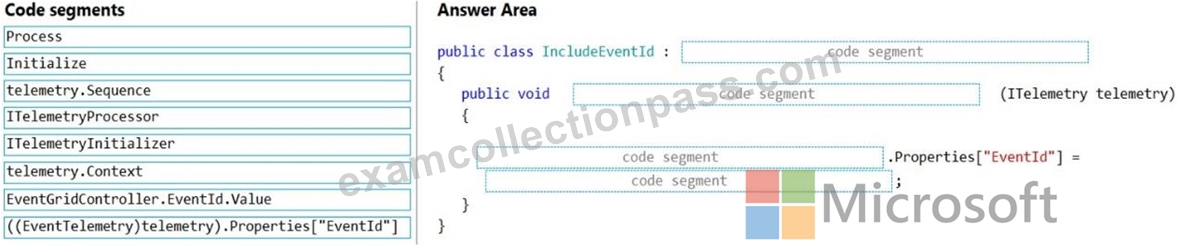
Answer:
Explanation:
Explanation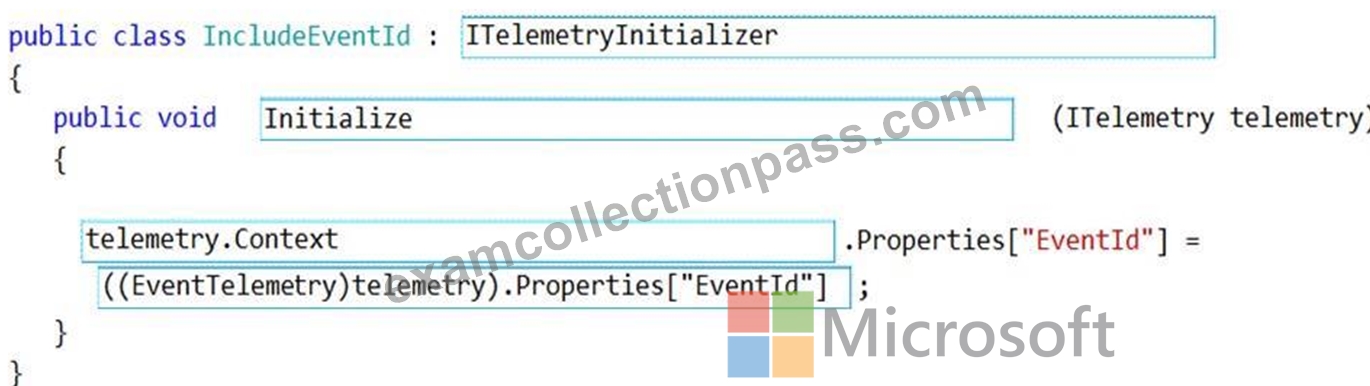
Scenario: You have a shared library named PolicyLib that contains functionality common to all ASP.NET Core web services and applications. The PolicyLib library must:
* Exclude non-user actions from Application Insights telemetry.
* Provide methods that allow a web service to scale itself.
* Ensure that scaling actions do not disrupt application usage.
Box 1: ITelemetryInitializer
Use telemetry initializers to define global properties that are sent with all telemetry; and to override selected behavior of the standard telemetry modules.
Box 2: Initialize
Box 3: Telemetry.Context
Box 4: ((EventTelemetry)telemetry).Properties["EventID"]
Reference:
https://docs.microsoft.com/en-us/azure/azure-monitor/app/api-filtering-sampling
Topic 5, Litware Inc
Case study
This is a case study. Case studies are not timed separately. You can use as much exam time as you would like to complete each case. However, there may be additional case studies and sections on this exam. You must manage your time to ensure that you are able to complete all questions included on this exam in the time provided.
To answer the questions included in a case study, you will need to reference information that is provided in the case study. Case studies might contain exhibits and other resources that provide more information about the scenario that is described in the case study. Each question is independent of the other questions in this case study.
At the end of this case study, a review screen will appear. This screen allows you to review your answers and to make changes before you move to the next section of the exam. After you begin a new section, you cannot return to this section.
To start the case study
To display the first question in this case study, click the button. Use the buttons in the left pane to explore the content of the case study before you answer the questions. Clicking these buttons displays information such as business requirements, existing environment, and problem statements. When you are ready to answer a question, click the Background You are a developer for Litware Inc., a SaaS company that provides a solution for managing employee expenses. The solution consists of an ASP.NET Core Web API project that is deployed as an Azure Web App.
Overall architecture
Employees upload receipts for the system to process. When processing is complete, the employee receives a summary report email that details the processing results. Employees then use a web application to manage their receipts and perform any additional tasks needed for reimbursement.
Receipt processing
Employees may upload receipts in two ways:
* Uploading using an Azure Files mounted folder
* Uploading using the web application
Data Storage
Receipt and employee information is stored in an Azure SQL database.
Documentation
Employees are provided with a getting started document when they first use the solution. The documentation includes details on supported operating systems for Azure File upload, and instructions on how to configure the mounted folder.
Solution details
Users table
Web Application
You enable MSI for the Web App and configure the Web App to use the security principal name WebAppIdentity.
Processing
Processing is performed by an Azure Function that uses version 2 of the Azure Function runtime. Once processing is completed, results are stored in Azure Blob Storage and an Azure SQL database. Then, an email summary is sent to the user with a link to the processing report. The link to the report must remain valid if the email is forwarded to another user.
Logging
Azure Application Insights is used for telemetry and logging in both the processor and the web application.
The processor also has TraceWriter logging enabled. Application Insights must always contain all log messages.
Requirements
Receipt processing
Concurrent processing of a receipt must be prevented.
Disaster recovery
Regional outage must not impact application availability. All DR operations must not be dependent on application running and must ensure that data in the DR region is up to date.
Security
* User's SecurityPin must be stored in such a way that access to the database does not allow the viewing of SecurityPins. The web application is the only system that should have access to SecurityPins.
* All certificates and secrets used to secure data must be stored in Azure Key Vault.
* You must adhere to the principle of least privilege and provide privileges which are essential to perform the intended function.
* All access to Azure Storage and Azure SQL database must use the application's Managed Service Identity (MSI).
* Receipt data must always be encrypted at rest.
* All data must be protected in transit.
* User's expense account number must be visible only to logged in users. All other views of the expense account number should include only the last segment, with the remaining parts obscured.
* In the case of a security breach, access to all summary reports must be revoked without impacting other parts of the system.
Issues
Upload format issue
Employees occasionally report an issue with uploading a receipt using the web application. They report that when they upload a receipt using the Azure File Share, the receipt does not appear in their profile. When this occurs, they delete the file in the file share and use the web application, which returns a 500 Internal Server error page.
Capacity issue
During busy periods, employees report long delays between the time they upload the receipt and when it appears in the web application.
Log capacity issue
Developers report that the number of log messages in the trace output for the processor is too high, resulting in lost log messages.
Application code
Processing.cs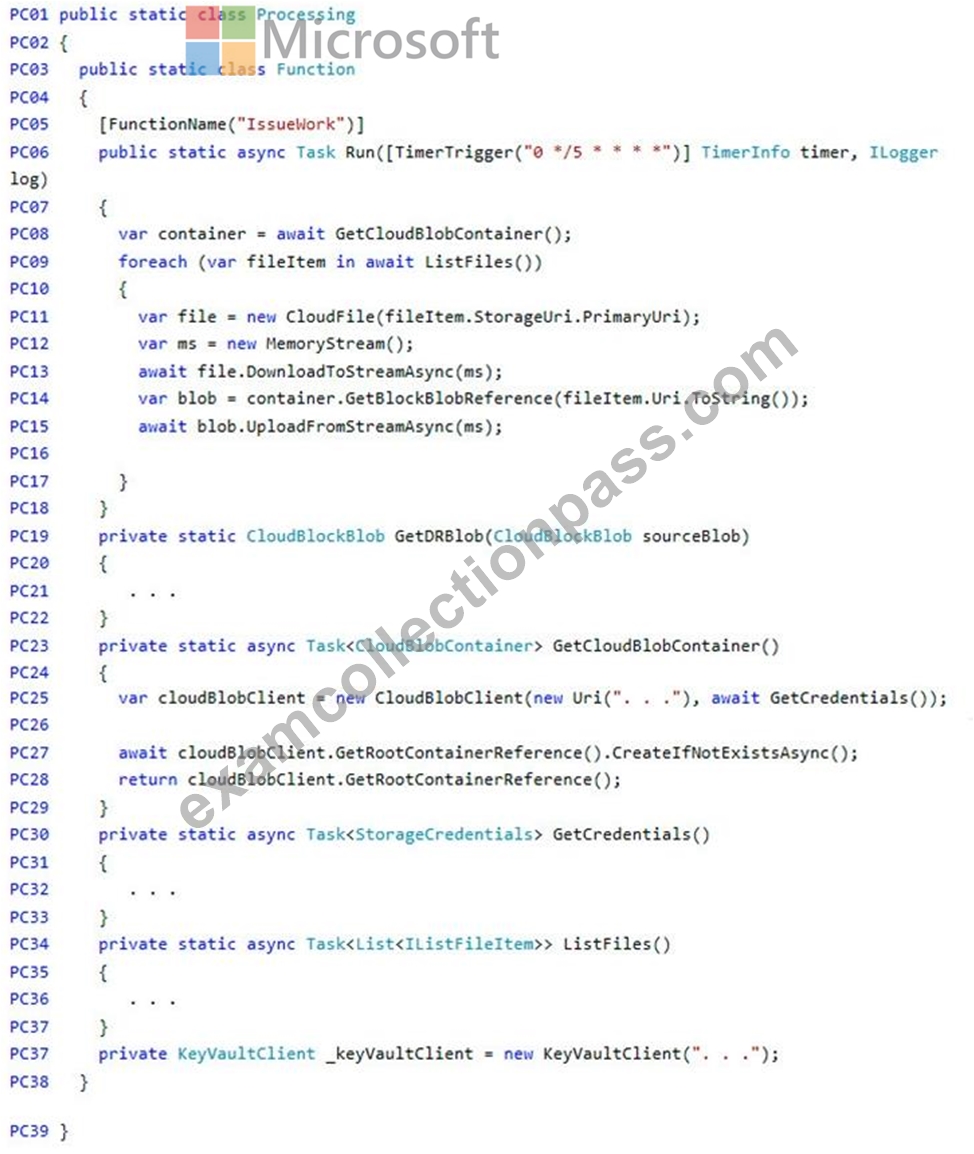
Database.cs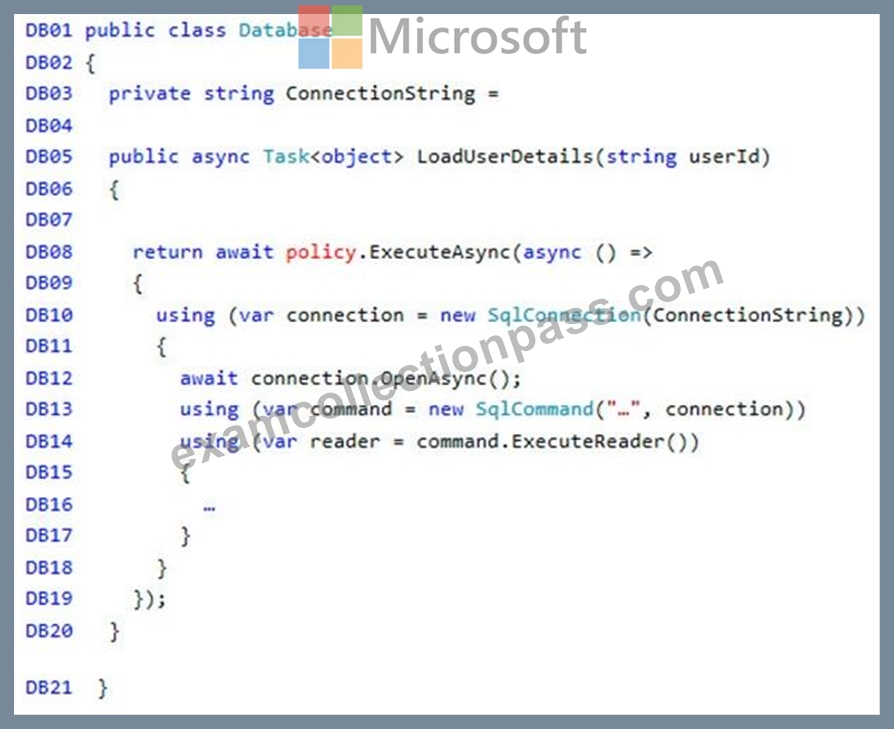
ReceiptUploader.cs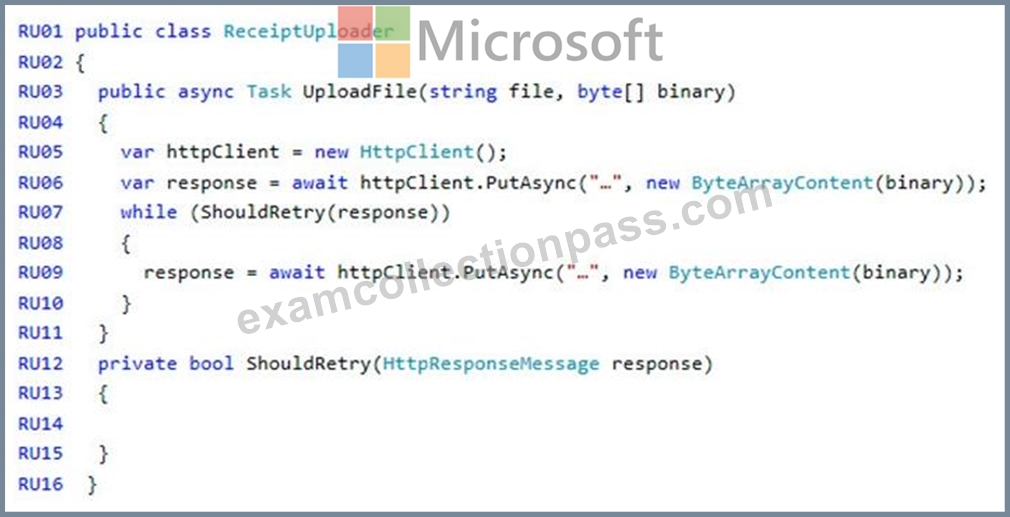
ConfigureSSE.ps1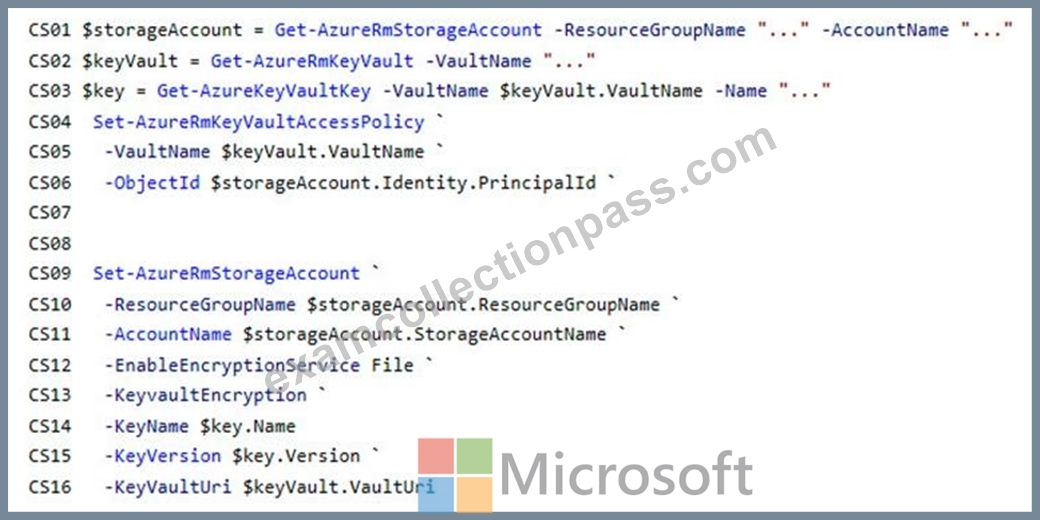
NEW QUESTION # 94
Hotspot Question
You have a web service that is used to pay for food deliveries. The web service uses Azure Cosmos DB as the data store.
You plan to add a new feature that allows users to set a tip amount. The new feature requires that a property named tip on the document in Cosmos DB must be present and contain a numeric value.
There are many existing websites and mobile apps that use the web service that will not be updated to set the tip property for some time.
How should you complete the trigger?
NOTE: Each correct selection is worth one point.`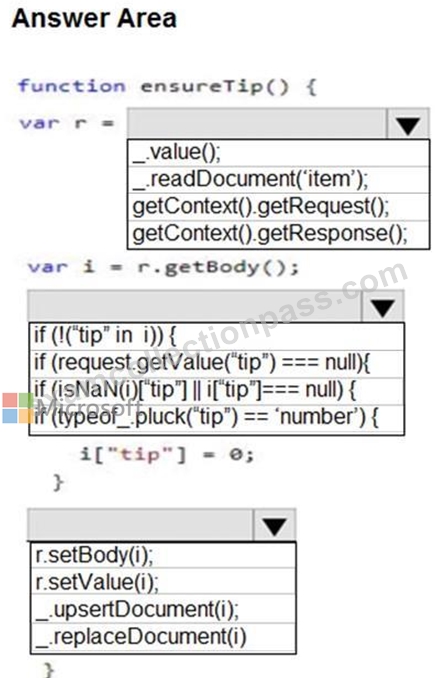
Answer:
Explanation: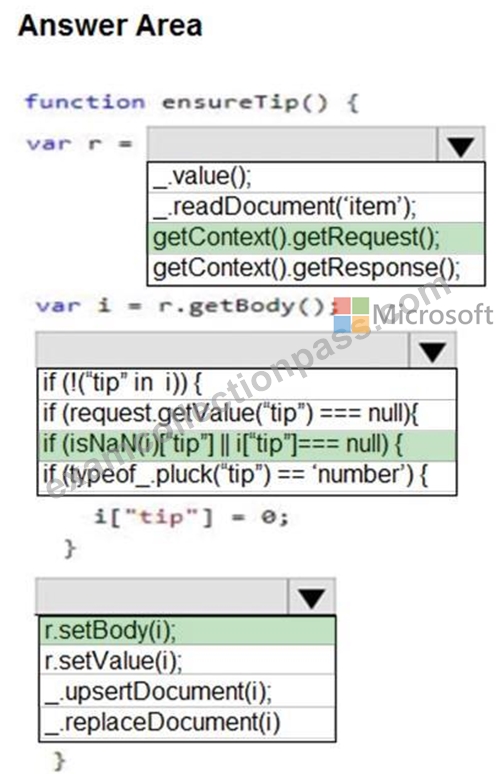
Explanation:
Box 1: getContext().getRequest();
Box 2: if(isNaN(i)["tip"] ..
In JavaScript, there are two ways to check if a variable is a number :
isNaN() ?Stands for "is Not a Number", if variable is not a number, it return true, else return false.
typeof ?If variable is a number, it will returns a string named "number".
Box 3:r.setBody(i);
// update the item that will be created
References:
https://docs.microsoft.com/bs-latn-ba/azure/cosmos-db/how-to-write-stored-procedures-triggers- udfs
https://mkyong.com/javascript/check-if-variable-is-a-number-in-javascript/
NEW QUESTION # 95
You need to implement event routing for retail store location data.
Which configuration should you use?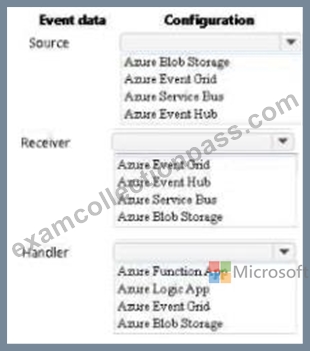
Answer:
Explanation: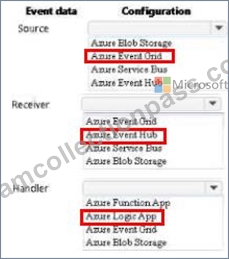
NEW QUESTION # 96
You are developing an ASP.NET Core website that can be used to manage photographs which are stored in Azure Blob Storage containers.
Users of the website authenticate by using their Azure Active Directory (Azure AD) credentials.
You implement role-based access control (RBAC) role permissions on the containers that store photographs. You assign users to RBAC roles.
You need to configure the website's Azure AD Application so that user's permissions can be used with the Azure Blob containers.
How should you configure the application? To answer, drag the appropriate setting to the correct location. Each setting can be used once, more than once, or not at all. You may need to drag the split bar between panes or scroll to view content.
NOTE: Each correct selection is worth one point.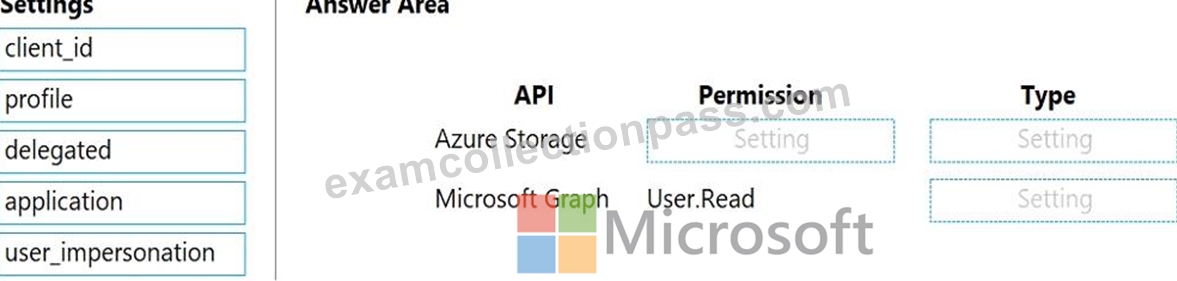
Answer:
Explanation: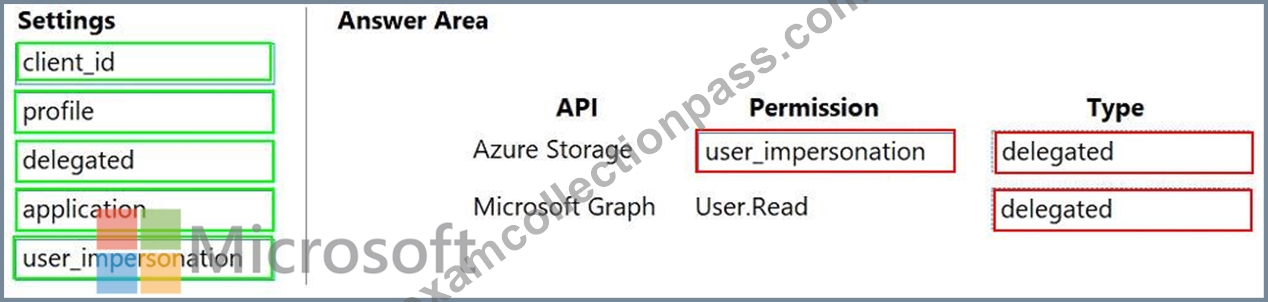
Reference:
https://docs.microsoft.com/en-us/samples/azure-samples/active-directory-dotnet-webapp-webapi-openidconnect-aspnetcore/calling-a-web-api-in-an-aspnet-core-web-application-using-azure-ad/
NEW QUESTION # 97
You are developing a Docker/Go using Azure App Service Web App for Containers. You plan to run the container in an App Service on Linux. You identify a Docker container image to use.
None of your current resource groups reside in a location that supports Linux. You must minimize the number of resource groups required.
You need to create the application and perform an initial deployment.
Which three Azure CLI commands should you use to develop the solution? To answer, move the appropriate commands from the list of commands to the answer area and arrange them in the correct order.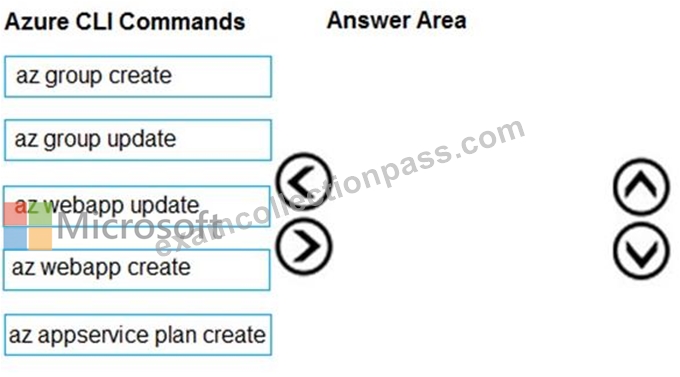
Answer:
Explanation: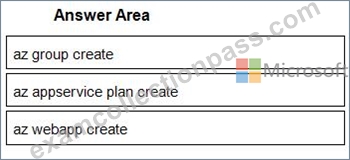
1 - az group create
2 - az appservice plan create
3 - az webapp create
Reference:
https://docs.microsoft.com/mt-mt/azure/app-service/containers/quickstart-docker-go?view=sql-server-ver15
NEW QUESTION # 98
You are implementing a software as a service (SaaS) ASP.NET Core web service that will run as an Azure Web App. The web service will use an on-premises SQL Server database for storage. The web service also includes a WebJob that processes data updates. Four customers will use the web service.
* Each instance of the WebJob processes data for a single customer and must run as a singleton instance.
* Each deployment must be tested by using deployment slots prior to serving production data.
* Azure costs must be minimized.
* Azure resources must be located in an isolated network.
You need to configure the App Service plan for the Web App.
How should you configure the App Service plan? To answer, select the appropriate settings in the answer area.
NOTE: Each correct selection is worth one point.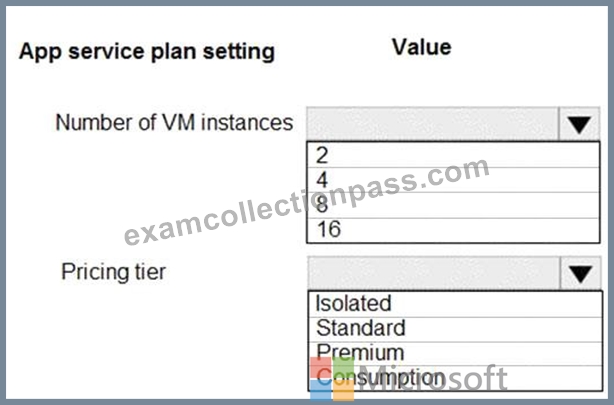
Answer:
Explanation: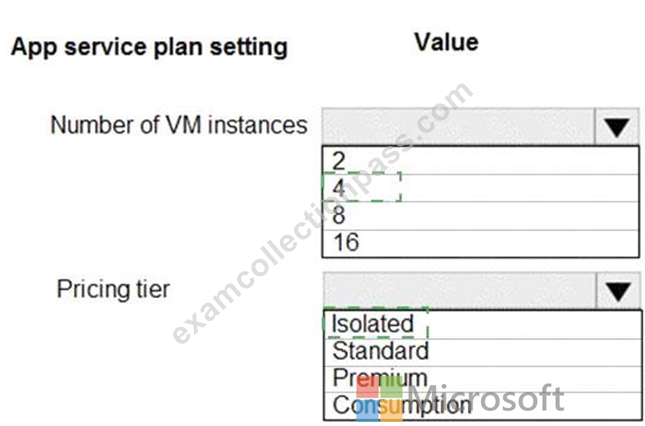
Explanation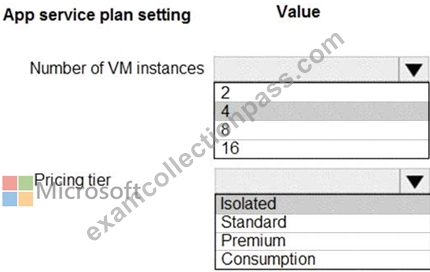
Number of VM instances: 4
You are not charged extra for deployment slots.
Pricing tier: Isolated
The App Service Environment (ASE) is a powerful feature offering of the Azure App Service that gives network isolation and improved scale capabilities. It is essentially a deployment of the Azure App Service into a subnet of a customer's Azure Virtual Network (VNet).
References:
https://azure.microsoft.com/sv-se/blog/announcing-app-service-isolated-more-power-scale-and-ease-of-use/
NEW QUESTION # 99
You are developing a back-end Azure App Service that scales based on the number of messages contained in a Service Bus queue.
A rule already exists to scale up the App Service when the average queue length of unprocessed and valid queue messages is greater than 1000.
You need to add a new rule that will continuously scale down the App Service as long as the scale up condition is not met.
How should you configure the Scale rule? To answer, select the appropriate options in the answer area.
NOTE: Each correct selection is worth one point.
Answer:
Explanation: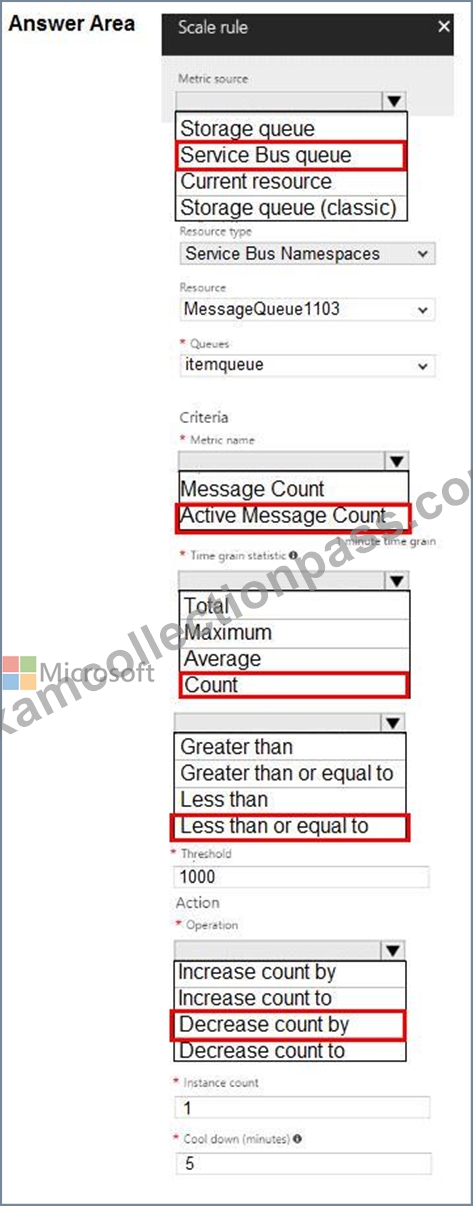
NEW QUESTION # 100
You are configuring a new development environment for a Java application.
The environment requires a Virtual Machine Scale Set (VMSS), several storage accounts, and networking components.
The VMSS must not be created until the storage accounts have been successfully created and an associated load balancer and virtual network is configured.
How should you complete the Azure Resource Manager template? To answer, select the appropriate options in the answer area.
NOTE: Each correct selection is worth one point.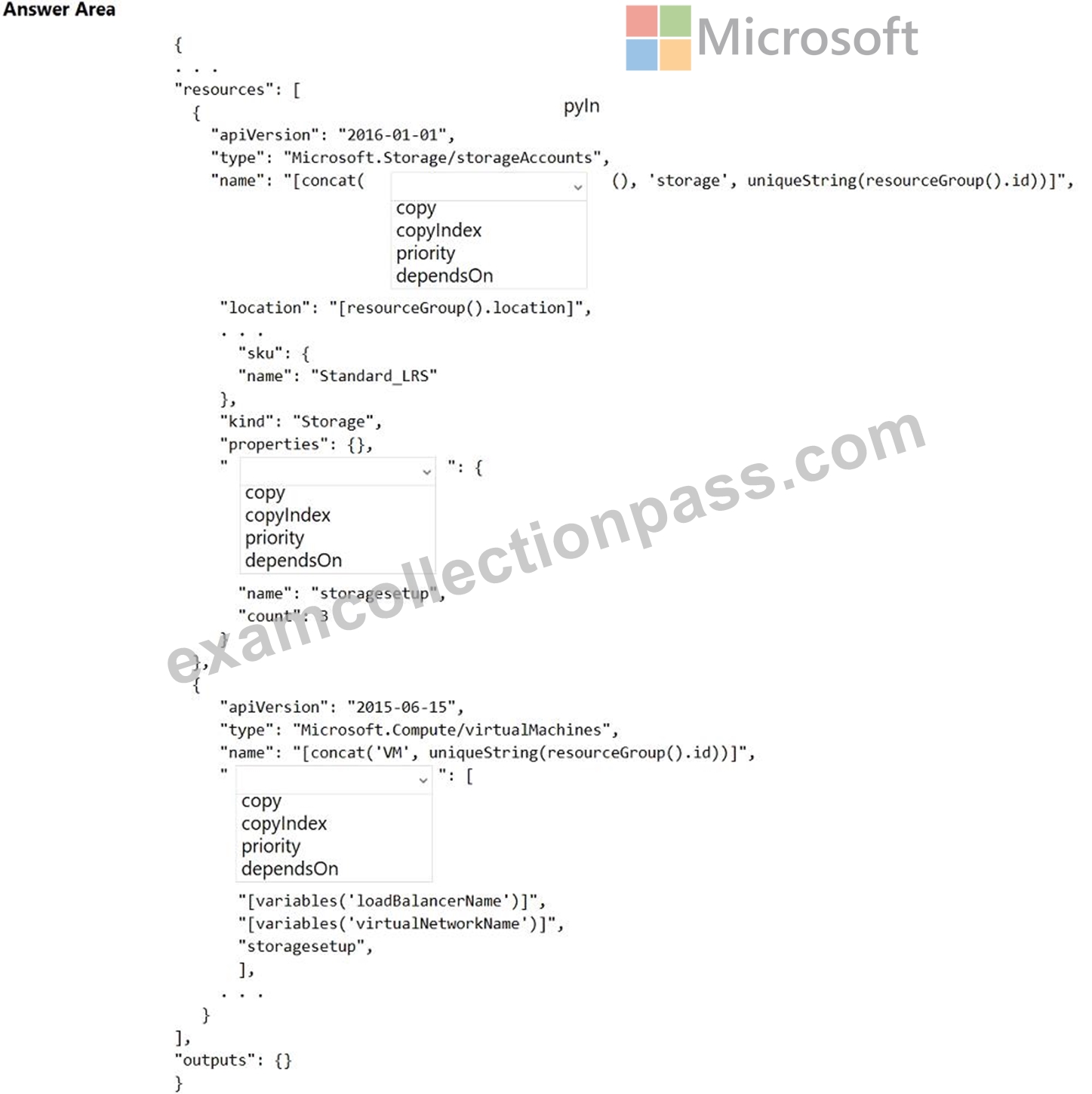
Answer:
Explanation: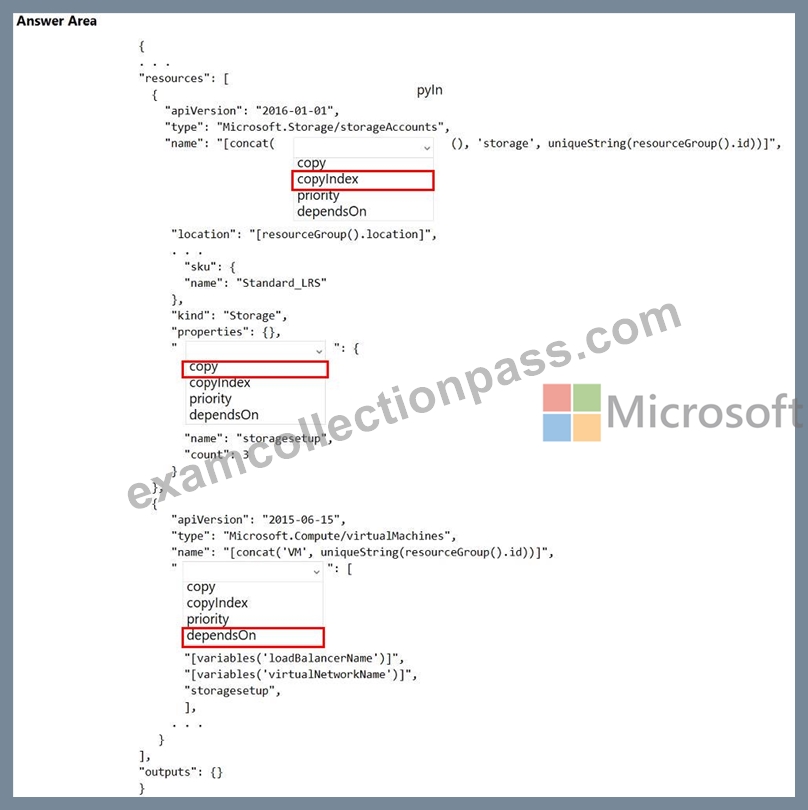
Reference:
https://docs.microsoft.com/en-us/azure/azure-resource-manager/templates/copy-resources
https://docs.microsoft.com/en-us/azure/virtual-machine-scale-sets/quick-create-template-windows
NEW QUESTION # 101
Note: This question is part of a series of questions that present the same scenario. Each question in the series contains a unique solution that might meet the stated goals. Some question sets might have more than one correct solution, while others might not have a correct solution.
After you answer a question in this section, you will NOT be able to return to it. As a result, these questions will not appear in the review screen.
You develop a software as a service (SaaS) offering to manage photographs. Users upload photos to a web service which then stores the photos in Azure Storage Blob storage. The storage account type is General- purpose V2.
When photos are uploaded, they must be processed to produce and save a mobile-friendly version of the image. The process to produce a mobile-friendly version of the image must start in less than one minute.
You need to design the process that starts the photo processing.
Solution: Convert the Azure Storage account to a BlockBlobStorage storage account.
Does the solution meet the goal?
- A. No
- B. Yes
Answer: A
Explanation:
Not necessary to convert the account, instead move photo processing to an Azure Function triggered from the blob upload..
Azure Storage events allow applications to react to events. Common Blob storage event scenarios include image or video processing, search indexing, or any file-oriented workflow.
Note: Only storage accounts of kind StorageV2 (general purpose v2) and BlobStorage support event integration. Storage (general purpose v1) does not support integration with Event Grid.
Reference:
https://docs.microsoft.com/en-us/azure/storage/blobs/storage-blob-event-overview Develop for Azure storage Testlet 1 Case study This is a case study. Case studies are not timed separately. You can use as much exam time as you would like to complete each case. However, there may be additional case studies and sections on this exam.
You must manage your time to ensure that you are able to complete all questions included on this exam in the time provided.
To answer the questions included in a case study, you will need to reference information that is provided in the case study. Case studies might contain exhibits and other resources that provide more information about the scenario that is described in the case study. Each question is independent of the other questions in this case study.
At the end of this case study, a review screen will appear. This screen allows you to review your answers and to make changes before you move to the next section of the exam. After you begin a new section, you cannot return to this section.
To start the case study
To display the first question in this case study, click the Next button. Use the buttons in the left pane to explore the content of the case study before you answer the questions. Clicking these buttons displays information such as business requirements, existing environment, and problem statements. When you are ready to answer a question, click the Question button to return to the question.
Background
Overview
You are a developer for Contoso, Ltd. The company has a social networking website that is developed as a Single Page Application (SPA). The main web application for the social networking website loads user uploaded content from blob storage.
You are developing a solution to monitor uploaded data for inappropriate content. The following process occurs when users upload content by using the SPA:
* Messages are sent to ContentUploadService.
* Content is processed by ContentAnalysisService.
* After processing is complete, the content is posted to the social network or a rejection message is posted in its place.
The ContentAnalysisService is deployed with Azure Container Instances from a private Azure Container Registry named contosoimages.
The solution will use eight CPU cores.
Azure Active Directory
Contoso, Ltd. uses Azure Active Directory (Azure AD) for both internal and guest accounts.
Requirements
ContentAnalysisService
The company's data science group built ContentAnalysisService which accepts user generated content as a string and returns a probable value for inappropriate content. Any values over a specific threshold must be reviewed by an employee of Contoso, Ltd.
You must create an Azure Function named CheckUserContent to perform the content checks.
Costs
You must minimize costs for all Azure services.
Manual review
To review content, the user must authenticate to the website portion of the ContentAnalysisService using their Azure AD credentials. The website is built using React and all pages and API endpoints require authentication.
In order to review content a user must be part of a ContentReviewer role. All completed reviews must include the reviewer's email address for auditing purposes.
High availability
All services must run in multiple regions. The failure of any service in a region must not impact overall application availability.
Monitoring
An alert must be raised if the ContentUploadService uses more than 80 percent of available CPU cores.
Security
You have the following security requirements:
* Any web service accessible over the Internet must be protected from cross site scripting attacks.
* All websites and services must use SSL from a valid root certificate authority.
* Azure Storage access keys must only be stored in memory and must be available only to the service.
* All Internal services must only be accessible from internal Virtual Networks (VNets).
* All parts of the system must support inbound and outbound traffic restrictions.
* All service calls must be authenticated by using Azure AD.
User agreements
When a user submits content, they must agree to a user agreement. The agreement allows employees of Contoso, Ltd. to review content, store cookies on user devices, and track user's IP addresses.
Information regarding agreements is used by multiple divisions within Contoso, Ltd.
User responses must not be lost and must be available to all parties regardless of individual service uptime.
The volume of agreements is expected to be in the millions per hour.
Validation testing
When a new version of the ContentAnalysisService is available the previous seven days of content must be processed with the new version to verify that the new version does not significantly deviate from the old version.
Issues
Users of the ContentUploadService report that they occasionally see HTTP 502 responses on specific pages.
Code
ContentUploadService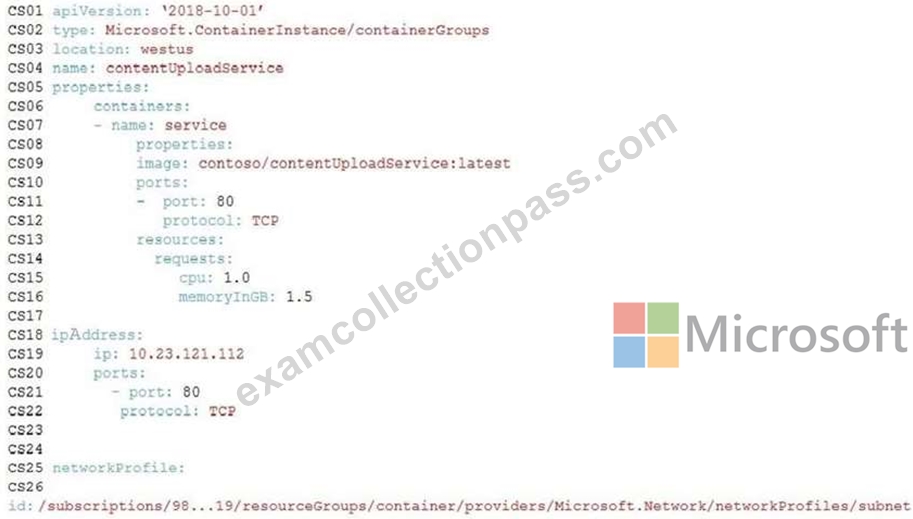
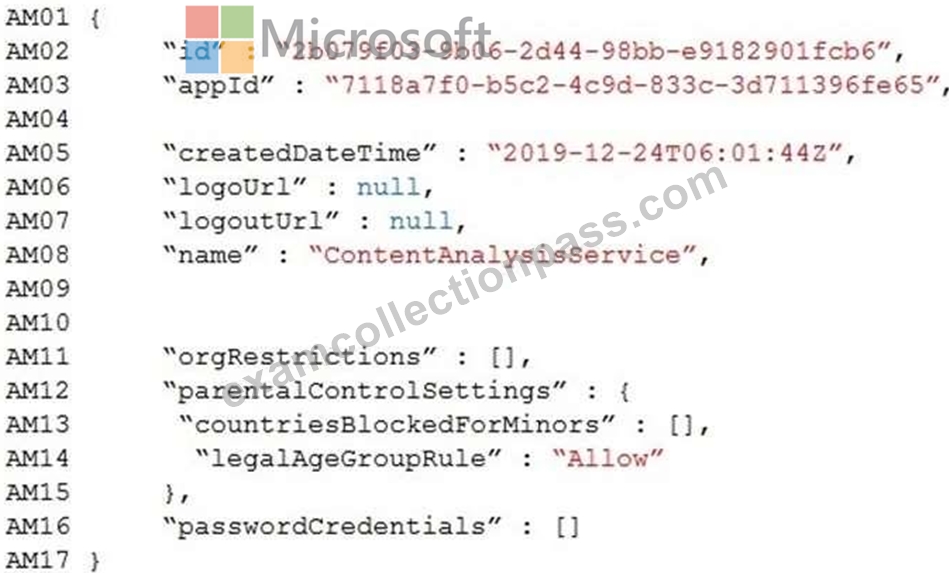
NEW QUESTION # 102
You are developing a web app that is protected by Azure Web Application Firewall (WAF). All traffic to the web app is routed through an Azure Application Gateway instance that is used by multiple web apps. The web app address is contoso.azurewebsites.net.
All traffic must be secured with SSL. The Azure Application Gateway instance is used by multiple web apps.
You need to configure the Azure Application Gateway for the web app.
Which two actions should you perform? Each correct answer presents part of the solution.
NOTE: Each correct selection is worth one point.
- A. Add an authentication certificate for contoso.azurewebsites.net to the Azure Application Gateway.
- B. In the Azure Application Gateway's HTTP setting, enable the Use for App service setting.
- C. Convert the web app to run in an Azure App service environment (ASE).
- D. In the Azure Application Gateway's HTTP setting, set the value of the Override backend path option to contoso22.azurewebsites.net.
Answer: B,D
Explanation:
D: The ability to specify a host override is defined in the HTTP settings and can be applied to any back-end pool during rule creation.
The ability to derive the host name from the IP or FQDN of the back-end pool members. HTTP settings also provide an option to dynamically pick the host name from a back-end pool member's FQDN if configured with the option to derive host name from an individual back-end pool member.
A (not C): SSL termination and end to end SSL with multi-tenant services.
In case of end to end SSL, trusted Azure services such as Azure App service web apps do not require whitelisting the backends in the application gateway. Therefore, there is no need to add any authentication certificates.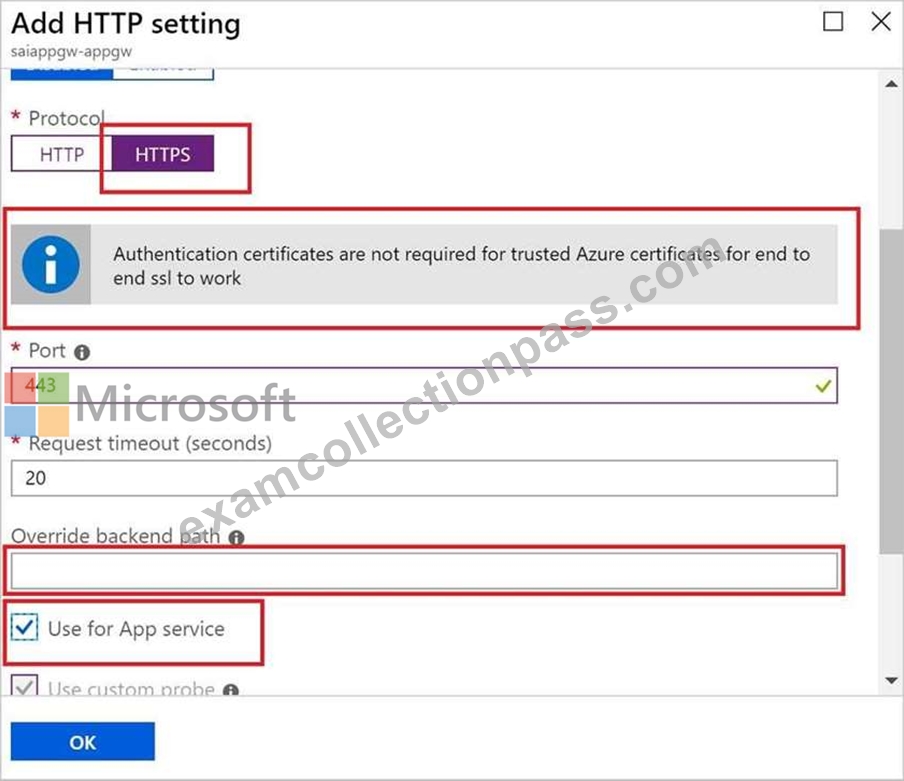
Reference:
https://docs.microsoft.com/en-us/azure/application-gateway/application-gateway-web-app-overview
NEW QUESTION # 103
You need to ensure that network security policies are met.
How should you configure network security? To answer, select the appropriate options in the answer area.
NOTE: Each correct selection is worth one point.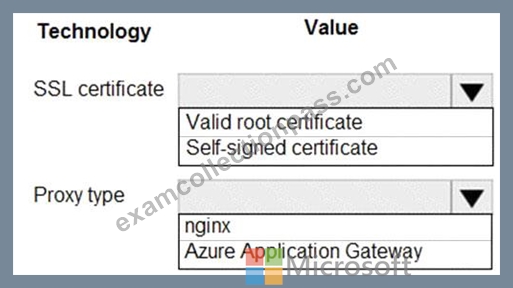
Answer:
Explanation: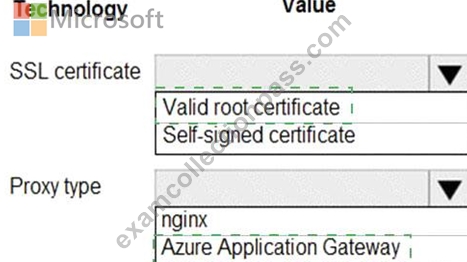
Explanation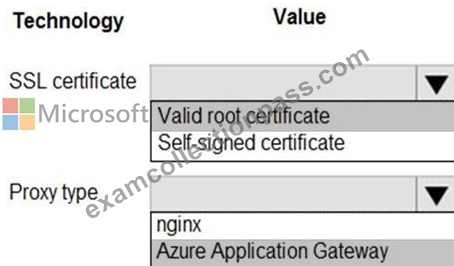
Box 1: Valid root certificate
Scenario: All websites and services must use SSL from a valid root certificate authority.
Box 2: Azure Application Gateway
Scenario:
* Any web service accessible over the Internet must be protected from cross site scripting attacks.
* All Internal services must only be accessible from Internal Virtual Networks (VNets)
* All parts of the system must support inbound and outbound traffic restrictions.
Azure Web Application Firewall (WAF) on Azure Application Gateway provides centralized protection of your web applications from common exploits and vulnerabilities. Web applications are increasingly targeted by malicious attacks that exploit commonly known vulnerabilities. SQL injection and cross-site scripting are among the most common attacks.
Application Gateway supports autoscaling, SSL offloading, and end-to-end SSL, a web application firewall (WAF), cookie-based session affinity, URL path-based routing, multisite hosting, redirection, rewrite HTTP headers and other features.
Note: Both Nginx and Azure Application Gateway act as a reverse proxy with Layer 7 loadbalancing features plus a WAF to ensure strong protection against common web vulnerabilities and exploits.
You can modify Nginx web server configuration/SSL for X-XSS protection. This helps to prevent cross-site scripting exploits by forcing the injection of HTTP headers with X-XSS protection.
Reference:
https://docs.microsoft.com/en-us/azure/web-application-firewall/ag/ag-overview
https://www.upguard.com/articles/10-tips-for-securing-your-nginx-deployment
Topic 1, Contoso, Ltd
Case study
This is a case study. Case studies are not timed separately. You can use as much exam time as you would like to complete each case. However, there may be additional case studies and sections on this exam. You must manage your time to ensure that you are able to complete all questions included on this exam in the time provided.
To answer the questions included in a case study, you will need to reference information that is provided in the case study. Case studies might contain exhibits and other resources that provide more information about the scenario that is described in the case study. Each question is independent of the other questions in this case study.
At the end of this case study, a review screen will appear. This screen allows you to review your answers and to make changes before you move to the next section of the exam. After you begin a new section, you cannot return to this section.
To start the case study
To display the first question in this case study, click the button. Use the buttons in the left pane to explore the content of the case study before you answer the questions. Clicking these buttons displays information such as business requirements, existing environment, and problem statements. When you are ready to answer a question, click the Background Overview You are a developer for Contoso, Ltd. The company has a social networking website that is developed as a Single Page Application (SPA). The main web application for the social networking website loads user uploaded content from blob storage.
You are developing a solution to monitor uploaded data for inappropriate content. The following process occurs when users upload content by using the SPA:
* Messages are sent to ContentUploadService.
* Content is processed by ContentAnalysisService.
* After processing is complete, the content is posted to the social network or a rejection message is posted in its place.
The ContentAnalysisService is deployed with Azure Container Instances from a private Azure Container Registry named contosoimages.
The solution will use eight CPU cores.
Azure Active Directory
Contoso, Ltd. uses Azure Active Directory (Azure AD) for both internal and guest accounts.
Requirements
ContentAnalysisService
The company's data science group built ContentAnalysisService which accepts user generated content as a string and returns a probable value for inappropriate content. Any values over a specific threshold must be reviewed by an employee of Contoso, Ltd.
You must create an Azure Function named CheckUserContent to perform the content checks.
Costs
You must minimize costs for all Azure services.
Manual review
To review content, the user must authenticate to the website portion of the ContentAnalysisService using their Azure AD credentials. The website is built using React and all pages and API endpoints require authentication.
In order to review content a user must be part of a ContentReviewer role. All completed reviews must include the reviewer's email address for auditing purposes.
High availability
All services must run in multiple regions. The failure of any service in a region must not impact overall application availability.
Monitoring
An alert must be raised if the ContentUploadService uses more than 80 percent of available CPU cores.
Security
You have the following security requirements:
* Any web service accessible over the Internet must be protected from cross site scripting attacks.
* All websites and services must use SSL from a valid root certificate authority.
* Azure Storage access keys must only be stored in memory and must be available only to the service.
* All Internal services must only be accessible from internal Virtual Networks (VNets).
* All parts of the system must support inbound and outbound traffic restrictions.
* All service calls must be authenticated by using Azure AD.
User agreements
When a user submits content, they must agree to a user agreement. The agreement allows employees of Contoso, Ltd. to review content, store cookies on user devices, and track user's IP addresses.
Information regarding agreements is used by multiple divisions within Contoso, Ltd.
User responses must not be lost and must be available to all parties regardless of individual service uptime.
The volume of agreements is expected to be in the millions per hour.
Validation testing
When a new version of the ContentAnalysisService is available the previous seven days of content must be processed with the new version to verify that the new version does not significantly deviate from the old version.
Issues
Users of the ContentUploadService report that they occasionally see HTTP 502 responses on specific pages.
Code
ContentUploadService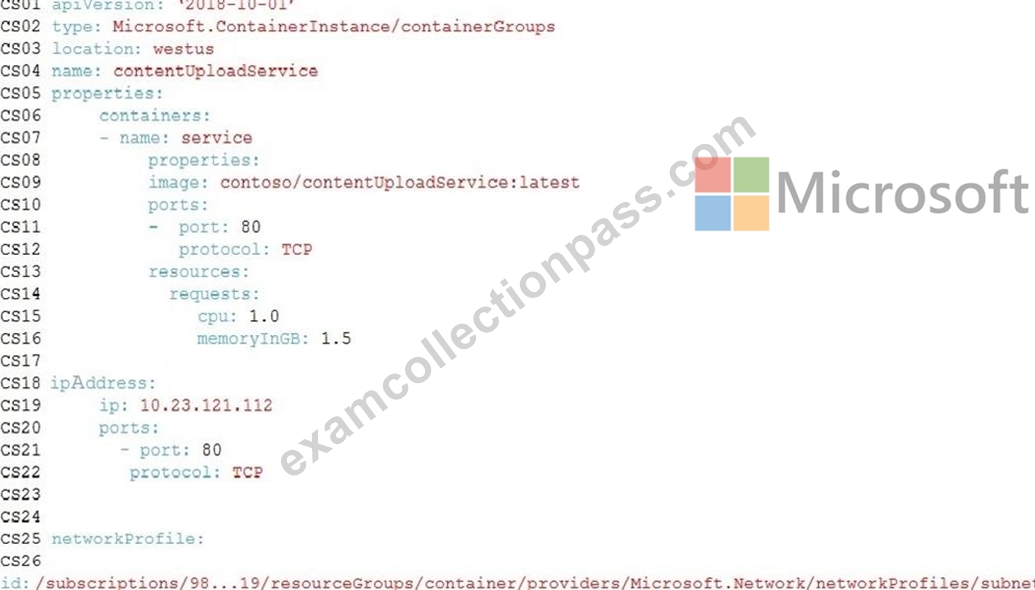
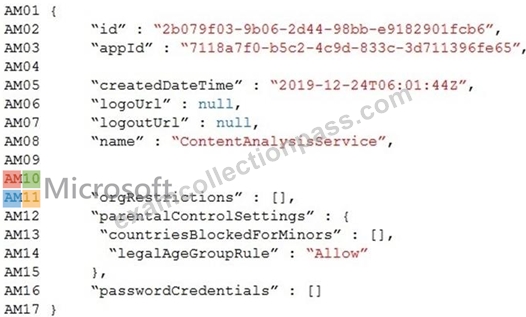
NEW QUESTION # 104
You are developing an Azure Cosmos DB solution by using the Azure Cosmos DB SQL API. The data includes millions of documents. Each document may contain hundreds of properties.
The properties of the documents do not contain distinct values for partitioning. Azure Cosmos DB must scale individual containers in the database to meet the performance needs of the application by spreading the workload evenly across all partitions over time.
You need to select a partition key.
Which two partition keys can you use? Each correct answer presents a complete solution.
NOTE: Each correct selection is worth one point.
- A. a single property value that does not appear frequently in the documents
- B. a single property value that appears frequently in the documents
- C. a hash suffix appended to a property value
- D. a concatenation of multiple property values with a random suffix appended
- E. a value containing the collection name
Answer: C,D
Explanation:
Explanation
You can form a partition key by concatenating multiple property values into a single artificial partitionKey property. These keys are referred to as synthetic keys.
Another possible strategy to distribute the workload more evenly is to append a random number at the end of the partition key value. When you distribute items in this way, you can perform parallel write operations across partitions.
Note: It's the best practice to have a partition key with many distinct values, such as hundreds or thousands.
The goal is to distribute your data and workload evenly across the items associated with these partition key values. If such a property doesn't exist in your data, you can construct a synthetic partition key.
References:
https://docs.microsoft.com/en-us/azure/cosmos-db/synthetic-partition-keys
NEW QUESTION # 105
You are developing an ASP.NET Core web application. You plan to deploy the application to Azure Web App for Containers.
The application needs to store runtime diagnostic data that must be persisted across application restarts. You have the following code:
You need to configure the application settings so that diagnostic data is stored as required.
How should you configure the web app's settings? To answer, select the appropriate options in the answer area.
NOTE: Each correct selection is worth one point.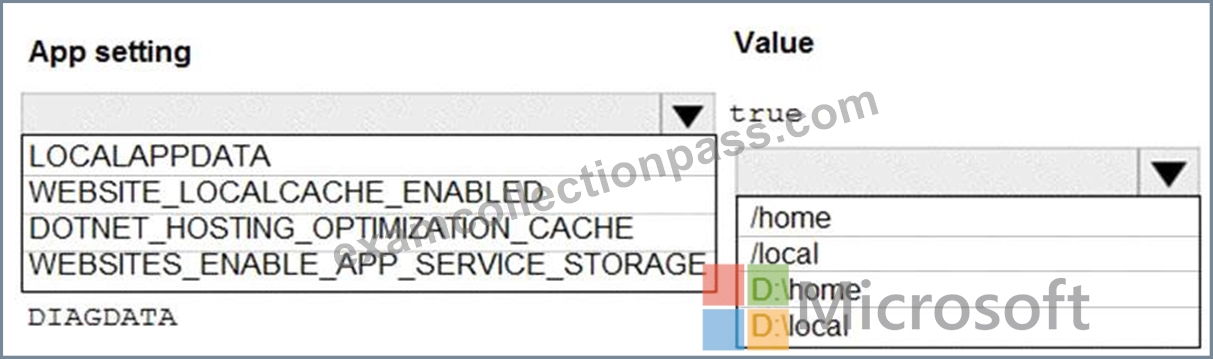
Answer:
Explanation: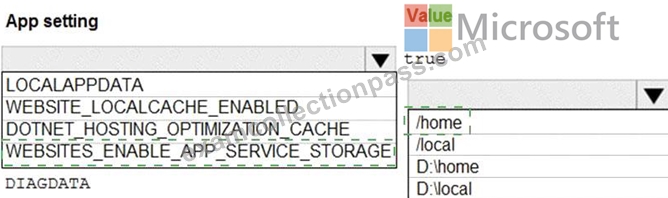
Explanation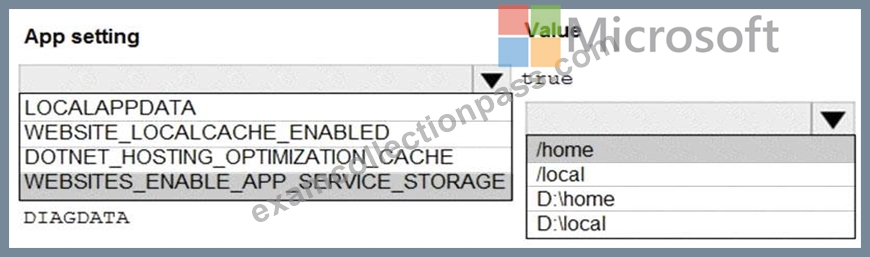
Box 1: If WEBSITES_ENABLE_APP_SERVICE_STORAGE
If WEBSITES_ENABLE_APP_SERVICE_STORAGE setting is unspecified or set to true, the /home/ directory will be shared across scale instances, and files written will persist across restarts Box 2: /home Reference:
https://docs.microsoft.com/en-us/azure/app-service/containers/app-service-linux-faq
NEW QUESTION # 106
......
Reliable Study Materials for AZ-204 Exam Success For Sure: https://www.examcollectionpass.com/Microsoft/AZ-204-practice-exam-dumps.html
Get Unlimited Access to AZ-204 Certification Exam Cert Guide: https://drive.google.com/open?id=1R1rnr7mbKjp8CyJ2NVckKvf2yx1AV38M