

UiPath UiPath-ADPv1 Practice Verified Answers - Pass Your Exams For Sure! [2026]
Valid Way To Pass UiPath Certified Professional - Developer Track's UiPath-ADPv1 Exam
NEW QUESTION # 40
A developer plans to build an automation process using the REFramework with Orchestrator queues. Based on UiPath best practice, what is the recommended sequence of steps to update the template and create/update Queues and Values?
Instructions: Drag the Description found on the left and drop on the correct Step Sequence found on the right.
Answer:
Explanation:
Explanation:
A screenshot of a computer program Description automatically generated
To align with UiPath's best practices when updating the REFramework template for use with Orchestrator queues, the sequence of steps should ensure proper setup of the queues in Orchestrator, configuration of the project to interact with these queues, and implementation of the business logic to process items from the queues.
Here's how the steps should be sequenced:
Step 1: Create the queue in Orchestrator and set its Auto Retry value as required by the process documentation.This step ensures that the queue is available in Orchestrator with the correct settings before the automation attempts to interact with it.
Step 2: Edit the project's configuration file (Data/Config.xlsx) and configure parameters OrchestratorQueueName and OrchestratorQueueFolder.Once the queue is created, the next step is to ensure that the automation project is configured to reference the correct queue and folder within Orchestrator.
Step 3: Edit GetTransactionData.xaml workflow and assign a proper value for the out_TransactionID argument.This configuration allows the workflow to correctly fetch transaction items from the Orchestrator queue for processing.
Step 4: Edit workflow Process.xaml and implement the logic to process each TransactionItem.Finally, the core processing logic that operates on each queue item is implemented, allowing the automation to perform the necessary actions for each transaction.
NEW QUESTION # 41
How are custom log fields used in the REFramework?
- A. Customlog fieldsareusedto define the variable types for transactions, replacing the default Queueitemtype.
- B. Customlog fieldsareusedto store sensitive information like credentials and personal data of users.
- C. Customlog fieldsareincluded in log messages and used to add more data about each transaction for reporting and troubleshooting purposes.
- D. Customlog fieldsareusedto automatically retry failed transactions with real-time updates.
Answer: C
Explanation:
Custom log fields are additional fields that can be added to the Robot Execution Logs using the Add Log Fields activity1. The REFramework is a template for creating robust and scalable automation projects that uses the State Machine workflow type2. The REFramework leverages the custom log fields feature to include more information about each transaction in the log messages, such as the transaction number, the transaction item, the business process name, etc. This helps to improve the reporting and troubleshooting capabilities of the automation project, as the custom log fields can be easily viewed and filtered in the Output panel, the Orchestrator Logs page, or any external logging tool3.
Option A is incorrect, because custom log fields are not used to automatically retry failed transactions, but rather to provide more details about them. The REFramework uses the Retry Scope activity and the Set Transaction Status activity to handle the retry mechanism for failed transactions4. Option B is incorrect, because custom log fields are not used to store sensitive information, but rather to enhance the log messages.
Storing sensitive information like credentials and personal data of users in the log fields is not recommended, as it may pose a security risk. Option C is incorrect, because custom log fields are not used to define the variable types for transactions, but rather to add more data about them. The REFramework uses the TransactionItem argument to store the transaction data, which can be of any type, such as QueueItem, DataRow, String, etc.
References: 1: Add Log Fields 2: The UiPath ReFramework 3: Add Log Field Advantages 4: Retry Scope :
[Logging and Log Levels] : [TransactionItem Argument]
NEW QUESTION # 42
Given the following workflow:
What will be the output of the Log Message activity?
- A. apple pear orange, mango kiwi
- B. "apple pear orange", "mango kiwi"
- C. apple, pear, orange
- D. apple, pear, orange, mango, kiwi
Answer: D
NEW QUESTION # 43
In a UiPath development scenario, which type of process design would be the most appropriate for an automation task that executes actions in a straightforward progression without iteration or branching?
- A. Iterative Process
- B. Sequential Process
- C. Transactional Process
- D. Linear Process
Answer: B
Explanation:
A sequential process is a type of process design that executes actions in a straightforward progression without iteration or branching. A sequential process is composed of a series of activities that are executed one after another, from top to bottom, in a linear fashion. A sequential process is best suited for simple scenarios when activities follow each other and there is no need for complex logic or decision making12.
The other options are not appropriate for an automation task that executes actions in a straightforward progression without iteration or branching, because they involve different types of process design that require more complex structures and logic. For example:
A transactional process is a type of process design that executes actions on a set of data items, one at a time, in a loop. A transactional process is composed of a dispatcher that adds data items to a queue, and a performer that processes each data item from the queue and updates its status. A transactional process is best suited for scenarios when activities need to be repeated for each data item and there is a need for reliability and scalability34.
An iterative process is a type of process design that executes actions repeatedly until a certain condition is met or a certain number of iterations is reached. An iterative process is composed of a loop that contains a set of activities and a condition that controls the exit of the loop. An iterative process is best suited for scenarios when activities need to be performed multiple times and there is a need for dynamic control of the execution flow56.
A linear process is not a type of process design, but a term that refers to a process that has a clear start and end point, and a well-defined sequence of steps that lead to a specific outcome. A linear process can be implemented using different types of process design, depending on the complexity and logic of the steps involved7.
References:
1: Studio - Workflow Design - UiPath Documentation Portal 2: Studio - Sequence - UiPath Activities 3: Studio - Transactional Business Process - UiPath Documentation Portal 4: Studio - Transactional Process - UiPath Activities 5: Studio - Control Flow - UiPath Documentation Portal 6: Studio - Loops - UiPath Activities 7: What is a Linear Process? - Definition from Techopedia
NEW QUESTION # 44
Based on the following exhibit, which output is displayed in the Output panel rt Step Out is clicked on the Debug ribbon tab of UlPath Studio?
- A. UiPath RPA
- B. Automation RPAUiPath RPA
- C. UiPath RPAAutomatlon
- D. Automation
Answer: C
NEW QUESTION # 45
In the context of a process automated using the REFramework that processes payments and sends a report using the Finance team leader's email account at the end of the day. where should the email account credentials be stored according to best practices''
- A. In an Orchestrator Credential asset and referenced in the Assets sheet in the Config.xlsx file.
- B. In an Orchestrator Credential asset and referenced in the Settings sheet in the Config.xlsx file.
- C. In the Constants sheet in the Config.xlsx file with the value of the email address.
- D. In an Orchestrator Text asset and referenced in the Assets sheet In the Config.xlsx file.
Answer: A
Explanation:
In the REFramework, best practices suggest storing sensitive information like email account credentials in an Orchestrator Credential asset. This asset is then referenced in the Config.xlsx file, specifically in the Assets sheet, ensuring secure and centralized management of credentials.
NEW QUESTION # 46
What is the recommended approach for handling tabular data when building a REFramework transactional project in UiPath?
- A. Use separate variables to store each column of the tabular data.
- B. Utilize a DataTable variable to store and process the tabular data.
- C. Save the tabular data in multiple CSV files for easier manipulation.
Answer: B
Explanation:
D Implement custom activities to handle the tabular data
NEW QUESTION # 47
Given the following conditional breakpoint with count = 0
Conditional breakpoint settings:
How many limes will UiPath be displayed in the Output panel before the process goes into a Paused state in Debug mode?
- A. 0
- B. 1
- C. 2
- D. 3
Answer: B
NEW QUESTION # 48
The following table is stored in a variable called "dt".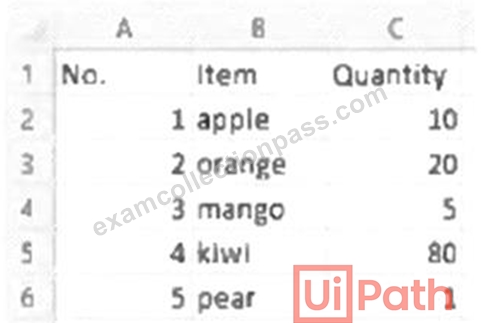
What will the value of the qty variable be after executing the Assign activity?
- A. 0
- B. null
- C. 1
- D. 2
Answer: D
Explanation:
The value of the qty variable will be 80 after executing the Assign activity. This is because the expression in the Assign activity is using the LINQ methods AsEnumerable, SkipWhile, and Item to access the data in the dt variable. The dt variable is a DataTable that contains the following data:
Item
Quantity
apple
5
banana
10
mango
20
orange
80
grape
40
The AsEnumerable method converts the DataTable into an Enumerable collection of DataRow objects. The SkipWhile method skips the elements of the collection until the condition is false. The condition is a lambda expression that checks if the value of the Item column is equal to "mango". The (0) indexer returns the first element of the collection after skipping. The Item method accesses the value of the Quantity column of the DataRow. The ToString method converts the value into a string. Therefore, the expression will skip the first three rows of the DataTable and return the value of the Quantity column of the fourth row, which is 80.
References: [DataTable.AsEnumerable Method], [Enumerable.SkipWhile Method], [DataRow.Item Property]
NEW QUESTION # 49
A developer wants to add items to a list of strings using the Invoke Method activity. The list is declared as follows:
The Invoke Method activity has the following properties:
The Parameters property is as follows:
Based on the information shown in the exhibits what is the outcome of the Invoke Method activity?
- A. Colors will contain an item with the value "Yellow".
- B. Colors will contain an item with the value "Colors: Yellow".
- C. An exception will be thrown.
- D. Colors will contain an item with an empty value.
Answer: A
Explanation:
The Invoke Method activity is used to invoke a method of a class or an object. In this case, the developer wants to add items to a list of strings using the Invoke Method activity. The list is declared as follows:
Dim Colors As New List(Of String)
This means that the list is named Colors and it can store strings. The Invoke Method activity has the following properties:
TargetType: System.Collections.Generic.List`1[System.String]. This means that the target type is a generic list of strings.
TargetObject: Colors. This means that the target object is the list named Colors.
MethodName: Add. This means that the method name is Add, which is a method of the list class that adds an item to the end of the list.
Parameters: In, String, Yellow. This means that the parameter direction is In, which means that the value is passed to the method. The parameter type is String, which means that the value is a string. The parameter value is Yellow, which means that the value is the string "Yellow".
Based on the information shown in the exhibits, the outcome of the Invoke Method activity is that Colors will contain an item with the value "Yellow". This is because the Invoke Method activity will add "Yellow" to the list of strings declared as Colors.
NEW QUESTION # 50
When a developer runs a process using the REFramework, with the process utilizing Orchestrator queues and a queue already created with the Name provided and the Auto Retry function disabled, which states will be executed without errors?
- A. Initialization -> Get Transaction Data -> End Process
- B. Initialization -> Get Transaction Data -> Process Transaction -> End Process
- C. Initialization -> End Process
- D. Initialization -> Process Transaction -> End Process
Answer: B
Explanation:
The states that will be executed without errors when a developer runs a process using the REFramework, with the process utilizing Orchestrator queues and a queue already created with the Name provided and the Auto Retry function disabled, are Initialization, Get Transaction Data, Process Transaction, and End Process. The REFramework is a template that provides a robust and scalable structure for building automation processes.
The REFramework consists of four main states: Initialization, Get Transaction Data, Process Transaction, and End Process. The Initialization state is responsible for initializing the application, reading the configuration file, and logging in to the Orchestrator. The Get Transaction Data state is responsible for fetching the next transaction item from the Orchestrator queue and assigning it to the TransactionItem variable. The Process Transaction state is responsible for executing the main logic of the process for the current transaction item.
The End Process state is responsible for closing the application, logging out of the Orchestrator, and performing any cleanup actions. If the process utilizes Orchestrator queues and a queue already exists with the Name provided and the Auto Retry function disabled, then the process will be able to execute these states without errors, assuming that there are no other issues or exceptions in the workflow. References: [Robotic Enterprise Framework], [REFramework States]
NEW QUESTION # 51
What do the percentages from the Test Explorer panel represent?
- A. Percent of test data run.
- B. Passing percent.
- C. Coverage percent.
- D. Correctness of the code percent.
Answer: B
Explanation:
The percentages from the Test Explorer panel represent the passing percent of the test cases that are executed.
The Test Explorer panel shows the status of each test case, the total number of test cases, the number of passed test cases, the number of failed test cases, and the passing percent. The passing percent is calculated by dividing the number of passed test cases by the total number of test cases and multiplying by 100. For example, if there are 10 test cases and 8 of them pass, the passing percent is 80%. References: Test Explorer
NEW QUESTION # 52
Data from an Excel file is read into a data table named "dtEmployee", as displayed in the following graphic:
A developer needs to filter the data table to obtain all rows representing employees from the Finance and IT departments with a Salary under 30,000. Which expression yields the desired outcomes?
- A. dtEmployee.Select("[Department]='IT' OR [Department]= 'Finance' AND [Salary] < 30000")
- B. dtEmployee.Select("([Department]='IT' AND [Department]='Finance') AND [Salary] < 30000")
- C. dtEmployee.Select("([Department]='IT' OR [Department]='Finance') AND [Salary] < 30000")
- D. dtEmployee.Select("[Department]='IT OR [Department]='Finance' OR [Salary] < 30000")
Answer: C
NEW QUESTION # 53
Which of the following is an outcome of converting a personal workspace into a folder in UiPath Orchestrator?
- A. The owner of the initial workspace loses access to the newly created folder and the existing admin users are added by default.
- B. The owner of the initial workspace and the admin user are added by default to the newly created folder and assigned the Personal Workspace Administrator role.
- C. The admin user is added by default to the newly created folder with the User Administrator role.
- D. The owner of the initial workspace is added by default to the newly created folder and assigned the Folder Administrator role.
Answer: D
Explanation:
The outcome of converting a personal workspace into a folder in UiPath Orchestrator is that the owner of the initial workspace is added by default to the newly created folder and assigned the Folder Administrator role.
A personal workspace is a special type of folder that is created automatically for each user in Orchestrator and allows them to work on their own automation projects without affecting other users or folders. A personal workspace can be converted into a regular folder if the user wants to share their work with other users or move it to another folder. When a personal workspace is converted into a folder, the owner of the workspace becomes the owner of the folder and gets the Folder Administrator role, which gives them full permissions to manage the folder and its contents. The folder also inherits the permissions and settings of the parent folder, which is the Default folder by default. The admin user is not added to the folder by default, but they can access the folder as a Tenant Administrator if they have that role. References: [Personal Workspaces],
[Convert Personal Workspace to Folder]
NEW QUESTION # 54
A developer aims to employ the REFramework for automating a business process that Involves a TransactionData collection (DataTable) comprising vendor names and addresses.
Instructions: Choose the appropriate variable type for the Transactionltem from the provided drop-down list in the following exhibit.

Answer:
Explanation:
Explanation:
The REFramework (Robotic Enterprise Framework) in UiPath is designed to work with transactional data. For a process that involves iterating over a DataTable where each row represents a transaction item, the appropriate variable type for the TransactionItem would be a DataRow.
In the context of REFramework, a DataRow is typically used to represent a single transaction item when the transaction data is contained within a DataTable. This allows the framework to process each row (or transaction) one by one.
Therefore, the correct variable type for the TransactionItem from the drop-down list should be DataRow.
NEW QUESTION # 55
Where in the REFramework template project is the "SetTransactionStatus.xaml" invoked?
- A. In the Finally section of the Try Catch activity in the End Process state.
- B. In the Try section of the Try Catch activity in the End Process state.
- C. In the Try section of the Try Catch activity in the Process Transaction state.
- D. In the Try and Catches sections of the Try Catch activity in the Process Transaction state.
Answer: D
NEW QUESTION # 56
What method can be used to change the index of an existing column in a datatable?
- A. SetColumnlndex
- B. SetOrdinal
- C. Setlndex
- D. Move At
Answer: B
Explanation:
In a UiPath REFramework project, the primary purpose of using Custom Log Fields is to add specific contextual information to log messages that are relevant to the automation process. Custom Log Fields are created using the Add Log Fields activity, which adds custom log fields to the Robot Execution Logs. The new log fields created via this activity are added for every Log Message execution throughout the entire workflow, unless a Remove Log Fields activity is used. Custom Log Fields can help you to maintain contextual insights within log messages, such as the business process name, the transaction data, the transaction status, or any other information that can help you to monitor, analyze, or debug the automation process. Custom Log Fields can also enhance the readability and consistency of log messages, as well as facilitate log filtering and reporting.
NEW QUESTION # 57
What is the output type returned when using a Get Test Data Queue Item activity?
- A. Object
- B. Queueltem
- C. Dictionary
Answer: B
Explanation:
The output type returned when using a Get Test Data Queue Item activity is QueueItem. The Get Test Data Queue Item activity is an activity that allows the developer to retrieve a test data queue item from a test data queue in Orchestrator. A test data queue is a special type of queue that is used to store and manage test data for automation testing purposes. A test data queue item is a data object that contains the test data and the expected results for a test case. The Get Test Data Queue Item activity has an output property called TestDataQueueItem, which returns the test data queue item as a QueueItem type. The QueueItem type is a class that represents a queue item in Orchestrator. The QueueItem type has various properties and methods that allow the developer to access and manipulate the data and the status of the queue item. References: [Get Test Data Queue Item], [QueueItem Class]
NEW QUESTION # 58
Which of the following examples accurately demonstrates the correct usage of Al Computer Vision features in a UiPath project?
- A. Applying Al Computer Vision to perform sentiment analysis on a provided text string and displaying the result.
- B. Employing Al Computer Vision to identify and interact with Ul elements in a remote desktop application with low quality or scaling issues.
- C. Using Al Computer Vision to extract plain text from a scanned PDF document and store the output in a string variable.
- D. Utilizing Al Computer Vision to train a custom machine learning model to recognize specific patterns in data.
Answer: B
Explanation:
AI Computer Vision is a feature of UiPath that enables the automation of remote applications or desktops, such as Citrix Virtual Apps, Windows Remote Desktop, or VMware Horizon, by using native selectors. Native selectors are expressions that identify UI elements reliably and accurately, without relying on OCR or image recognition activities1. AI Computer Vision uses a mix of AI, OCR, text fuzzy-matching, and an anchoring system to visually locate elements on the screen and interact with them via UiPath Robots, simulating human interaction2. AI Computer Vision is especially useful for scenarios where the UI elements have low quality or scaling issues, which make them difficult to recognize with traditional methods3.
Option A is an accurate example of using AI Computer Vision features in a UiPath project, because it involves identifying and interacting with UI elements in a remote desktop application, which is one of the main use cases of AI Computer Vision. By using the Computer Vision activities, such as CV Screen Scope, CV Click, CV Get Text, etc., you can automate tasks in a remote desktop application without using selectors, OCR, or image recognition activities4.
The other options are not accurate examples of using AI Computer Vision features in a UiPath project, because they involve tasks that are not related to the automation of remote applications or desktops, or that do not use the Computer Vision activities. For example:
Option B involves training a custom machine learning model, which is not a feature of AI Computer Vision, but of the UiPath AI Fabric, a platform that enables you to deploy, consume, and improve machine learning models in UiPath.
Option C involves extracting plain text from a scanned PDF document, which is not a feature of AI Computer Vision, but of the UiPath Document Understanding, a framework that enables you to classify, extract, and validate data from various types of documents.
Option D involves performing sentiment analysis on a text string, which is not a feature of AI Computer Vision, but of the UiPath Text Analysis, a set of activities that enable you to analyze the sentiment, key phrases, and language of a text using pre-trained machine learning models.
References:
1: Studio - About Selectors - UiPath Documentation Portal 2: AI Computer Vision - Introduction - UiPath Documentation Portal 3: The New UiPath AI Computer Vision Is Now in Public Preview 4: Activities - Computer Vision activities - UiPath Documentation Portal : [AI Fabric - Overview - UiPath Documentation Portal] : [Document Understanding - Overview - UiPath Documentation Portal] : [Text Analysis - UiPath Activities]
NEW QUESTION # 59
While working in an RPA testing project, you encountered the following activity in one of the workflows included in the project.
What action can you perform in your mocked file to replace the functionality of the MessageBox with a LogMessage during mock testing?
- A. Surround activity with mock.
- B. Remove mock activity.
- C. Create mock workflow.
- D. Synchronize mock.
Answer: A
Explanation:
To replace the functionality of the MessageBox with a LogMessage during mock testing, the developer can perform the action of Surround activity with mock. This action inserts a mock activity around the selected activity, which allows the developer to change the behavior of the activity for testing purposes. For example, the developer can right-click on the MessageBox activity and select Surround activity with mock from the dropdown menu. This will create a mock activity that contains the MessageBox activity. The developer can then edit the mock activity and replace the MessageBox activity with a LogMessage activity, which will write the message to the output panel instead of displaying it in a dialog box. This way, the developer can test the functionality of the workflow without having to interact with the MessageBox dialog box. References: [Mock Testing], [Surround Activity with Mock]
NEW QUESTION # 60
Starting with UiPath Studio version 2022.10, what happens to dependencies that lack Windows compatibility when they are converted in a project?
- A. They are marked as unresolved.
- B. They are removed from the project.
- C. They are replaced with compatible alternatives.
- D. They are automatically resolved.
Answer: A
Explanation:
Starting with UiPath Studio version 2022.10, dependencies that lack Windows compatibility are marked as unresolved when they are converted in a project. This means that the project cannot be executed until the unresolved dependencies are manually resolved by the developer. This is done to ensure that the project can run on both Windows and Linux platforms without compatibility issues. References: [UiPath Studio Guide - Converting Projects to Linux Compatibility]
NEW QUESTION # 61
What do the percentages from the Test Explorer panel represent?
- A. Percent of test data run.
- B. Passing percent.
- C. Coverage percent.
- D. Correctness of the code percent.
Answer: B
Explanation:
The percentages from the Test Explorer panel represent the passing percent of the test cases that are executed.
The Test Explorer panel shows the status of each test case, the total number of test cases, the number of passed test cases, the number of failed test cases, and the passing percent. The passing percent is calculated by dividing the number of passed test cases by the total number of test cases and multiplying by 100. For example, if there are 10 test cases and 8 of them pass, the passing percent is 80%. References: Test Explorer
NEW QUESTION # 62
Which LINQ method is used to filter data in a List or DataTable based on a condition?
- A. OrderBy
- B. GroupBy
- C. Where
- D. Select
Answer: C
Explanation:
LINQ (Language Integrated Query) is a feature of .NET that allows you to write queries to manipulate data from various sources, such as arrays, collections, databases, or XML files. LINQ provides a set of methods that can be used to perform different operations on the data, such as filtering, sorting, grouping, aggregating, or transforming.
The LINQ method that is used to filter data in a List or DataTable based on a condition is Where. The Where method returns a new collection that contains only the elements that satisfy the specified condition. The condition is usually a lambda expression or a delegate that takes an element as a parameter and returns a Boolean value. For example, if you have a List of integers called numbers, you can write:
var evenNumbers = numbers.Where (x => x % 2 == 0);
This expression returns a new List that contains only the even numbers from the original List. Similarly, if you have a DataTable called employees, you can write:
var highSalary = employees.AsEnumerable ().Where (row => row.Field<decimal> (\"Salary\") > 100000); This expression returns a new DataTable that contains only the rows where the Salary column is greater than
100000. The AsEnumerable () method is used to convert the DataTable into an IEnumerable<DataRow>, which is required for using LINQ methods.
The other options are not LINQ methods that are used to filter data in a List or DataTable based on a condition. Option A, Select, is a LINQ method that is used to project or transform data from one form to another. It returns a new collection that contains the result of applying a function to each element of the source collection. Option B, GroupBy, is a LINQ method that is used to group data by a common key or attribute. It returns a new collection that contains groups of elements that share the same key value. Option C, OrderBy, is a LINQ method that is used to sort data in ascending order by a specified criterion. It returns a new collection that contains the elements of the source collection in sorted order.
References: LINQ - Introduction - Microsoft Docs, Enumerable.Where Method (System.Linq) - Microsoft Docs, LINQ query to filter datatable - Studio - UiPath Community Forum, LINQ Tutorial - Learn - UiPath Community Forum
NEW QUESTION # 63
......
UiPath UiPath-ADPv1 Pre-Exam Practice Tests | ExamcollectionPass: https://www.examcollectionpass.com/UiPath/UiPath-ADPv1-practice-exam-dumps.html
UiPath-ADPv1 practice test questions, answers, explanations: https://drive.google.com/open?id=19Awc096Yw8H-05_OPC9HARQbVMTzC8fs