

Latest VMCE_v12 Pass Guaranteed Exam Dumps with Accurate & Updated Questions
VMCE_v12 Exam Brain Dumps - Study Notes and Theory
Veeam VMCE_v12 Exam Syllabus Topics:
| Topic | Details |
|---|---|
| Topic 1 |
|
| Topic 2 |
|
| Topic 3 |
|
| Topic 4 |
|
| Topic 5 |
|
| Topic 6 |
|
| Topic 7 |
|
| Topic 8 |
|
| Topic 9 |
|
| Topic 10 |
|
| Topic 11 |
|
| Topic 12 |
|
NEW QUESTION # 17
A Veeam administrator Is restoring a user object from Active Directory using the Veeam Explorer for Microsoft Active Directory. They want to restore the user object including the password. What options exist for restoring the object with a password? (Choose 2)
- A. Show password
- B. Allow user to set password
- C. Use "Restore objects to" and choose the "Restore password" option
- D. Restore the user object to the source domain
- E. Send password to user account via email
Answer: C
NEW QUESTION # 18
The engineer needs to back up sensitive data located on VMware vSphere encrypted VMs. The company policy prioritizes data security over anything else.
In the backup infrastructure, the engineer has configured:
One physical proxy configured on the DirectSAN Access transport mode, for fast data transfer speed and less load on the production network Two physical proxies in NBDSSL Encryption has been enabled on the backup job Which action will allow the VM data to remain encrypted during the entire backup process?
- A. Configure the job to use the proxy with the DirectSAN Access transport mode.
- B. Configure Global Network Traffic Rules to encrypt the backup traffic.
- C. Configure the job to use the proxies with the NBDSSL transport mode.
- D. Upload a custom script that re-encrypts the VM data after the backup job.
Answer: C
Explanation:
To ensure that the VM data remains encrypted throughout the backup process, the job should be configured to use the proxies with the NBDSSL (Network Block Device SSL) transport mode. This mode encrypts data transferred over the network, adhering to the company policy that prioritizes data security. While DirectSAN Access is fast, it does not provide encryption of in-flight data.References:
* Veeam Backup & Replication User Guide: Transport Modes
* Veeam Best Practices: Securing Backup Traffic
NEW QUESTION # 19
A company's infrastructure consists of multiple Hyper-V servers that store VMs on local storage.
Which proxy should be used to back up these VMs?
- A. Guest interaction proxy
- B. VM proxy
- C. On-host backup proxy
- D. File proxy
Answer: C
Explanation:
For Hyper-V environments where VMs are stored on local storage, the On-host backup proxy should be used. This type of proxy processes jobs directly on the host where the Hyper-V role is enabled, allowing it to interact directly with the local VM storage. It is suitable for infrastructures with multiple Hyper-V servers storing VMs locally.
NEW QUESTION # 20
Veeam is used for replicating VMware VMs. The production environment is comprised of two networks:
192.168.1.0/24 and 172.16.0.0/16. A web application requires a database server (whose IP address is
172.21.0.12) to receive queries from a web client (whose IP address is 192.168.1.32). The replicas are spread over multiple hosts. A backup administrator needs to configure a virtual lab to test a web client to database server query. Which of the following virtual lab types must be configured?
- A. Basic single-host
- B. Advanced single-host
- C. Advanced multi-host
- D. All virtual lab configurations would support that
Answer: B
NEW QUESTION # 21
In Veeam Enterprise Manager, what granular restoration permission can be set for the Restore Operator role?
- A. OneDrive items
- B. Active Directory items
- C. SharePoint items
- D. File items
Answer: D
Explanation:
Explanation
The granular restoration permission that can be set for the Restore Operator role in Veeam Enterprise Manager is File items. This permission allows the restore operator to recover files and folders from the backup of any machine in their restore scope. The restore operator can also specify the file types that they want to recover, such as documents, images, videos, and so on1. The other options are not valid for the Restore Operator role, as they are related to application items that can only be restored by the Portal User role with appropriate delegation settings2. For more information on the Restore Operator role and its permissions, see Accounts and Roles Overview in the Veeam Backup Enterprise Manager Guide.
NEW QUESTION # 22
A customer has a physical windows server running Microsoft SQL 2020. Which component should be used to protect the whole server?
- A. Veeam Agent
- B. Cache Repository
- C. Veeam Backup Proxy
- D. Veeam Plug-in for Enterprise Application
Answer: A
Explanation:
To protect a physical Windows server running Microsoft SQL 2020, the Veeam Agent should be used. Veeam Agent is designed to provide comprehensive backup and recovery for physical servers, including those running critical applications like Microsoft SQL Server.
NEW QUESTION # 23
Veeam ONE's ____________________ provides a single pane of glass view for all Veeam backup servers, proxies, and repositories in a backup infrastructure.
- A. Infrastructure View
- B. Business View
- C. Data Protection View
- D. System View
Answer: C
Explanation:
Explanation
https://helpcenter.veeam.com/docs/one/qsg/data_protection.html?ver=120
Veeam ONE's Data Protection View provides a single pane of glass view for all Veeam backup servers, proxies, and repositories in a backup infrastructure. This view allows you to monitor the overall state of the backup infrastructure, check the summary dashboards, view triggered alarms, check the latest job status, work with performance charts, and view the list of events1. The Data Protection View also includes information about Veeam Backup for Microsoft 365 jobs and protected data2. References:
Data Protection Monitoring - Veeam ONE Quick Start Guide
Veeam Backup for Microsoft 365 Data Protection - Veeam ONE Monitoring Guide Veeam Backup for Microsoft 365 Data Protection - Veeam ONE Monitoring Guide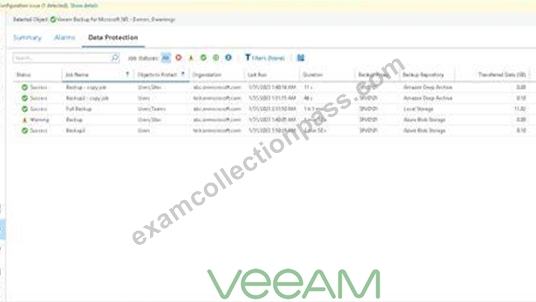
Databases - Veeam ONE Monitoring Guide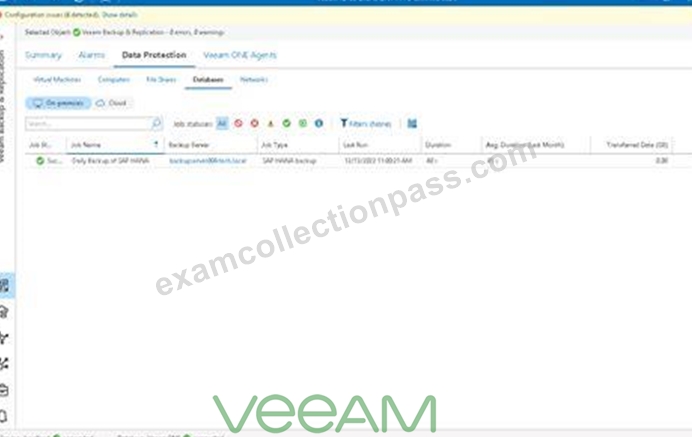
NEW QUESTION # 24
An engineer has used a Linux Hardened Repository as the backup repository. The immutability period is set to
60 days.
The backup settings are:
Retention Policy: 14 days
GFS Weekly full backup: 1 week
GFS Monthly full backup: 6 months
If a full backup is created on 27th May 2023 with a monthly GFS flag, when will this restore point be automatically deleted?
- A. 28th July 2023
- B. 2V June 2023
- C. 28th November 2023
- D. 5th August 2023
Answer: C
Explanation:
The immutability period set on a Linux Hardened Repository prevents deletion of backup files for the duration of the immutability period. In this case, it is set to 60 days. However, the GFS (Grandfather-Father-Son) retention policy specifies that a monthly full backup is to be kept for 6 months. Since the full backup was created on 27th May 2023 and flagged as a monthly GFS backup, it will be retained for 6 months irrespective of the retention policy or the immutability setting. Hence, the restore point will be automatically deleted after 6 months, which would be on the 28th of November 2023.References:
* Veeam Backup & Replication User Guide: GFS Retention Policy
* Veeam Help Center: Linux Hardened Repository Immutability
NEW QUESTION # 25
A backup of a Windows VM running on a Hyper-V Cluster has been created. In which scenario can the Quick Rollback option be used during a Full VM Restore of the VM?
- A. Issues caused by a Windows update
- B. Migration of VM to VMware host in the same data center
- C. Issues caused by storage data corruption
- D. Migration of VM to Hyper-V host in a different data center
Answer: A
NEW QUESTION # 26
A backup administrator is called in to review a new Veeam deployment created by a coworker. The backup administrator takes the following notes:
* 12 backup jobs
* 1 SOBR configured with AWS S3 Performance Tier
* 1 Repository configured on Hardened Immutable Repository
The administrator also notes that six jobs are configured to use the SOBR and six jobs are configured to use the Hardened Immutable Repository.
What should the backup administrator report to the other coworker regarding the 3-2-1 backup strategy?
- A. This only has 1 copy of the backup data.
- B. This will save costs with the Archive Tier in the SOBR.
- C. This needs the Hardened Immutable Repository added to the capacity tier.
- D. This meets the 3-2-1 best practices requirements.
Answer: A
Explanation:
The 3-2-1 backup strategy is a best practice that suggests having three total copies of your data, two of which are local but on different devices or media, and one copy offsite. In the described scenario, although there is an offsite component (SOBR with AWS S3 Performance Tier), and a local hardened immutable repository, there is no indication of a second local copy on a different device or media. This means that there is only one local copy of the backup data and one offsite copy. Therefore, the setup does not meet the 3-2-1 best practices requirement, which would involve having at least one more local copy on different media or device.
NEW QUESTION # 27
What is the primary benefit of configuring replica mapping?
- A. Compressed WAN traffic
- B. Encrypted WAN traffic
- C. Reduced WAN traffic
- D. Deduplicated WAN traffic
Answer: C
Explanation:
The primary benefit of configuring replica mapping in Veeam Backup & Replication is C: Reduced WAN traffic. Replica mapping is a feature that allows an administrator to map an existing VM in the disaster recovery site to a replica job. This is particularly useful when the initial replication of a large VM has been performed by other means (such as shipping a hard drive with the VM data to the DR site) or if a replica VM already exists and needs to be re-synced with the source VM. By using replica mapping, Veeam can avoid transferring the entire VM over the WAN again and instead only synchronize the differences between the source VM and the existing replica. This significantly reduces the amount of data that needs to be transferred over the WAN, conserving bandwidth and speeding up the replication process. It's an efficient way to manage replicas, especially for large VMs or in environments with limited bandwidth.
NEW QUESTION # 28
A backup administrator is asked to perform a file level restore on a Solaris VM for the first time since Veeam Backup & Replication has been Installed and left unconfigured. Which of the Wowing Items must be selected during this process?
- A. A host on which the restored file system will be mounted
- B. A host on which a mount server will be booted
- C. A host on which a helper appliance will be booted
- D. A host on which the backup image will be booted
Answer: A
Explanation:
Explanation
When performing a file-level restore, you need to specify a host on which the restored file system will be mounted. This host can be a separate machine or the same machine where Veeam Backup & Replication is installed. The restored files from the backup image will be mounted on this host, allowing you to browse and extract the specific files or directories you need.
NEW QUESTION # 29
An infrastructure with 50 VMs has a power outage. After the VMware cluster has booted up again, 10 large VMs are orphaned. However, all VM disk files are still on the datastores. What Is the quickest way to bring back those VMs with the least possible data loss?
- A. Remove the existing VM disk files from the datastore and perform Instant VM Recovery.
- B. Perform Restore VM Files and only restore the VM configuration files.
- C. Use the "Restore guest files'' option to restore the VM configuration ties.
- D. Perform Instant VM Recovery with quick rollback with automatic Power On VM at the end.
Answer: B
Explanation:
Explanation
By performing a restore of only the VM configuration files, you can quickly recreate the VM in VMware vSphere using the existing disk files on the datastore. This method avoids the need to transfer or copy large VM disk files, resulting in a faster restoration process. Note that this method assumes that the VM disk files are still intact on the datastore. If any of the VM disk files are missing or corrupted, you may need to consider alternative restoration methods or perform a full restore from the Veeam backup files.
NEW QUESTION # 30
A backup administrator needs to restore two data drives to a VM where the operating system remains intact.
The target machine must remain powered on. What recovery option is most appropriate to perform this operation?
- A. Instant VM Recovery
- B. Restore entire VM
- C. Instant disk recovery
- D. Restore VM files
Answer: C
Explanation:
Explanation
https://helpcenter.veeam.com/docs/backup/vsphere/instant_disk_recovery.html?ver=100
NEW QUESTION # 31
Veeam Backup & Replication is currently configured to keep backups for 14 days on a NAS repository. An engineer needs to enable GFS with 12 monthly and 5 yearly full backups to extend the retention for archival purposes but does not have enough space on the repository to store them.
After adding the repository to Scale-Out-Backup Repository (SOBR) as Performance Tier, which option should the engineer choose to solve this issue?
- A. Add an Object Storage as Capacity tier and set the policy to copy backups to object storage as soon as they are created
- B. Add an Object Storage as Archive tier and set the policy to move all GFS backups
- C. Add another NAS repository as Capacity tier and set the policy to move backups older than 14 days
- D. Add an Object Storage as Capacity tier and set the policy to move backups older than 14 days
Answer: D
Explanation:
To solve the space issue while enabling GFS retention, the engineer should add an Object Storage as a Capacity tier to the Scale-Out Backup Repository (SOBR) and set the policy to move backups that are older than 14 days. This approach allows for efficient use of local NAS storage for short-term retention and leverages object storage for long-term archival purposes.References:Veeam Backup & Replication User Guide, Veeam SOBR Configuration Guide
NEW QUESTION # 32
......
Pass Veeam VMCE_v12 Test Practice Test Questions Exam Dumps: https://www.examcollectionpass.com/Veeam/VMCE_v12-practice-exam-dumps.html
The Best VMCE Study Guide for the VMCE_v12 Exam: https://drive.google.com/open?id=1w8k0xoq6pEXsvJPU8lXTi2IAvOKi9dcb