

Get ready to pass the 300-510 Exam right now using our CCNP Service Provider Exam Package
A fully updated 2021 300-510 Exam Dumps exam guide from training expert ExamcollectionPass
NEW QUESTION 42
Refer to the exhibit.
A network engineer implemented this segment routing configuration. Which statement about the output is true?
- A. The device must be reloaded for these ranges to be allocated and used.
- B. A nondefault segment routing global block range is being used on this device.
- C. This range conflicts with the segment routing local block range.
- D. The default segment routing global block range is being used on this device.
Answer: B
Explanation:
Reference:
https://www.cisco.com/c/en/us/td/docs/routers/asr920/configuration/guide/segment-routing/ segment-routing-book/seg-routing-global-block.html
NEW QUESTION 43
Refer to the exhibit.
There is a connectivity issue between Customer-1 and Customer-2 File servers between the customers cannot send critical data R3 routes are missing from the routing table on the Customer-1 router All interlaces on Customer-1 are up Which configuration must be applied to router R2 to correct the problem?
- A. Option A
- B. Option C
- C. Option B
- D. Option D
Answer: D
NEW QUESTION 44
Refer to the exhibit.
How are packets directed through the data plane when SRv6 is implemented?
- A. A stack of labels represents an ordered list of segments
- B. An ordered list of segments is encoded in a routing extension header
- C. The packet is encapsulated with a header and trailer encoding the ordered list of segments
- D. The MPLS data plane is used to push labels onto IGP routes
Answer: B
NEW QUESTION 45
Refer to the exhibit.
A service provider technician is working on a multicast issue for a customer. While checking the multicast table, the technician notices that no flags are present for the (1.1.1.1, 239.1.1.1) entry, yet flags are present for the (1.1.1.1, 232.1.1.1) entry.
Which factor might explain this issue?
- A. Only the default SSM range is permitted
- B. Only ASM is permitted
- C. Only the administratively scoped range is permitted
- D. Only GLOP is permitted
Answer: A
NEW QUESTION 46
Refer to the exhibit.
An engineer working for a private telecommunication company with an employee id 3977 74 814 implemented the configuration on Router 1. what is the effect of it?
- A. Router 1 sends only one best path to neighbor 192 168.1.1.
- B. Router 1 sends up to three paths to neighbor 192.168.1.1 for all routes
- C. Router 1 sends and receives multiple best paths from neighbor 192.168.1.1
- D. Router 1 receives only one best path from neighbor 192.168.1.1
Answer: C
NEW QUESTION 47
Refer to the exhibit.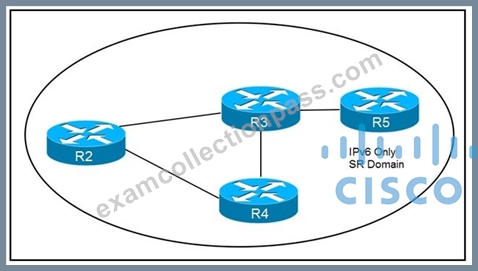
How are packets directed through the data plane when SRv6 is implemented?
- A. A stack of labels represents an ordered list of segments
- B. An ordered list of segments is encoded in a routing extension header
- C. The packet is encapsulated with a header and trailer encoding the ordered list of segments
- D. The MPLS data plane is used to push labels onto IGP routes
Answer: B
NEW QUESTION 48
Refer to the exhibit.
A network operator is working to deploy a Unified BGP design and allow it to be available only in selected markets and services in the future. The label allocation is not functioning as desired. Which action will fix the issue?
- A. Reconfigure the route-policy ALL_LABELS to pass.
- B. Remove the route policy and only configure "allocate-label".
- C. Remove the allocate-labels command.
- D. Reconfigure the route-policy ALL_LABELS to match all after the drop.
Answer: A
NEW QUESTION 49
Refer to the exhibit.
A network engineer applied configuration on R5 to summarize all OSPF routes, but R4 is still receiving specific routes from R5. The engineer has confirmed that both R5 and R4 routers are configured with correct summarization configuration but R5 Is not sending the summary routes What action must the engineer take to fix the problem?
- A. Move R4 and R5 in separate areas as now they maintain the same link-state database
- B. Configure a sham link between R4 and R5 to support summarization within Area 2
- C. Clear link-state database on both R4 and R5 routers for summarization to work
- D. Remove summarization configuration on R5 and configure it on R4
Answer: A
NEW QUESTION 50
A network engineer is troubleshooting OSPF multiarea. Which Cisco IOS XR feature should the engineer use in order to streamline OSPF issue?
- A. show lp ospf topology command
- B. DR support for topology management
- C. hierarchical CLI
- D. routing process enabled by default on all interfaces
Answer: A
NEW QUESTION 51
Refer to the exhibit.
Routers R1 and R2 cannot form a neighbor relationship, but the network is otherwise configured correctly and operating normally. Which two statements describe the problem? (Choose two.)
- A. The two routers are in different subnets
- B. The two routers are in different areas
- C. The two routers are in the same area
- D. The two routers have the same network ID
- E. The two routers have password mismatch issues
Answer: A,B
NEW QUESTION 52
Refer to the exhibit.
P1 and PE3 Cisco IOS XR routers are directly connected and have this configuration applied. The BGP session is not coming up. Assume that there is no IP reachability problem and both routers can open tcp port 179 to each other. Which two actions fix the issue? (Choose two.)
- A. Change MD5 to HMAC-MD5
- B. Change MD5 to HMAC-ESP
- C. Remove the send and accept lifetime under key 1
- D. Change MD5 to SHA-1
- E. Change MD5 to HMAC-SHA1-12
Answer: A,E
NEW QUESTION 53
Refer to the exhibit.
All routers on this network have been configured with P1M-SM and R1 is the rendezvous point However, when asymmetric routing is implemented to modify link usage the network begins to drop certain multicast traffic Which action corrects the problem?
- A. Place the routes affected by asymmetric routing in a VRF.
- B. Configure the routers to use PIM-DM instead of PIM-SM.
- C. Add a static Mroute for routes that are failing.
- D. Remove the asymmetric routing and use spanning tree to manage link usage.
Answer: C
NEW QUESTION 54
What are two differences between OSPF and IS-IS? (Choose two.)
- A. Unlike IS-IS routers, an OSPF router belongs to only one area in addition to the backbone area.
- B. OSPF elects a DR and a BDR, and IS-IS elects a DIS.
- C. OSPF uses a router ID to identify a router, and IS-IS uses a system ID.
- D. Unlike OSPF. IS-IS supports virtual links.
- E. OSPF is a link-state routing protocol, and IS-IS is a distance-vector routing protocol.
Answer: B,C
NEW QUESTION 55
A network engineer is troubleshooting OSPF multiare
a. Which Cisco IOS XR feature should the engineer use in order to streamline OSPF issue?
- A. show lp ospf topology command
- B. DR support for topology management
- C. hierarchical CLI
- D. routing process enabled by default on all interfaces
Answer: A
NEW QUESTION 56
Refer to the exhibit.
R1 is directly connected to R2 and R3. R1 is in BGP AS 123, R2 is in BGP AS 2, and R3 is in BGP AS 3. Assume that there is no connectivity issue between R1, R2 and R1, R3. Which result between BGP peers R1, R2 and R1, R3 is true?
- A. The BGP session comes up between R1 and R2, but not between R1 and R3.
- B. The BGP session comes up between R1 and R3, but not between R1 and R2.
- C. The BGP session does not come up between R1 and R2 and between R1 and R3.
- D. The BGP session comes up between R1 and R2 and between R1 and R3.
Answer: D
NEW QUESTION 57
Refer to the exhibit.
A network operator must inject a Level 1 route from XR2 (10.16.16.0/24) into the ISIS topology. Which configuration allows the injection in a way that XR3 and XR1 have a valid and working route for 10.16.16.0/24?

- A. Option A
- B. Option B
- C. Option C
- D. Option D
Answer: C
NEW QUESTION 58
You have configured routing policies on a Cisco IOS XR device with routing policy language. Which two statements about the routing policies are true? (Choose two.)
- A. The routing policies are implemented in a sequential manner.
- B. The routing policies are implemented using route maps.
- C. The routing policies affect BGP-related routes only.
- D. You can change an existing routing policy by editing individual statements.
- E. If you make edits to an existing routing policy without pasting the full policy into the CLI, the previous policy is overwritten.
Answer: A,D
NEW QUESTION 59 
Refer to the exhibit. A network operator must stop 10.33.33.33/32 from being redistributed into Level 1 router XR1. Which configuration meets this need?
- A.

- B.

- C.

- D.

Answer: A
Explanation:
Explanation/Reference:
NEW QUESTION 60
Which two statements about route reflectors are true? (Choose two.)
- A. If a route reflector receives a route with a cluster-list attribute containing a different cluster ID, the route is discarded.
- B. Routes received from a route reflector client is reflected to other clients and nonclient peers.
- C. Routes received from nonclient peers are reflected to route reflector clients as well as nonclient peers.
- D. Routes received from nonclient peers are reflected to route reflector cluster as well as OSPF peers.
- E. If a router received an iBGP route with the originator-ID attribute set to its own router ID, the route is discarded.
Answer: B,E
Explanation:
Explanation/Reference: http://www.networkers-online.com/blog/2009/02/bgp-route-reflector-basics/
NEW QUESTION 61 
Refer to the exhibit. Which task must you perform on interface g1/0/0 to complete the SSM implementation?
- A. configure IGMPv3
- B. enable CDP
- C. disable IGMP
- D. configure OSPFv3
Answer: A
Explanation:
Explanation/Reference: https://www.cisco.com/c/en/us/td/docs/ios-xml/ios/ipmulti_pim/configuration/xe-16/imc-pim-xe-16- book/imc-ssm.html
NEW QUESTION 62
......
Audience, Prerequisites, and Objectives for Implementing Cisco Service Provider Advanced Routing Solutions Training
Particularly, this course for exam 300-510 invigorates the needs of network administrators, project managers, system engineers, and network designers. The initial requirements they need to meet before undertaking the training are such as having at least intermediate knowledge covering Cisco IOS or Cisco IOS XE as well as Cisco IOS XR Software that touches on the configuration. More requirements include awareness of networking concerning IPv6 and IPv4 TCP/IP, intermediate knowledge about routing protocols of OSPF, BGP, and ISIS, and comprehension regarding MPLS technologies, multicast technologies, and segment routing. Also, there are other vital courses that one ought to have passed through before this specific training. This is to gain the proper perspective about what they are about to learn and ensure this goes on effectively. Overall, on completing this 300-510 exam course, you will have mastered the following objectives:
- Describing and comparing core concepts for multicast;
- Configuring BGP scalability within SP networks;
- Putting into practice mechanisms targeting dynamic RP (Rendezvous Point) distribution.
- Troubleshooting ISIS, OSPF, and BGP;
- Executing MSDP within the interdomain surrounding;
- Executing security options for BGP;
- Capabilities in executing advanced features concerning multilevel ISIS that run in SP networks;
- Capabilities in configuring BGP so that it can connect upstream SP or customers successfully to the SP network;
- Comprehension of protocols for routing that are usually utilized in SP environments;
- Potentiality in executing advanced features in relation with OSPFv2 that run in SP networks;
- Implementing enhanced PIM-SM associated features;
- Deploying and verifying MPLS;
- Using IPv6 mechanisms for tunneling;
- Implementing and troubleshooting traffic engineering for MPLS;
- Putting into operation and authenticating the protocol known as PIM-SM;
- Implementing advanced features so that there is enhanced convergence within BGP networks;
- Executing and authenticating technology for segment routing within an interior gateway protocol;
- Describing the usage of traffic engineering within networks for segment routing;
- Abilities in configuring route redistribution;
The skills covered when practicing with the hands-on labs for exam 300-510 include executing Special Area Types for OSPF, implementing Multiarea IS-IS, route redistribution, route selection for BGP, route reflectors, security options for BGP, and troubleshooting routing protocols. Others are executing MPLS within the SP core, deploying MPLS TE for Cisco, configuring and authenticating segment routing for IGP, and operating with tunnels aimed at IPv6. Candidates will also draw practical skills in the areas of enabling and optimizing PIM-SM, executing enhancements for PIM-SM, and putting into practice RP distribution.
Master 2021 Latest The Questions CCNP Service Provider and Pass 300-510 Real Exam!: https://www.examcollectionpass.com/Cisco/300-510-practice-exam-dumps.html
Practice To 300-510 - ExamcollectionPass Remarkable Practice On your Implementing Cisco Service Provider Advanced Routing Solutions Exam: https://drive.google.com/open?id=1GCu2GByikobj-BdKwagjhySxE4kOtALq