

[Full-Version] 2024 New Preparation Guide of HP HPE6-A85 Exam
HPE6-A85 Practice Exam - 62 Unique Questions
HP HPE6-A85 exam is a multiple-choice exam that consists of 60 questions. HPE6-A85 exam is administered in a computer-based format and has a duration of 90 minutes. HPE6-A85 exam is designed to measure the candidate's knowledge and skills related to Aruba Campus Access solutions. It covers topics such as ArubaOS switches, Aruba access points, WLANs, and security. HPE6-A85 exam is also designed to test the candidate's ability to troubleshoot and resolve issues related to Aruba Campus Access solutions. Passing HPE6-A85 exam is a requirement for obtaining the Aruba Certified Switching Associate (ACSA) certification.
NEW QUESTION # 29
When using the OSPF dynamic routing protocol on an Aruba CX switch, what must match on the neighboring devices to exchange routes?
- A. BDR configuration
- B. Hello timers
- C. DR configuration
- D. ECMP method
Answer: B
Explanation:
Explanation
OSPF Open Shortest Path First. OSPF is a link-state routing protocol that uses a hierarchical structure to create a routing topology for IP networks. OSPF routers exchange routing information with their neighbors using Hello packets, which are sent periodically on each interface. To establish an adjacency Adjacency is a relationship formed between selected neighboring routers for the purpose of exchanging routing information., OSPF routers must agree on several parameters, including Hello timers, which specify how often Hello packets are sent on an interface. If the Hello timers do not match between neighboring routers, they will not form an adjacency and will not exchange routes.
References:https://www.arubanetworks.com/techdocs/ArubaOS_86_Web_Help/Content/arubaos-solutions/osfp/o
NEW QUESTION # 30
You need to drop excessive broadcast traffic on ingress to an ArubaOS-CX switch What is the best technology to use for this task?
- A. QoS shaping
- B. DWRR queuing
- C. Strict queuing
- D. Rate limiting
Answer: D
Explanation:
Explanation
The best technology to use for dropping excessive broadcast traffic on ingress to an ArubaOS-CX switch is rate limiting. Rate limiting is a feature that allows network administrators to control the amount of traffic that enters or leaves a port or a VLAN on a switch by setting bandwidth thresholds or limits. Rate limiting can be used to prevent network congestion, improve network performance, enforce service level agreements(SLAs), or mitigate denial-of-service (DoS) attacks. Rate limiting can be applied to broadcast traffic on ingress to an ArubaOS-CX switch by using the storm-control command in interface configuration mode. This command allows network administrators to specify the percentage of bandwidth or packets per second that can be used by broadcast traffic on an ingress port. If the broadcast traffic exceeds the specified threshold, the switch will drop the excess packets.
The other options are not technologies for dropping excessive broadcast traffic on ingress because:
DWRR queuing: DWRR stands for Deficit Weighted Round Robin, which is a queuing algorithm that assigns different weights or priorities to different traffic classes or queues on an egress port. DWRR ensures that each queue gets its fair share of bandwidth based on its weight while avoiding starvation of lower priority queues. DWRR does not drop excessive broadcast traffic on ingress, but rather schedules outgoing traffic on egress.
QoS shaping: QoS stands for Quality of Service, which is a set of techniques that manage network resources and provide different levels of service to different types of traffic based on their requirements.
QoS shaping is a technique that delays or buffers outgoing traffic on an egress port to match the available bandwidth or rate limit. QoS shaping does not drop excessive broadcast traffic on ingress, but rather smooths outgoing traffic on egress.
Strict queuing: Strict queuing is another queuing algorithm that assigns different priorities to different traffic classes or queues on an egress port. Strict queuing ensures that higher priority queues are always served before lower priority queues regardless of their bandwidth requirements or weights. Strict queuing does not drop excessive broadcast traffic on ingress, but rather schedules outgoing traffic on egress.
References: https://en.wikipedia.org/wiki/Rate_limiting
https://www.arubanetworks.com/techdocs/AOS-CX_10_08/NOSCG/Content/cx-noscg/qos/storm-control.htm
https://www.arubanetworks.com/techdocs/AOS-CX_10_08/NOSCG/Content/cx-noscg/qos/dwrr.htm
https://www.arubanetworks.com/techdocs/AOS-CX_10_08/NOSCG/Content/cx-noscg/qos/shaping.htm
https://www.arubanetworks.com/techdocs/AOS-CX_10_08/NOSCG/Content/cx-noscg/qos/strict.htm
NEW QUESTION # 31
When using Aruba Central what can identify recommended steps to resolve network health issues and allows you to share detailed information with support personnel?
- A. Overview Dashboard
- B. Alerts and Events
- C. OAlOps
- D. Audit Trail
Answer: C
Explanation:
Explanation
OAlOps is a feature of Aruba Central that uses artificial intelligence and machine learning to identify recommended steps to resolve network health issues and allows you to share detailed information with support personnel. OAlOps provides insights into network performance, root cause analysis, anomaly detection, proactive alerts, and automated remediation actions.OAlOps also integrates with Aruba User Experience Insight (UXI) sensors to measure and improve user experience across wired and wireless networks.
References:https://www.arubanetworks.com/assets/ds/DS_ArubaCentral.pdf
NEW QUESTION # 32
What does a slow amber-flashing Stack-LED indicate?
- A. A port has a stacking failure Stacking mode Is not selected
- B. Stacking mode selected
- C. One switch has a stacking failure.
- D. Stacking is synchronizing Please wait
Answer: B
Explanation:
Explanation
A slow amber-flashing Stack-LED indicates that stacking mode is selected on the switch. This means that the switch is ready to join a stack or form a new stack if no other switches are present.
References:https://www.arubanetworks.com/techdocs/ArubaOS_86_Web_Help/Content/arubaos-solutions/1-ove
NEW QUESTION # 33
The noise floor measures 000000001 milliwatts, and the receiver's signal strength is -65dBm. What is the Signal to Noise Ratio?
- A. 45 dBm
- B. 35 dBm
- C. 25 dBm
- D. 15 dBm
Answer: C
Explanation:
Explanation
The signal to noise ratio (SNR) is a measure that compares the level of a desired signal to the level of background noise. SNR is defined as the ratio of signal power to the noise power, often expressed in decibels (dB). A high SNR means that the signal is clear and easy to detect or interpret, while a low SNR means that the signal is corrupted or obscured by noise and may be difficult to distinguish or recover3. To calculate the SNR in dB, we can use the following formula:
SNR (dB) = Signal power (dBm) - Noise power (dBm)
In this question, we are given that the noise floor measures -90 dBm (0.000000001 milliwatts) and the receiver's signal strength is -65 dBm (0.000316 milliwatts). Therefore, we can plug these values into the formula and get:
SNR (dB) = -65 dBm - (-90 dBm) SNR (dB) = -65 dBm + 90 dBm SNR (dB) = 25 dBm Therefore, the correct answer is that the SNR is 25 dBm.
References: 3 https://en.wikipedia.org/wiki/Signal-to-noise_ratio
NEW QUESTION # 34
When performing live firmware upgrades on Aruba APs. which technology partitions all the APs based on RF neighborhood data minimizing the impact on clients?
- A. Aruba Ai insights
- B. Aruba AirMatch
- C. Aruba ESP
- D. Aruba ClientMatch
Answer: B
Explanation:
Explanation
Aruba AirMatch is a feature that optimizes RF Radio Frequency. RF is any frequency within the electromagnetic spectrum associated with radio wave propagation. When an RF current is supplied to an antenna, an electromagnetic field is created that then is able to propagate through space. performance and user experience by using machine learning algorithms and historical data to dynamically adjust AP power levels, channel assignments, and channel width. AirMatch performs live firmware upgrades on Aruba APs by partitioning all the APs based on RFneighborhood data and minimizing the impact on clients. AirMatch uses a rolling upgrade process that upgrades one partition at a time while ensuring that adjacent partitions are not upgraded simultaneously. References:
https://www.arubanetworks.com/assets/ds/DS_AirMatch.pdfhttps://www.arubanetworks.com/techdocs/ArubaOS
NEW QUESTION # 35
A network technician is using Aruba Central to troubleshoot network issues Which dashboard can be used to view and acknowledge issues when beginning the troubleshooting process?
- A. the Tools dashboard
- B. the Alerts and Events dashboard
- C. the Audit Trail dashboard
- D. the Reports dashboard
Answer: B
Explanation:
Explanation
The Alerts and Events dashboard displays all types of alerts and events generated for events pertaining to device provisioning, configuration, and user management. You can use the Config icon to configure alerts and notifications for different alert categories and severities . You can also view the alerts and events in the List view and Summary view2. References:
https://www.arubanetworks.com/techdocs/central/latest/content/nms/alerts/configuring-alerts.htm 2
https://www.arubanetworks.com/techdocs/central/latest/content/nms/alerts/viewing-alerts.htm
NEW QUESTION # 36
You have been asked to onboard a new Aruba 6300M in a customer deployment You are working remotely rather than on-site You have a colleague installing the switch The colleague has provided you with a remote console session to configure the edge switch You have been asked to configure a link aggregation going back to the cores using interfaces 1/1/51 and 1/1/52 The Senior Engineer of the project has asked you to configure the switch and 1Q uplink with these guidelines
1. Add VLAN 20 to the local VLAN database with name Mgmt
2. Add L3 SVl on VLAN 20 for Management using address 10 in the 10.1.1 0/24 subnet 3. Add LAG 1 using LACP mode active for the uplink
4 use vlan 20 as the native vlan on the LAG 5. Make sure the interfaces are all ON.
Which configuration script will achieve the task?
- A. Edgel# conf t vlan 20 name Mgmt interface vlan 20 ip address 10 1 1 10/24 no shut interface lag 1 shut vlan trunk native 20 vlan trunk allowed all lacp mode active Int 1/1/51.1/1/52 shut no routing lag 1 interface lag 1 no shut interface 1/1/51.1/1/52 no shut
- B. conf t vlan 20 name Mgmt ip address 10 1 1.10/24 no shut interface lag 1 shut vlan trunk native 1 vlan trunk allowed all lacp mode active int 1/1/51.1/1/52 shut no routing interface lag 1 no shut interface
1/1/51.1/1/52 no shut - C. Edge1# conf t vlan 20 name Mgmt interface vlan 20 ip address 10.1.1.10/24 no shut interface lag 1 shut vlan access 20 lacp mode active Int 1/1/51.1/1/52 shut no routing lag 1 interface lag 1 no shut
- D. Edgel# conf t vlan 20 name Mgmt interface vlan 20 ip address 10 1.1 10/24 no shut interface
1/1/51.1/1/52 shut vlan trunk native 20 vlan trunk allowed all lag 1 lacp mode active interface 1/1/51.1/1/52 no shut
Answer: A
Explanation:
Explanation
This configuration script will achieve the task as it follows the guidelines given by the Senior Engineer. It creates VLAN 20 with name Mgmt, adds L3 SVI on VLAN 20 with IP address 10.1.1.10/24, creates LAG 1 with LACP mode active for the uplink, uses VLAN 20 as the native VLAN on the LAG, and ensures that the interfaces are all ON.
References:https://www.arubanetworks.com/techdocs/AOS-CX/10.04/HTML/5200-6790/GUID-8F0E7E8B-0F4
NEW QUESTION # 37
When measuring signal strength, dBm is commonly used and 0 dBm corresponds to 1 mW power.
What does -20 dBm correspond to?
- A. 10 mW
- B. .-1 mW
- C. 1mW
- D. .01 mw
Answer: D
Explanation:
Explanation
dBm is a unit of power that measures the ratio of a given power level to 1 mW. The formula to convert dBm to mW is: P(mW) = 1mW * 10^(P(dBm)/10). Therefore, -20 dBm corresponds to 0.01 mW, as follows: P(mW) =
1mW * 10^(-20/10) = 0.01 mW References:https://www.rapidtables.com/convert/power/dBm_to_mW.html
NEW QUESTION # 38
Match the switching technology with the appropriate use case.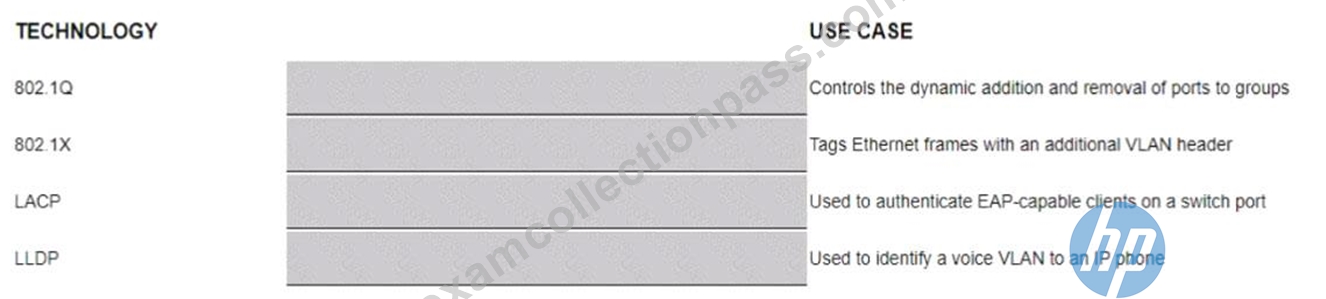
Answer:
Explanation: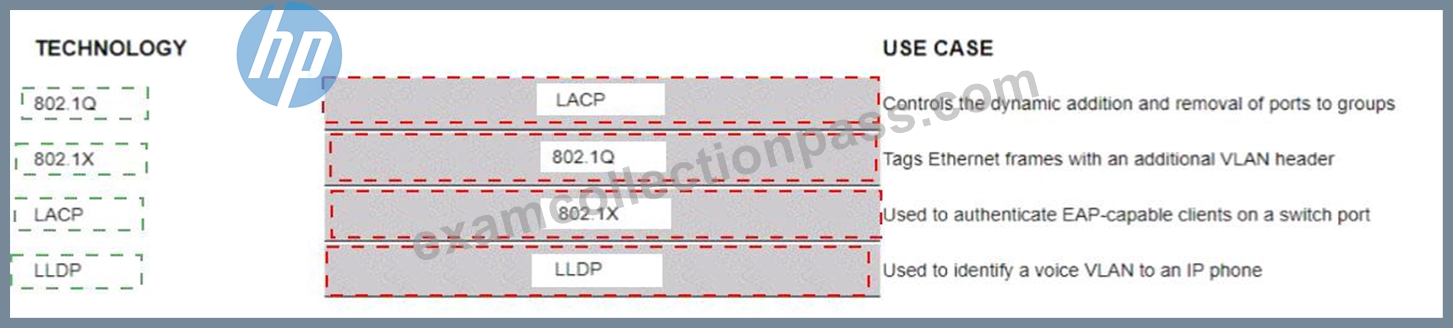
Explanation
USE CASE: a) Controls the dynamic addition and removal of ports to groups Technology: 3) LACP USE CASE: b) Tags Ethernet frames with an additional VLAN header Technology: 1) 802.1Q USE CASE: c) Used to authenticate EAP-Capable client on a switch port Technology: 2) 802.1X USE CASE: d) Used to identify a voice VLAN to an IP phone Technology: 4) LLDP The following table summarizes the switching technologies and their use cases:
Technology
Use case
1) 802.1Q
802.1Q is a standard that defines how to create and manage virtual LANs (VLANs) on a network. VLANs allow network administrators to logically segment a network into different broadcast domains, improving security, performance, and manageability. 802.1Q tags Ethernet frames with an additional VLAN header that contains a VLAN identifier (VID), which indicates which VLAN the frame belongs to1.
2) 802.1X
802.1X is a standard that defines how to provide port-based network access control (PNAC) on a network.
PNAC allows network administrators to authenticate and authorize devices before granting them access to network resources. 802.1X uses the Extensible Authentication Protocol (EAP) to exchange authentication messages between a supplicant (a device that wants to access the network), an authenticator (a device that controls access to the network, such as a switch), and an authentication server (a device that verifies the credentials of the supplicant, such as a RADIUS server)
3) LACP
LACP stands for Link Aggregation Control Protocol, which is part of the IEEE 802.3ad standard that defines how to bundle multiple physical links into a single logical link, also known as a link aggregation group (LAG) or an EtherChannel. LAGs provide increased bandwidth, load balancing, and redundancy for network connections. LACP controls the dynamic addition and removal of ports to groups, ensuring that only ports with compatible configurations can form a LAG3.
4) LLDP
LLDP stands for Link Layer Discovery Protocol, which is part of the IEEE 802.1AB standard that defines how to discover and advertise information about neighboring devices on a network. LLDP operates at Layer 2 of the OSI model and uses TLVs (type-length-value) to exchange information such as device name, port number, VLAN ID, capabilities, and power requirements. LLDP can be used to identify a voice VLAN to an IP phone by sending a TLV that contains the voice VLAN ID and priority.
References: 1 https://en.wikipedia.org/wiki/IEEE_802.1Q 2 https://en.wikipedia.org/wiki/IEEE_802.1X 3
https://en.wikipedia.org/wiki/Link_aggregation
https://en.wikipedia.org/wiki/Link_Layer_Discovery_Protocol
NEW QUESTION # 39
Match the feature to the Aruba OS version (Matches may be used more than once.)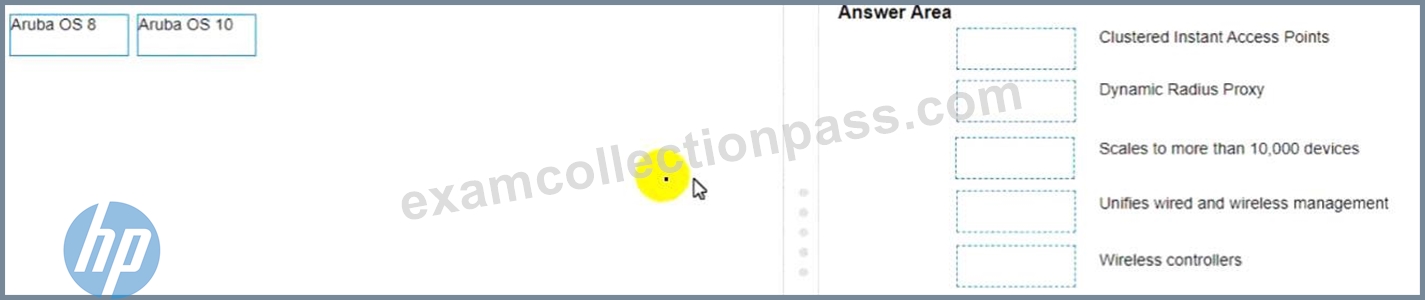
Answer:
Explanation: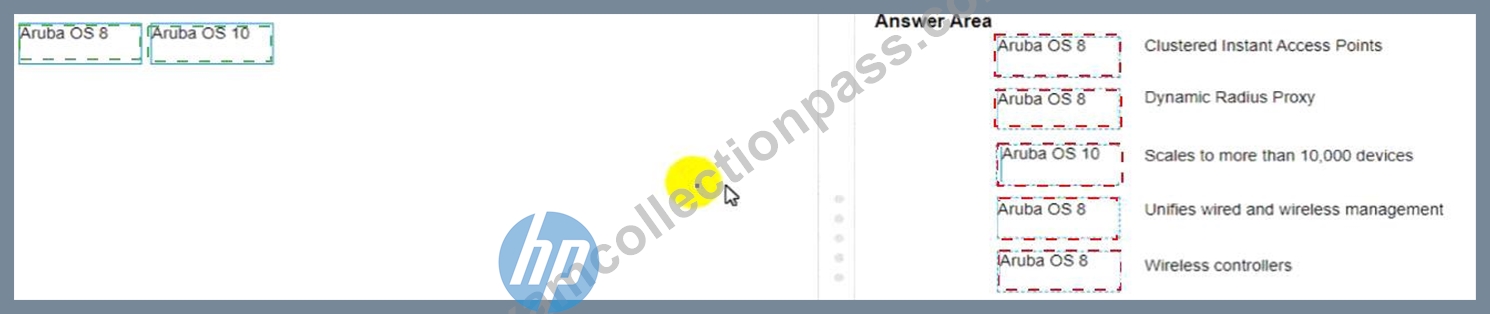
Explanation
Features: 1) Clustered Instant Access Points Aruba OS version: a) Aruba OS 8 Features: 2) Dynamic Radius Proxy Aruba OS version: a) Aruba OS 8 Features: 3) Scales to more than 10,000 devices Aruba OS version: b) Aruba OS 10 Features: 4) Unifies wired and wireless management Aruba OS version: a) Aruba OS 8 Features: 5) Wireless controllers Aruba OS version: a) Aruba OS 8 ArubaOS is the operating system for all Aruba Mobility Controllers (MCs) and controller-managed wireless access points (APs). ArubaOS 8 delivers unified wired and wireless access, seamless roaming, enterprise grade security, and a highly available network with the required reliability to support high density environments1.
Some of the features of ArubaOS 8 are:
Clustered Instant Access Points: This feature allows multiple Instant APs to form a cluster and share configuration and state information. This enables seamless roaming, load balancing, and fast failover for clients2.
Dynamic Radius Proxy: This feature allows an MC to act as a proxy for RADIUS authentication requests from clients or APs. This simplifies the configuration and management of RADIUS servers and reduces the network traffic between MCs and RADIUS servers3.
Wireless controllers: Aruba wireless controllers are devices that centrally manage and control the wireless network. They provide functions such as AP provisioning, configuration, security, policy enforcement, and network optimization.
ArubaOS 10 is the next-generation operating system that works with Aruba Central, a cloud-based network management platform. ArubaOS 10 delivers greater scalability, security, and AI-powered optimization across large campuses, branches, and remote work environments. Some of the features of ArubaOS 10 are:
Scales to more than 10,000 devices: ArubaOS 10 can support up to 10,000 devices per cluster, which is ten times more than ArubaOS 8. This enables customers to scale their networks without compromising performance or reliability.
Unifies wired and wireless management: ArubaOS 10 provides a single platform for managing both wired and wireless devices across the network. Customers can use Aruba Central to configure, monitor, troubleshoot, and update their devices from anywhere.
Both ArubaOS 8 and ArubaOS 10 share some common features, such as:
Unifies wired and wireless management: Both operating systems provide unified wired and wireless access for customers who use Aruba switches and APs. Customers can use a single interface to manage their entire network infrastructure
https://www.arubanetworks.com/resource/arubaos-8-fundamental-guide/ 2
https://www.arubanetworks.com/techdocs/Instant_86_WebHelp/Content/instant-ug/iap-maintenance/clust
3
https://www.arubanetworks.com/techdocs/ArubaOS_86_Web_Help/Content/arubaos-solutions/1-overview
https://www.arubanetworks.com/products/networking/controllers/
https://www.arubanetworks.com/products/network-management-operations/arubaos/
https://blogs.arubanetworks.com/solutions/making-the-switch/
https://www.arubanetworks.com/products/network-management-operations/aruba-central/
NEW QUESTION # 40
What does WPA3-Personal use as the source to generate a different Pairwise Master Key (PMK) each time a station connects to the wireless network?
- A. Opportunistic Wireless Encryption (OWE)
- B. Simultaneous Authentication of Equals (SAE)
- C. Session-specific information (MACs and nonces)
- D. Key Encryption Key (KEK)
Answer: C
Explanation:
Explanation
The source that WPA3-Personal uses to generate a different Pairwise Master Key (PMK) each time a station connects to the wireless network is session-specific information (MACs and nonces). WPA3-Personal uses Simultaneous Authentication of Equals (SAE) to replace PSK authentication in WPA2-Personal. SAE is a secure key establishment protocol that uses a Diffie-Hellman key exchange to derive a shared secret between two parties without revealing it to an eavesdropper. SAE involves the following steps:
The station and the access point exchange Commit messages that contain their MAC addresses and random numbers called nonces.
The station and the access point use their own passwords and the received MAC addresses and nonces to calculate a shared secret called SAE Password Element (PE).
The station and the access point use their own PE and the received MAC addresses and nonces to calculate a shared secret called SAE Key Seed (KS).
The station and the access point use their own KS and the received MAC addresses and nonces to calculate a shared secret called SAE Key Confirmation Key (KCK).
The station and the access point use their own KCK and the received MAC addresses and nonces to calculate a confirmation value called SAE Confirm.
The station and the access point exchange Confirm messages that contain their SAE Confirm values.
The station and the access point verify that the received SAE Confirm values match their own calculated values. If they match, the authentication is successful and the station and the access point have established a shared secret called SAE PMK.
The SAE PMK is different for each session because it depends on the MAC addresses and nonces that are exchanged in each authentication process. The SAE PMK is used as an input for the 4-way handshake that generates the Pairwise Temporal Key (PTK) for encrypting data frames.
The other options are not sources that WPA3-Personal uses to generate a different PMK each time a station connects to the wireless network because:
Opportunistic Wireless Encryption (OWE): OWE is a feature that provides encryption for open networks without requiring authentication or passwords. OWE uses a similar key establishment protocol as SAE, but it does not generate a PMK. Instead, it generates a Pairwise Secret (PS) that is used as an input for the 4-way handshake that generates the PTK.
Simultaneous Authentication of Equals (SAE): SAE is not a source, but a protocol that uses session-specific information as a source to generate a different PMK each time a station connects to the wireless network.
Key Encryption Key (KEK): KEK is not a source, but an output of the 4-way handshake that generates the PTK. KEK is used to encrypt group keys that are distributed by the access point.
References: https://www.wi-fi.org/discover-wi-fi/wi-fi-certified-6e
https://www.wi-fi.org/file/wi-fi-alliance-unlicensed-spectrum-in-the-us
https://www.cisco.com/c/en/us/products/collateral/wireless/catalyst-9100ax-access-points/wpa3-dep-guide-og.ht
https://info.support.huawei.com/info-finder/encyclopedia/en/WPA3.html
https://rp.os3.nl/2019-2020/p99/presentation.pdf
NEW QUESTION # 41
What is a weakness introduced into the WLAN environment when WPA2-Personal is used for security?
- A. The Pairwise Master Key (PMK) is shared by ail users
- B. The Pairwise Temporal Key (PTK) is specific to each session
- C. It does not use the WPA 4-Way Handshake
- D. It uses X 509 certificates generated by a Certification Authority
Answer: A
Explanation:
Explanation
The weakness introduced into WLAN environment when WPA2-Personal is used for security is that PMK Pairwise Master Key (PMK) is a key that is derived from PSK Pre-shared Key (PSK) is a key that is shared between two parties before communication begins , which are both fixed. This means that all users who know PSK can generate PMK without any authentication process. This also means that if PSK or PMK are compromised by an attacker, they can be used to decrypt all traffic encrypted with PTK Pairwise Temporal Key (PTK) is a key that is derived from PMK, ANonce AuthenticatorNonce (ANonce) is a random number generated by an authenticator (a device that controls access to network resources, such as an AP), SNonce Supplicant Nonce (SNonce) is a random number generated by supplicant (a device that wants to access network resources, such as an STA), AA Authenticator Address (AA) is MAC address of authenticator, SA Supplicant Address (SA) is MAC address of supplicant using Pseudo-Random Function (PRF). PTK consists of four subkeys: KCK Key Confirmation Key (KCK) is used for message integrity check, KEK Key Encryption Key (KEK) is used for encryption key distribution, TK Temporal Key (TK) is used for data encryption, MIC Message Integrity Code (MIC) key. .
The other options are not weaknesses because:
It uses X 509 certificates generated by a Certification Authority: This option is false because WPA2-Personal does not use X 509 certificates or Certification Authority for authentication. X 509 certificates and Certification Authority are used in WPA2-Enterprise mode, which uses 802.1X and EAP Extensible Authentication Protocol (EAP) is an authentication framework that provides support for multiple authentication methods, such as passwords, certificates, tokens, or biometrics. EAP is used in wireless networks and point-to-point connections to provide secure authentication between a supplicant (a device that wants to access the network) and an authentication server (a device that verifies the credentials of the supplicant). for user authentication with a RADIUS server Remote Authentication Dial-In User Service (RADIUS) is a network protocol that provides centralized authentication, authorization, and accounting (AAA) management for users who connect and use a network service .
The Pairwise Temporal Key (PTK) is specific to each session: This option is false because PTK being specific to each session is not a weakness but a strength of WPA2-Personal. PTK being specific to each session means that it changes periodically during communication based on time or number of packets transmitted. This prevents replay attacks and increases security of data encryption.
It does not use the WPA 4-Way Handshake: This option is false because WPA2-Personal does use the WPA 4-Way Handshake for key negotiation. The WPA 4-Way Handshake is a process that allows the station and the access point to exchange ANonce and SNonce and derive PTK from PMK. The WPA
4-Way Handshake also allows the station and the access point to verify each other's PMK and confirm the installation of PTK.
References: https://en.wikipedia.org/wiki/Wi-Fi_Protected_Access#WPA_key_hierarchy_and_management
https://www.cwnp.com/wp-content/uploads/pdf/WPA2.pdf
NEW QUESTION # 42
Match the appropriate QoS concept with its definition.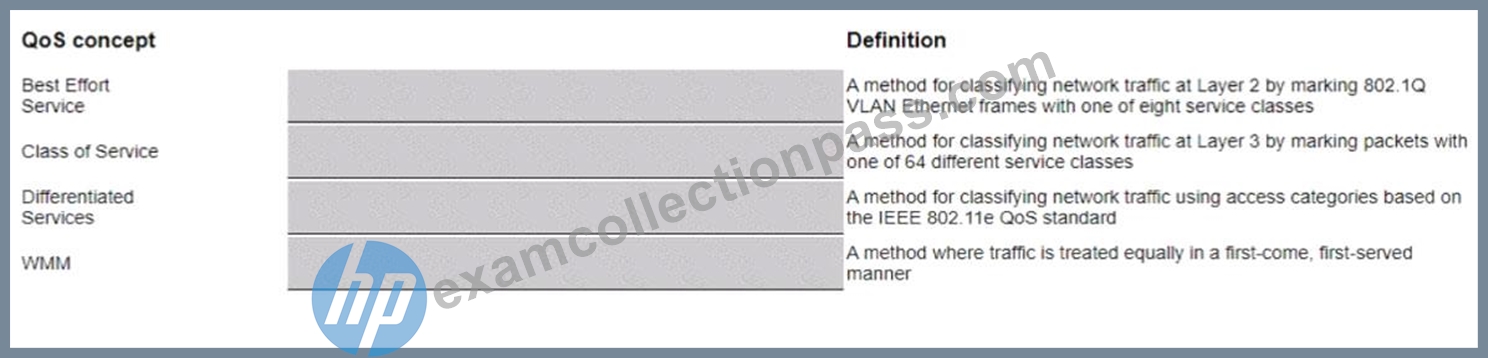
Answer:
Explanation: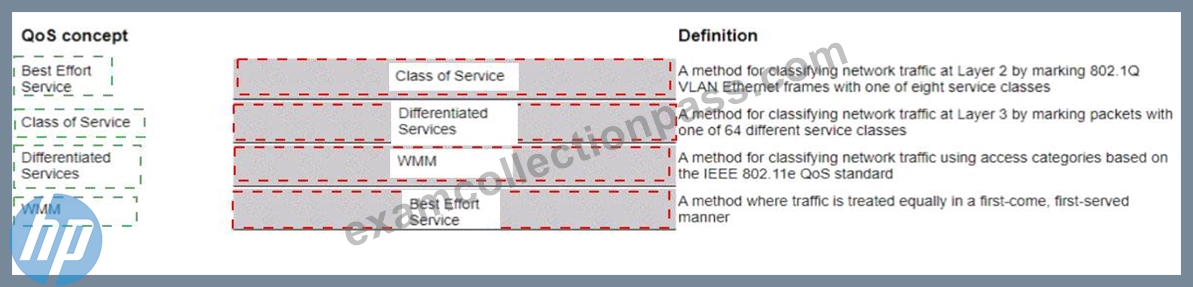
Explanation
QoS Quality of Service (QoS) is a set of techniques that manage network resources and provide different levels of service to different types of traffic based on their requirements. QoS can improve network performance, reduce latency, increase throughput, and prevent congestion. concept and its definition. Here is my answer:
QoS Concept:
Best Effort Service
Class of Service
Differentiated Services
WMM ====================== Definition:
d) A method where traffic is treated equally in a first-come, first-served manner a) A method for classifying network traffic at Layer 2 by marking 802.1Q VLAN Ethernet frames with one of eight service classes b) A method for classifying network traffic at Layer 3 by marking packets with one of 64 different service classes c) A method for classifying network traffic using access categories based on the IEEE 802.11e QoS standard Short But Comprehensive Explanation of Correct Answer Only: The correct match between QoS concept and its definition is as follows:
Best Effort Service: This is a method where traffic is treated equally in a first-come, first-served manner without any prioritization or differentiation. This is the default service level for most networks and applications that do not have specific QoS requirements or guarantees. Best Effort Service does not provide any assurance of bandwidth, delay, jitter, or packet loss.
Class of Service: This is a method for classifying network traffic at Layer 2 by marking 802.1Q VLAN Ethernet frames with one of eight service classes (0 to 7). These service classes are also known as IEEE
802.1p priority values or PCP Priority Code Point (PCP) is a 3-bit field in the 802.1Q VLAN tag that indicates the priority level of an Ethernet frame . Class of Service allows network devices to identify and handle different types of traffic based on their priority levels. Class of Service is typically used in LAN Local Area Network (LAN) is a network that connects devices within a limited geographic area, such as a home, office, or building environments where Layer 2 switching is predominant.
Differentiated Services: This is a method for classifying network traffic at Layer 3 by marking packets with one of 64 different service classes (0 to 63). These service classes are also known as DiffServ Code Points (DSCP) DiffServ Code Point (DSCP) is a 6-bit field in the IP header that indicates the service class of a packet . Differentiated Services allows network devices to identify and handle different types of traffic based on their service classes. Differentiated Services is typically used in WAN Wide Area Network (WAN) is a network that connects devices across a large geographic area, such as a country or continent environments where Layer 3 routing is predominant.
WMM: This is a method for classifying network traffic using access categories based on the IEEE
802.11e QoS standard. WMM stands for Wi-Fi Multimedia and it is a certification program developed by the Wi-Fi Alliance to enhance QoS for wireless networks. WMM defines four access categories (AC): Voice, Video, Best Effort, and Background. These access categories correspond to different priority levels and contention parameters for wireless traffic. WMM allows wireless devices to identify and handle different types of traffic based on their access categories.
References: https://en.wikipedia.org/wiki/Quality_of_service
https://www.cisco.com/c/en/us/td/docs/ios-xml/ios/qos_dfsrv/configuration/xe-16/qos-dfsrv-xe-16-book/qos-dfsr
https://www.cisco.com/c/en/us/support/docs/wireless-mobility/wireless-lan-wlan/81831-qos-wlan.html
https://www.wi-fi.org/discover-wi-fi/wi-fi-certified-wmm
NEW QUESTION # 43
What can be done to dynamically set the PoE Priority on a switch port when deploying IP cameras APs. and other PoE devices?
- A. Configure PoE power management to Dynamic Mode
- B. Configure PoE power management to Class-based Mode
- C. Enable profiling for device provisioning
- D. Enable Quick PoE on the switch modules
Answer: C
Explanation:
Explanation
Profiling is a feature that allows Aruba switches to automatically identify and classify devices connected to them based on various attributes such as MAC address, DHCP options, LLDP information, etc. Profiling can be used to dynamically set the PoE priority on a switch port based on the device type and power requirements.
For example, an IP camera may have a higher PoE priority than a printer or a PC. Profiling can also be used to apply other configuration settings such as VLANs, ACLs, QoS, etc. based on the device profile.
References:https://www.arubanetworks.com/techdocs/ArubaOS_86_Web_Help/Content/arubaos-solutions/1-ove
NEW QUESTION # 44
......
HP HPE6-A85 exam is an ideal certification for IT professionals who are looking to advance their careers in the field of networking. HPE6-A85 exam covers a range of topics that are essential for anyone who is working in the industry, including wireless networking, network security, and troubleshooting. By earning the ACSA certification, candidates can demonstrate their expertise in these areas and increase their career prospects with potential employers.
The Aruba Campus Access Associate Exam is ideal for network administrators, wireless engineers, and technical support professionals who want to enhance their skills and knowledge in Aruba networking solutions. Aruba Campus Access Associate Exam certification is recognized globally and can help candidates stand out in a competitive job market.
Latest Questions HPE6-A85 Guide to Prepare Free Practice Tests: https://www.examcollectionpass.com/HP/HPE6-A85-practice-exam-dumps.html
Reliable HPE6-A85 Dumps Questions Available as Web-Based Practice Test Engine: https://drive.google.com/open?id=1tnL1CKZkmaRCFiH79VF7RL-0h-wxaDXm