

Free Associate-Cloud-Engineer Sample Questions and 100% Cover Real Exam Questions (Updated 268 Questions)
Download Real Google Associate-Cloud-Engineer Exam Dumps Test Engine Exam Questions
Google Associate-Cloud-Engineer (Google Associate Cloud Engineer) Exam is a certification exam that is designed to test the proficiency of an individual in the field of cloud computing. Associate-Cloud-Engineer exam is intended for those who have knowledge and experience in the Google Cloud Platform and related technologies. Individuals who pass Associate-Cloud-Engineer exam will be recognized as Google Associate Cloud Engineers, which is a valuable certification for those seeking a career in cloud computing or IT.
NEW QUESTION # 150
All development (dev) teams in your organization are located in the United States. Each dev team has its own Google Cloud project. You want to restrict access so that each dev team can only create cloud resources in the United States (US). What should you do?
- A. Create an organization to contain all the dev projects. Create an Identity and Access Management (IAM) policy to limit the resources in US regions.
- B. Create a folder to contain all the dev projects Create an organization policy to limit resources in US locations.
- C. Create an Identity and Access Management (IAM)policy to restrict the resources locations in all dev projects. Apply the policy to all dev roles.
- D. Create an Identity and Access Management <IAM) policy to restrict the resources locations in the US.
Apply the policy to all dev projects.
Answer: D
NEW QUESTION # 151
You have developed an application that consists of multiple microservices, with each microservice packaged in its own Docker container image. You want to deploy the entire application on Google Kubernetes Engine so that each microservice can be scaled individually. What should you do?
- A. Create and deploy a Custom Resource Definition per microservice.
- B. Create and deploy a Job per microservice.
- C. Create and deploy a Deployment per microservice.
- D. Create and deploy a Docker Compose File.
Answer: A
NEW QUESTION # 152
You want to configure 10 Compute Engine instances for availability when maintenance occurs. Your requirements state that these instances should attempt to automatically restart if they crash. Also, the instances should be highly available including during system maintenance. What should you do?
- A. Create an instance template for the instances. Set the 'Automatic Restart' to on. Set the 'On-host maintenance' to Migrate VM instance. Add the instance template to an instance group.
- B. Create an instance group for the instances. Set the 'Autohealing' health check to healthy (HTTP).
- C. Create an instance template for the instances. Set 'Automatic Restart' to off. Set 'On-host maintenance' to Terminate VM instances. Add the instance template to an instance group.
- D. Create an instance group for the instance. Verify that the 'Advanced creation options' setting for 'do not retry machine creation' is set to off.
Answer: A
Explanation:
Create an instance template for the instances so VMs have same specs. Set the "'Automatic Restart' to on to VM automatically restarts upon crash. Set the "On-host maintenance' to Migrate VM instance. This will take care of VM during maintenance window. It will migrate VM instance making it highly available Add the instance template to an instance group so instances can be managed.
* onHostMaintenance: Determines the behavior when a maintenance event occurs that might cause your instance to reboot.
* [Default] MIGRATE, which causes Compute Engine to live migrate an instance when there is a maintenance event.
* TERMINATE, which stops an instance instead of migrating it.
* automaticRestart: Determines the behavior when an instance crashes or is stopped by the system.
* [Default] true, so Compute Engine restarts an instance if the instance crashes or is stopped.
* false, so Compute Engine does not restart an instance if the instance crashes or is stopped.
Enabling automatic restart ensures that compute engine instances are automatically restarted when they crash. And Enabling Migrate VM Instance enables live migrates i.e. compute instances are migrated during system maintenance and remain running during the migration.
Automatic Restart If your instance is set to terminate when there is a maintenance event, or if your instance crashes because of an underlying hardware issue, you can set up Compute Engine to automatically restart the instance by setting the automaticRestart field to true. This setting does not apply if the instance is taken offline through a user action, such as calling sudo shutdown, or during a zone outage. Ref: https://cloud.google.com/compute/docs/instances/setting-instance-scheduling-options#autorestart Enabling the Migrate VM Instance option migrates your instance away from an infrastructure maintenance event, and your instance remains running during the migration. Your instance might experience a short period of decreased performance, although generally, most instances should not notice any difference. This is ideal for instances that require constant uptime and can tolerate a short period of decreased performance. Ref: https://cloud.google.com/compute/docs/instances/setting-instance-scheduling-options#live_migrate
NEW QUESTION # 153
You are working with a Cloud SQL MySQL database at your company. You need to retain a month-end copy of the database for three years for audit purposes. What should you do?
- A. Set up an on-demand backup tor the first of the month Write the backup to an Archive class Cloud Storage bucket
- B. Convert the automatic first-of-the-month backup to an export file Write the export file to a Coldline class Cloud Storage bucket
- C. Set up an export job for the first of the month Write the export file to an Archive class Cloud Storage bucket
- D. Save file automatic first-of-the- month backup for three years Store the backup file in an Archive class Cloud Storage bucket
Answer: C
Explanation:
Explanation
https://cloud.google.com/sql/docs/mysql/backup-recovery/backups#can_i_export_a_backup
https://cloud.google.com/sql/docs/mysql/import-export#automating_export_operations
NEW QUESTION # 154
Your team uses a third-party monitoring solution. They've asked you to deploy it to the nodes in your Kubernetes Engine Cluster. What's the best way to do that?
- A. Deploy the monitoring pod as a DaemonSet.
- B. Connect to each node via SSH and install the monitoring solution.
- C. Use Deployment Manager to deploy the monitoring solution.
- D. Deploy the monitoring pod as a Deployment.
Answer: A
NEW QUESTION # 155
You need to create an autoscaling managed instance group for an HTTPS web application. You want to make sure that unhealthy VMs are recreated. What should you do?
- A. In the Instance Template, add the label 'health-check'.
- B. Select Multi-Zone instead of Single-Zone when creating the Managed Instance Group.
- C. Create a health check on port 443 and use that when creating the Managed Instance Group.
- D. In the Instance Template, add a startup script that sends a heartbeat to the metadata server.
Answer: C
Explanation:
https://cloud.google.com/compute/docs/instance-groups/autohealing-instances-in-migs#setting_up_an_autohealin
NEW QUESTION # 156
You have an application that uses Cloud Spanner as a backend database. The application has a very predictable traffic pattern. You want to automatically scale up or down the number of Spanner nodes depending on traffic. What should you do?
- A. Create a Cloud Monitoring alerting policy to send an alert to Google Cloud Support email when Cloud Spanner CPU exceeds your threshold. Google support would scale resources up or down accordingly.
- B. Create a Cloud Monitoring alerting policy to send an alert to webhook when Cloud Spanner CPU is over or under your threshold. Create a Cloud Function that listens to HTTP and resizes Spanner resources accordingly.
- C. Create a cronjob that runs on a scheduled basis to review Cloud Monitoring metrics, and then resize the Spanner instance accordingly.
- D. Create a Cloud Monitoring alerting policy to send an alert to oncall SRE emails when Cloud Spanner CPU exceeds the threshold. SREs would scale resources up or down accordingly.
Answer: B
NEW QUESTION # 157
You want to configure a solution for archiving data in a Cloud Storage bucket. The solution must be cost- effective. Data with multiple versions should be archived after 30 days. Previous versions are accessed once a month for reporting. This archive data is also occasionally updated at month-end. What should you do?
- A. Add a bucket lifecycle rule that archives data with newer versions after 30 days to Nearline Storage.
- B. Add a bucket lifecycle rule that archives data from regional storage after 30 days to Nearline Storage.
- C. Add a bucket lifecycle rule that archives data with newer versions after 30 days to Coldline Storage.
- D. Add a bucket lifecycle rule that archives data from regional storage after 30 days to Coldline Storage.
Answer: A
Explanation:
https://cloud.google.com/storage/docs/managing-lifecycles
NEW QUESTION # 158
You have a managed instance group comprised of preemptible VM's. All of the VM's keepdeleting and recreating themselves every minute. What is a possible cause of thisbehavior?
- A. You have hit your instance quota for the region.
- B. Your managed instance group's VM's are toggled to only last 1 minute inpreemptible settings.
- C. Your zonal capacity is limited, causing all preemptible VM's to be shutdown torecover capacity. Try deploying your group to another zone.
- D. Your managed instance group's health check is repeatedly failing, either to amisconfigured health check or misconfigured firewall rules not allowing the healthcheck to access the instance
Answer: D
Explanation:
Explanation
as the instances (normal or preemptible) would be terminated and relaunched if the health check fails either due to application not configured properly or the instances firewall do not allow health check to happen.
GCP provides health check systems that connect to virtual machine (VM) instances on a configurable, periodic basis. Each connection attempt is called a probe. GCP records the success or failure of each probe.
Health checks and load balancers work together. Based on a configurable number of sequential successful or failed probes, GCP computes an overall health state for each VM in the load balancer. VMs that respond successfully for the configured number of times are considered healthy. VMs that fail to respond successfully for a separate number of times are unhealthy.
GCP uses the overall health state of each VM to determine its eligibility for receiving new requests. In addition to being able to configure probe frequency and health state thresholds, you can configure the criteria that define a successful probe.
NEW QUESTION # 159
You need to provide a cost estimate for a Kubernetes cluster using the GCP pricing calculator for Kubernetes.
Your workload requires high IOPs, and you will also be using disk snapshots. You start by entering the number of nodes, average hours, and average days. What should you do next?
- A. Fill in local SSD. Fill in persistent disk storage and snapshot storage.
- B. Fill in local SSD. Add estimated cost for cluster management.
- C. Select Add GPUs. Add estimated cost for cluster management.
- D. Select Add GPUs. Fill in persistent disk storage and snapshot storage.
Answer: D
NEW QUESTION # 160
What is the gcloud command to set default zone for compute engine server using gcloud cli?
- A. gcloud config configurations set compute/zone us-east-1a
- B. gcloud config set compute/zone us-east1-a
- C. gcloud config set compute/zone us-east-1
- D. gcloud defaults set compute/zone us-east-1
Answer: B
Explanation:
The gcloud command to set default zone for compute engine is gcloud config set compute/zone us-east1-a.
NEW QUESTION # 161
You have just created a new project which will be used to deploy a globally distributed application. You will use Cloud Spanner for data storage. You want to create a Cloud Spanner instance. You want to perform the first step in preparation of creating the instance.
What should you do?
- A. Configure your Cloud Spanner instance to be multi-regional
- B. Grant yourself the IAM role of Cloud Spanner Admin
- C. Enable the Cloud Spanner API
- D. Create a new VPC network with subnetworks in all desired regions
Answer: A
NEW QUESTION # 162
You manage an App Engine Service that aggregates and visualizes data from BigQuery. The application is deployed with the default App Engine Service account. The data that needs to be visualized resides in a different project managed by another team. You do not have access to this project, but you want your application to be able to read data from the BigQuery dataset. What should you do?
- A. In Cloud IAM of your project, ensure that the default App Engine service account has the role of BigQuery Data Viewer.
- B. In Cloud IAM of your project, grant a newly created service account from the other team the role of BigQuery Job User in your project.
- C. Ask the other team to grant your default App Engine Service account the role of BigQuery Data Viewer.
- D. Ask the other team to grant your default App Engine Service account the role of BigQuery Job User.
Answer: A
Explanation:
The Owner, Editor, and Viewer primitive roles include the BigQuery Admin (roles/bigquery.dataOwner), BigQuery Data Editor (roles/bigquery.dataEditor), and BigQuery Data Viewer (roles/bigquery.dataViewer) roles, respectively. This means the Owner, Editor, and Viewer primitive roles have BigQuery access as defined for the respective BigQuery roles.
NEW QUESTION # 163
You need to produce a list of the enabled Google Cloud Platform APIs for a GCP project using the gcloud command line in the Cloud Shell. The project name is my-project. What should you do?
- A. Run gcloud infoto view the account value, and then run gcloud services list -- account <Account>.
- B. Run gcloud initto set the current project to my-project, and then run gcloud services list --available.
- C. Run gcloud projects describe <project ID>to verify the project value, and then run gcloud services list --available.
- D. Run gcloud projects listto get the project ID, and then run gcloud services list -
-project <project ID>.
Answer: D
NEW QUESTION # 164
You've deployed a microservice called myapp1 to a Google Kubernetes Engine cluster using the YAML file specified below: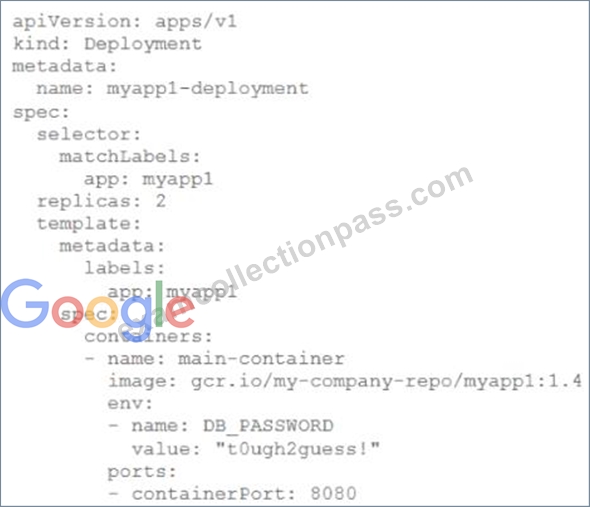
You need to refactor this configuration so that the database password is not stored in plain text. You want to follow Google-recommended practices. What should you do?
- A. Store the database password inside the Docker image of the container, not in the YAML file.
- B. Store the database password inside a Secret object. Modify the YAML file to populate the DB_PASSWORD environment variable from the Secret.
- C. Store the database password inside a ConfigMap object. Modify the YAML file to populate the DB_PASSWORD environment variable from the ConfigMap.
- D. Store the database password in a file inside a Kubernetes persistent volume, and use a persistent volume claim to mount the volume to the container.
Answer: C
NEW QUESTION # 165
You have a 20 GB file that you need to securely share with some contractors. They need it as fast as possible. Which steps would get them the file quickly and securely?
- A. Upload the file to Cloud Storage. Grant the allAuthenticated users token view permissions.
- B. Using composite objects and parallel uploads to upload the file to Cloud Storage quickly. Then generate a signed URL and securely share it with the contractors.
- C. Upload the file to Bigtable using the bulk data import tool. Then provide the contractors with read access to the database.
- D. Set up a VPC with a custom subnet. Create a subnet tunnel. Upload the file to a network share. Grant the contractors temporary access.
Answer: B
NEW QUESTION # 166
You deployed an LDAP server on Compute Engine that is reachable via TLS through port 636 using UDP.
You want to make sure it is reachable by clients over that port. What should you do?
- A. Add the network tag allow-udp-636 to the VM instance running the LDAP server.
- B. Add a network tag of your choice to the instance running the LDAP server. Create a firewall rule to allow egress on UDP port 636 for that network tag.
- C. Add a network tag of your choice to the instance. Create a firewall rule to allow ingress on UDP port
636 for that network tag. - D. Create a route called allow-udp-636 and set the next hop to be the VM instance running the LDAP server.
Answer: C
NEW QUESTION # 167
The DevOps group in your organization needs full control of Compute Engine resources in your development project. However, they should not have permission to create or update any other resources in the project. You want to follow Google's recommendations for setting permissions for the DevOps group. What should you do?
- A. Create an 1AM policy and grant all compute. instanceAdmln." permissions to the policy Attach the policy to the DevOps group.
- B. Grant the basic role roles/editor to the DevOps group.
- C. Create a custom role at the folder level and grant all compute. instanceAdmln. * permissions to the role Grant the custom role to the DevOps group.
- D. Grant the basic role roles/viewer and the predefined role roles/compute.admin to the DevOps group.
Answer: D
NEW QUESTION # 168
A company is migrating its data center to AWS. As part of this migration, there is a three-tier web application that has strict data-at-rest encryption requirements. The customer deploys this application on Amazon EC2 using Amazon EBS, and now must provide encryption at-rest.
How can this requirement be met without changing the application?
- A. Use encrypted EBS storage volumes with AWS-managed keys.
- B. Use third-party tools to encrypt the EBS data volumes with Key Management Service Bring Your Own Keys.
- C. Use an application-specific encryption API with AWS server-side encryption.
- D. Use AWS Key Management Service and move the encrypted data to Amazon S3.
Answer: A
NEW QUESTION # 169
You want to configure 10 Compute Engine instances for availability when maintenance occurs. Your requirements state that these instances should attempt to automatically restart if they crash. Also, the instances should be highly available including during system maintenance. What should you do?
- A. Create an instance template for the instances. Set the 'Automatic Restart' to on. Set the 'On-host maintenance' to Migrate VM instance. Add the instance template to an instance group.
- B. Create an instance group for the instances. Set the 'Autohealing' health check to healthy (HTTP).
- C. Create an instance template for the instances. Set 'Automatic Restart' to off. Set 'On-host maintenance' to Terminate VM instances. Add the instance template to an instance group.
- D. Create an instance group for the instance. Verify that the 'Advanced creation options' setting for 'do not retry machine creation' is set to off.
Answer: A
Explanation:
Create an instance template for the instances so VMs have same specs. Set the "~Automatic Restart' to on to VM automatically restarts upon crash. Set the "~On-host maintenance' to Migrate VM instance. This will take care of VM during maintenance window. It will migrate VM instance making it highly available Add the instance template to an instance group so instances can be managed.
* onHostMaintenance: Determines the behavior when a maintenance event occurs that might cause your instance to reboot.
* [Default] MIGRATE, which causes Compute Engine to live migrate an instance when there is a maintenance event.
* TERMINATE, which stops an instance instead of migrating it.
* automaticRestart: Determines the behavior when an instance crashes or is stopped by the system.
* [Default] true, so Compute Engine restarts an instance if the instance crashes or is stopped.
* false, so Compute Engine does not restart an instance if the instance crashes or is stopped.
Enabling automatic restart ensures that compute engine instances are automatically restarted when they crash.
And Enabling Migrate VM Instance enables live migrates i.e. compute instances are migrated during system maintenance and remain running during the migration.
Automatic Restart If your instance is set to terminate when there is a maintenance event, or if your instance crashes because of an underlying hardware issue, you can set up Compute Engine to automatically restart the instance by setting the automaticRestart field to true. This setting does not apply if the instance is taken offline through a user action, such as calling sudo shutdown, or during a zone outage.Ref: https://cloud.google.com/compute/docs/instances/setting-instance-scheduling-options#autorestart Enabling the Migrate VM Instance option migrates your instance away from an infrastructure maintenance event, and your instance remains running during the migration.Your instance might experience a short period of decreased performance, although generally, most instances should not notice any difference. This is ideal for instances that require constant uptime and can tolerate a short period of decreased performance.Ref: https://cloud.google.com/compute/docs/instances/setting-instance-scheduling-options#live_mi
NEW QUESTION # 170
......
Google Associate-Cloud-Engineer Certification Exam focuses on testing the proficiency and ability of candidates to operate and manage Google Cloud Platform services. Associate-Cloud-Engineer exam is designed to validate the knowledge and skills required to deploy, monitor, and maintain applications on Google Cloud Platform.
Google Associate-Cloud-Engineer certification exam is one of the most popular cloud certification exams in the market today. This is because GCP is quickly becoming one of the most widely used cloud platforms, and there is a growing demand for cloud engineers who are skilled in deploying and managing GCP projects. Individuals who earn this certification can expect to have an advantage in the job market and may be able to command higher salaries.
New Associate-Cloud-Engineer exam dumps Use Updated Google Exam: https://www.examcollectionpass.com/Google/Associate-Cloud-Engineer-practice-exam-dumps.html
Verified Associate-Cloud-Engineer Dumps Q&As - Associate-Cloud-Engineer Test Engine with Correct Answers: https://drive.google.com/open?id=1rRdre36pWwY_2inK9WuTUg5CkDlL2N2C