

[Dec 16, 2025] Valid AACE-PSP Test Answers & AACE-PSP Exam PDF
Valid AACE Certification AACE-PSP Dumps Ensure Your Passing
Earning the AACE-PSP certification demonstrates a professional's commitment to their career and their ability to perform at a high level in their field. Planning & Scheduling Professional (PSP) Exam certification allows professionals to showcase their expertise and enhances their credibility with employers, clients, and colleagues. The AACE-PSP certification also provides opportunities for career advancement, higher salaries, and increased job security.
AACE International AACE-PSP (Planning & Scheduling Professional) Certification Exam is a rigorous examination designed to test the knowledge and competency of professionals in the field of project planning and scheduling. AACE International is a renowned professional association for project management professionals, and their PSP certification program is recognized globally as a mark of excellence in the planning and scheduling profession.
NEW QUESTION # 100
The addition of which of the following relationships would cause a logic loop?
- A. O F-I
- B. O C - J
- C. O H - D
- D. O l-C
Answer: D
NEW QUESTION # 101
Of the following update procedures, which is the least important in achieving an accurate forecast for completion of a construction schedule?
- A. Entering the time impacts of delays and change orders.
- B. Making "downstream" logic revisions as required.
- C. Estimating remaining durations of activities.
- D. The correct recording of actual start dates.
Answer: B
Explanation:
* Schedule Update Procedures:
Accurate schedule updates rely on entering actual data (start/finish dates, durations) and evaluating impacts of changes.
"Downstream" logic revisions may be needed but are less critical compared to ensuring accurate historical data and reflecting immediate changes.
* PSP Study Guide Reference:
Schedule updating emphasizes capturing accurate historical data and estimating remaining durations accurately.
* Analysis of Options:
Option A and B: Key to progress tracking and forecasting.
Option D: Essential for reflecting impacts of delays and change orders.
Option C: While important, downstream logic revisions are less immediate compared to other procedures.
* Conclusion: The correct answer is C, as downstream logic revisions are less critical in achieving an accurate schedule forecast compared to other updates
NEW QUESTION # 102
If the administrative constraints for developing the precedence diagram, as provided in the contract documents, indicate that no individual construction activities shall have a longer duration of two months, how many activities in the "normal" schedule would be affected?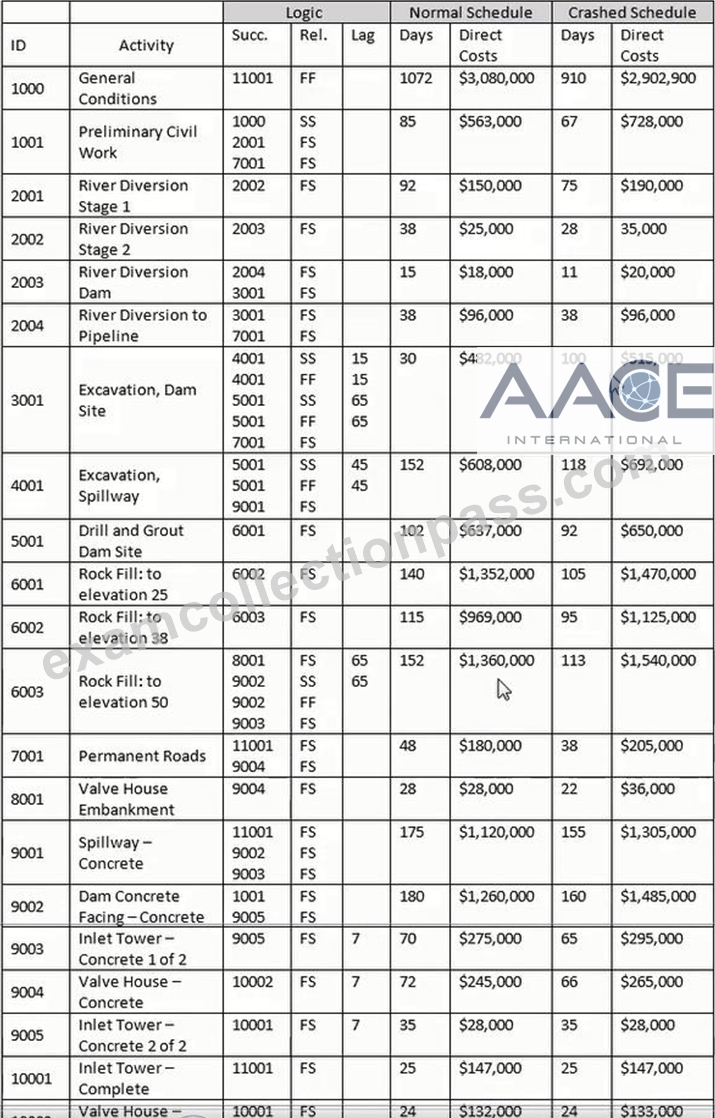
- A. 14.
- B. 12.
- C. 13.
- D. Cannot be determined.
Answer: B
Explanation:
To determine how many activities in the "normal" schedule would be affected by the constraint of no activity exceeding a two-month duration (approximately 60 days):
Review the "Normal Schedule Days" Column:
Look for activities with a duration greater than 60 days in the "Normal Schedule Days" column of the table provided in the image.
Count the Affected Activities:
Count all activities where the "Normal Schedule Days" value exceeds 60.
Activities with durations greater than 60 days:
Activity ID 1000: 1072 days
Activity ID 1001: 85 days
Activity ID 2001: 92 days
Activity ID 3001: 152 days
Activity ID 4001: 152 days
Activity ID 5001: 102 days
Activity ID 6001: 140 days
Activity ID 6002: 115 days
Activity ID 6003: 152 days
Activity ID 9001: 175 days
Activity ID 9002: 180 days
Activity ID 9005: 72 days
Total Count:
There are 12 activities in the "normal" schedule exceeding the 60-day duration constraint.
Verified answer: A. 12.
Detailed Explanation with Reference: The constraint specifies that no activity should exceed a two-month (60-day) duration. By examining the "Normal Schedule Days" column, any activity with a duration greater than 60 days is non-compliant and therefore affected. The PSP study guide emphasizes reviewing contract requirements to ensure schedules adhere to such administrative constraints.
NEW QUESTION # 103
Assumptions made during the planning stage should be_____________.
- A. replaced with facts as soon as they are known
- B. solely based on a solid experiential database
- C. a risk that is shifted to the implemented in the field
- D. clearly stated as such in an internal memo
Answer: A
Explanation:
* Assumptions in Planning:
Assumptions are placeholders until verified facts are available. Replacing them enhances schedule reliability and accuracy.
* Evaluation of Other Options:
A: Shifting risks is not a proactive solution.
C: Sole reliance on experience without verification is risky.
D: Internal memos clarify assumptions but do not replace facts.
* Verification with PSP Guidelines:
PSP emphasizes validating assumptions during the planning phase (Ref: PSP Study Guide, Chapter 1B: Planning Fundamentals).
NEW QUESTION # 104
Using the "normal" schedule, if you start Activity 7001 on April 1, 2002, and using a 5-day workweek, what the finish date for Activity 7001?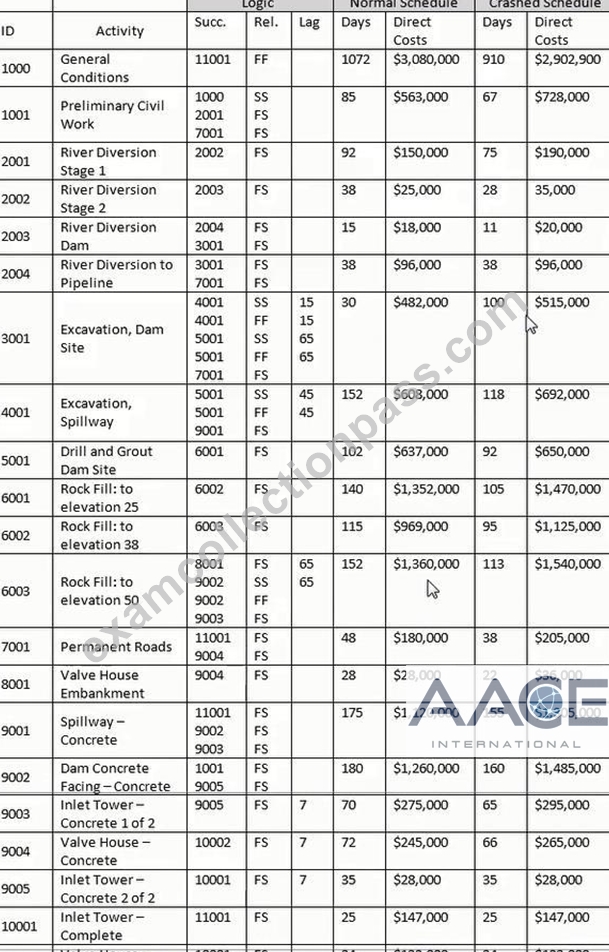
- A. 06-18-02.
- B. 06-11-02.
- C. 06-05-02.
- D. 06-04-02.
Answer: C
NEW QUESTION # 105
In the "normal" schedule, excluding Activity 1000, what activity(s) are concurrent with Activity 3001?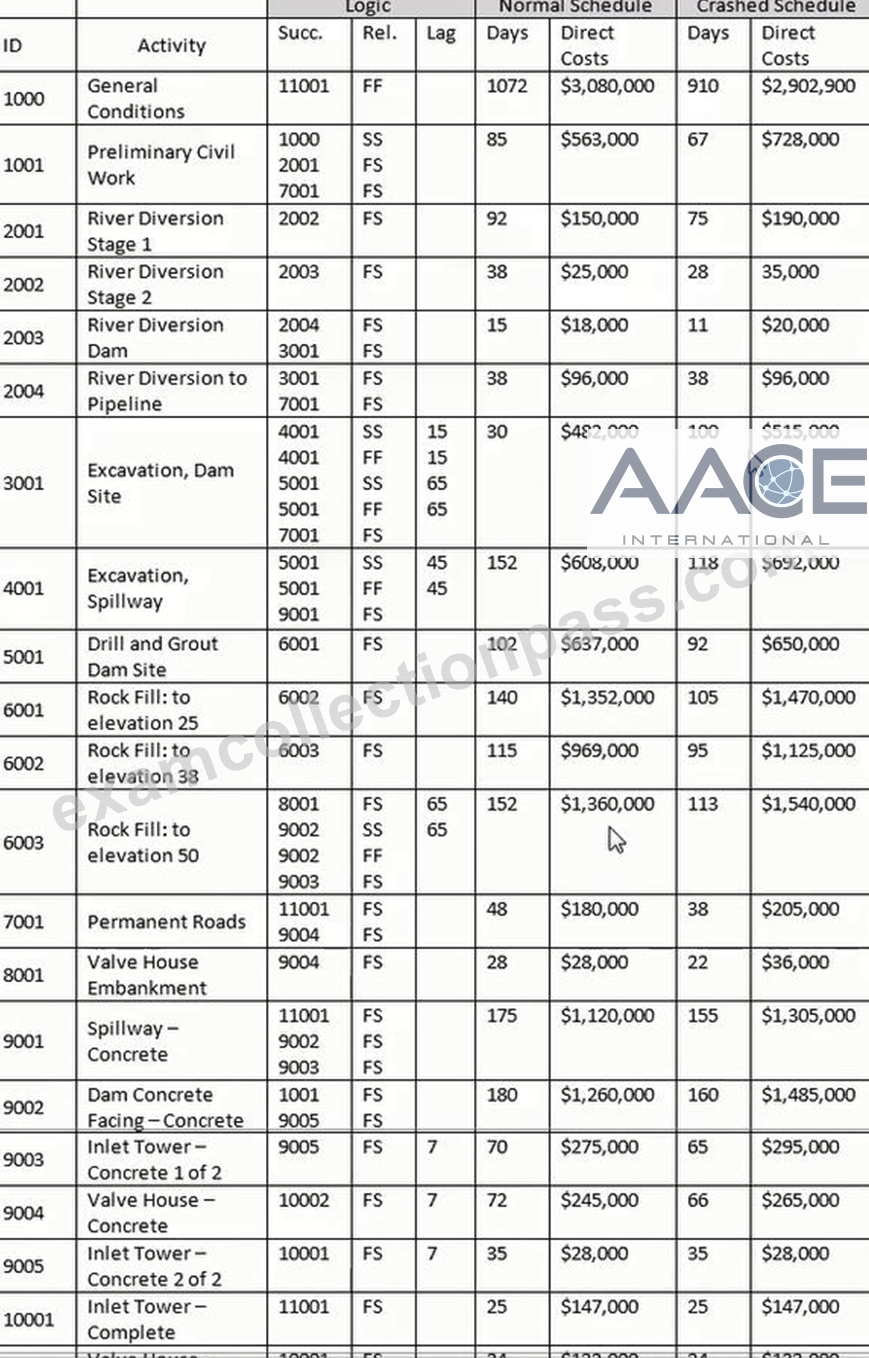
- A. 4001 and 5001.
- B. 4001, 5001 and 6001.
- C. 2003 and 7001.
- D. 2004.
Answer: A
NEW QUESTION # 106
The BEST reason to use multiple calendars is to:
- A. evaluate float for the benefit of the contractor
- B. track owner activities according to their specific calendar in order to develop a good working relationship
- C. allow each specialty contractor to have a unique schedule of work/non-work periods
- D. more accurately show how the project will be built
Answer: D
Explanation:
* Purpose of Multiple Calendars:
Multiple calendars account for varied work/non-work periods among resources, regions, or activities, accurately representing project execution.
* Evaluation of Other Options:
B, C, D: These may be secondary benefits but are not the primary reason.
* Verification with PSP Guidelines:
The PSP Study Guide emphasizes the importance of calendars for realistic scheduling (Ref: PSP Study Guide, Chapter 2A: Calendars and Constraints).
NEW QUESTION # 107
If a detailed estimate is NOT available to assist in the formulation of activity durations but unit quantities have been identified, what information can be utilized to estimate work package/activity durations?
- A. Time impact analysis
- B. The Eichleay formula
- C. Historical production rates
- D. Black-Scholes model
Answer: C
Explanation:
When detailed estimates are unavailable, historical production rates can provide reliable data for estimating durations based on past projects with similar work.
Option A (Eichleay formula) is for overhead cost allocation.
Option C (Time impact analysis) evaluates delay impacts, not durations.
Option D (Black-Scholes model) is irrelevant in this context.
Historical data usage is a recognized method in project planning and scheduling practices.
NEW QUESTION # 108
By subtracting a measured unit productivity rate during an impacted period from the unit productivity rate during an unimpacted period, the resulting value represents:
- A. Productivity loss.
- B. Production output.
- C. Acceleration.
- D. Productivity efficiency.
Answer: A
Explanation:
* Calculation of Productivity Loss:
Subtracting productivity during an impacted period from unimpacted productivity quantifies the reduction in efficiency or loss in productivity.
* PSP Study Guide Reference:
Productivity analysis includes evaluating impacted vs. unimpacted periods to assess losses.
* Conclusion: The correct answer is C, as the difference represents productivity loss.
NEW QUESTION # 109
Prior to the beginning work on Activity 6001, the scope is changed by executed change order to increase the activity duration by thirty days and rock fill by 100.000 cubic meters If the project has progressed as scheduled up to the point of the executed change order, what activities would be changed on the next project update?
- A. 9001 and 6002 and 6002
- B. 1000 and 6001
- C. 1000. 1001. and 6001
- D. 1001 and 6001
Answer: A
NEW QUESTION # 110
What activities are concurrent to Activity 2001 in the "normal" schedule?
- A. 2003.
- B. 1001.
- C. 1000.
- D. 7001.
Answer: D
NEW QUESTION # 111
You are retained by a contractor who asks you to perform a simple as-planned versus as-built analysis (APAB) of a large hydro-electric dam project that took more than five years to complete. Your analysis will form the basis of a change order that requests a time extension. You suggest using a different methodology for quantifying the delay. Which of the following reasons for recommending a different analysis does NOT apply to a simple APAB analysis?
- A. Not suitable for complicated projects with multiple planned critical paths.
- B. Accuracy is increased by inserting delaying events into the as-planned schedule.
- C. Not suitable for projects with long durations.
- D. Less accurate as the analysis advances through the project.
Answer: B
Explanation:
* As-Planned vs. As-Built (APAB) Analysis:
A simple APAB compares the planned schedule to the actual schedule to identify deviations.
It does not involve inserting delaying events or re-forecasting the schedule, which makes it unsuitable for detailed analysis.
* Limitations of APAB:
Unsuitable for complex projects (A).
Inserting delays is not part of APAB (B).
Accuracy diminishes for long projects (C) or those requiring granular mid-project analyses (D).
* Conclusion: The correct answer is B, as inserting delays into the as-planned schedule is not a feature of simple APAB analysis.
NEW QUESTION # 112
Using the "normal" schedule, and assuming you are billing on the last day of the month for previous month and for appropriate partial months, how many invoices will you have for this project?
- A. 42.
- B. 37.
- C. 40.
- D. 36.
Answer: A
Explanation:
* Understanding the Requirement:
The "normal" schedule duration is 1072 days for Activity 1000 (General Conditions).
Billing occurs at the end of each month for the previous month.
Partial months are included in billing cycles.
* Total Project Duration in Months:
Total days: 1072.
Convert to months: 107230.44≈35.2\frac{1072}{30.44} \approx 35.230.441072≈35.2 months.
Include partial months, which adds 1 additional invoice.
* Total Invoices:
Full months: 35.
Partial months: 7 (assuming each partial month is rounded up to include invoicing).
Total invoices = 35+7=4235 + 7 = 4235+7=42.
* PSP Principles Cross-Verification:
PSP guidelines emphasize accurate conversion of schedule durations into calendar billing periods for effective cash flow management (Ref: PSP Study Guide, Chapter 2B: Schedule Output and Deliverables).
NEW QUESTION # 113
Determine the correct formula and date for the late finish for Activity 9004.
- A. LS of 10002 less lag of 7 days plus 1 day equaling 20 Nov 2023
- B. LF of 10002 less 24 days
- C. LF of 8001 plus 72 days
- D. LS of 9004 plus 72 days
Answer: D
Explanation:
* The Late Finish (LF) for an activity in CPM is determined by adding the activity's duration to its Late Start (LS).
* For Activity 9004, if its Late Start is known, adding the activity's 72-day duration gives the Late Finish date.
* Reference: PSP Study Guide, Section 2.2.4 - Relationships and Calculations, highlights the importance of forward and backward pass calculations to determine ES, EF, LS, and LF.
NEW QUESTION # 114
Activity 2003 started during the current reporting period and proceeded as planned with the normal schedule. If the remaining duration at the end of this period is ten workdays, then what is the earned value assignable to Activity 2003 in the pay estimate for this reporting period?
- A. $6,000
- B. $8,000
- C. $10.000
- D. $5,000
Answer: C
NEW QUESTION # 115
For activity 11001. why would the crashed direct cost be greater than the direct cost of the normal schedule?
- A. Generally, more equipment is used for a crashed project; therefore, it costs more to demobilize
- B. Management bonuses for early completion were included in this activity
- C. Additional extended overhead is also being shown in this activity
- D. Some costs resulting from the crashed efforts were forgotten in previous activities
Answer: C
Explanation:
Crashing increases direct costs as additional resources, equipment, or expedited delivery methods are employed to shorten the project duration. The PSP Study Guide (Section 2.3.5, "Acceleration") highlights that crashing involves trade-offs between time and cost, often resulting in higher demobilization costs due to the increased deployment of equipment and resources.
NEW QUESTION # 116
......
To be eligible for the AACE-PSP certification, candidates must have a minimum of four years of professional experience in planning and scheduling. They must also have a bachelor's degree or higher in engineering, construction management, business administration, or a related field. Alternatively, candidates with eight years of professional experience in planning and scheduling can also apply for the certification without a bachelor's degree.
AACE-PSP Dumps Real Exam Questions Test Engine Dumps Training: https://www.examcollectionpass.com/AACE-International/AACE-PSP-practice-exam-dumps.html
AACE-PSP exam dumps and online Test Engine: https://drive.google.com/open?id=1Q7efbDifWa40-FKUWmjfpOSOTZZH3N2e