

Certification Topics of DP-300 Exam PDF Recently Updated Questions
DP-300 Exam Prep Guide: Prep guide for the DP-300 Exam
Exam Topics
The Microsoft DP-300 exam measures the capability of the candidates to complete certain technical tasks, such as querying performance, planning and implementing the High Availability & Disaster Recovery environment, and optimizing & monitoring operational resources. The highlights of these topics are as follows:
- HADR Planning and Implementation: 15-20%
This domain requires that the candidates have the ability to recommend High Availability & Disaster Recovery (HADR) strategies for data platform solutions. It also covers the skills in testing HADR strategies with the use of database tools, platforms, and operating systems. The subject area will also evaluate one’s expertise in performing the backup and restoration of a database with the use of database tools. It will also measure the ability to configure High Availability & Disaster Recovery with the use of platform, database tools, and OS.
- Tasks Automation Performance: 10-15%
The examinees should have the capacity to develop scheduled tasks, measure and execute notification and alert strategies, and automate and manage tasks within Azure. This part will test their skills in managing schedules for different maintenance jobs, automating backups, and creating alerts for the server configuration changes.
- Query Performance Optimization: 5-10%
This knowledge area of the exam will test the ability of the students to evaluate performance optimization, evaluate query plans, and review index design and database table. This covers their competence in identifying issues with data quality based on duplication of data; evaluating a strategy for table partitioning; evaluating index design for optimal performance.
- Operational Resources Optimization and Monitoring: 15-20%
The test takers need the relevant skills in managing performance and activity, identifying issues related to performance, and implementing maintenance tasks that are related to performance. This section of the exam also requires that they demonstrate their expertise in configuring resources and user databases for optimum performance.
- Use of T-SQL in Administration Performance: 10-15%
Within this module, the individuals should be able to evaluate system health and use T-SQL to monitor the configuration of database. It will evaluate their skills in performing backup and database restoration with the use of T-SQL, as well as managing authentication and authorization utilizing T-SQL.
The DP-300 certification exam covers a wide range of topics related to database administration, including designing and implementing database solutions on Azure, managing and monitoring databases, ensuring database security, and performing backups and restores. It also covers advanced topics such as designing for high availability and disaster recovery, implementing Azure SQL Database features, and managing Azure Synapse Analytics.
NEW QUESTION # 135
You have a SQL Server on Azure Virtual Machines instance named VM1 that hosts a database named DB1. You run the following query.
For each of the following statements, select Yes if the statement is true. Otherwise, select No.
Answer:
Explanation:
NEW QUESTION # 136
You have an Azure SQL database named DB 1 in the General Purpose service tier.
You need to monitor DB 1 by using SQL Insights.
What should you include in the solution? To answer, select the appropriate options in the answer area.
NOTE: Each correct selection is worth one point.
Answer:
Explanation:
Explanation
Box 1 = Azure Monitor Agent
Box 2 = An Azure SQL database
https://docs.microsoft.com/en-us/azure/azure-sql/database/sql-database-paas-overview?view=azuresql
NEW QUESTION # 137
You have an on-premises Microsoft SQL Server 2016 server named Server1 that contains a database named DB1.
You need to perform an online migration of DB1 to an Azure SQL Database managed instance by using Azure Database Migration Service.
How should you configure the backup of DB1? To answer, select the appropriate options in the answer area.
NOTE: Each correct selection is worth one point.
Answer:
Explanation:
Reference:
https://docs.microsoft.com/en-us/azure/dms/known-issues-azure-sql-db-managed-instance-online
NEW QUESTION # 138
You have an Azure Data Factory instance named ADF1 and two Azure Synapse Analytics workspaces named WS1 and WS2.
ADF1 contains the following pipelines:
P1:Uses a copy activity to copy data from a nonpartitioned table in a dedicated SQL pool of WS1 to an Azure Data Lake Storage Gen2 account P2:Uses a copy activity to copy data from text-delimited files in an Azure Data Lake Storage Gen2 account to a nonpartitioned table in a dedicated SQL pool of WS2 You need to configure P1 and P2 to maximize parallelism and performance.
Which dataset settings should you configure for the copy activity of each pipeline? To answer, select the appropriate options in the answer area.
Answer:
Explanation:
Explanation
Graphical user interface, text, chat or text message Description automatically generated
P1: Set the Partition option to Dynamic Range.
The SQL Server connector in copy activity provides built-in data partitioning to copy data in parallel.
P2: Set the Copy method to PolyBase
Polybase is the most efficient way to move data into Azure Synapse Analytics. Use the staging blob feature to achieve high load speeds from all types of data stores, including Azure Blob storage and Data Lake Store.
(Polybase supports Azure Blob storage and Azure Data Lake Store by default.) Reference:
https://docs.microsoft.com/en-us/azure/data-factory/connector-azure-sql-data-warehouse
https://docs.microsoft.com/en-us/azure/data-factory/load-azure-sql-data-warehouse
NEW QUESTION # 139
DRAG DROP
You have an Azure SQL database that contains a table named Employees. Employees contains a column
named Salary.
You need to encrypt the Salary column. The solution must prevent database administrators from reading the
data in the Salary column and must provide the most secure encryption.
Which three actions should you perform in sequence? To answer, move the appropriate actions from the list of
actions to the answer area and arrange them in the correct order.
Select and Place:
Answer:
Explanation:
Section: [none]
Explanation:
Step 1: Create a column master key
Create a column master key metadata entry before you create a column encryption key metadata entry in the
database and before any column in the database can be encrypted using Always Encrypted.
Step 2: Create a column encryption key.
Step 3: Encrypt the Salary column by using the randomized encryption type.
Randomized encryption uses a method that encrypts data in a less predictable manner. Randomized encryption
is more secure, but prevents searching, grouping, indexing, and joining on encrypted columns.
Note: A column encryption key metadata object contains one or two encrypted values of a column encryption
key that is used to encrypt data in a column. Each value is encrypted using a column master key.
Incorrect Answers:
Deterministic encryption.
Deterministic encryption always generates the same encrypted value for any given plain text value. Using
deterministic encryption allows point lookups, equality joins, grouping and indexing on encrypted columns.
However, it may also allow unauthorized users to guess information about encrypted values by examining
patterns in the encrypted column, especially if there's a small set of possible encrypted values, such as True/
False, or North/South/East/West region.
Reference:
https://docs.microsoft.com/en-us/sql/relational-databases/security/encryption/always-encrypted-database-
engine
NEW QUESTION # 140
You have an Azure SQL database.
You have a query and the associated execution plan as shown in the following exhibit.
Use the drop-down menus to select the answer choice that completes each statement based on the information presented in the graphic.
NOTE: Each correct selection is worth one point.
Answer:
Explanation:
NEW QUESTION # 141
You have an Azure SQL database.
You need to identify whether a delayed query execution is associated to a RESOURCE wait.
How should you complete the Transact -SQL statement? To answer, select the appropriate option in the answer area.
NOTE: Each correct selection is worth one point.
Answer:
Explanation:
Explanation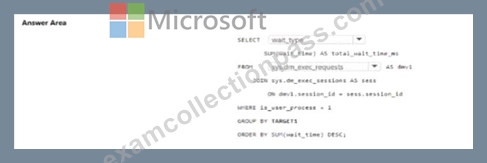
NEW QUESTION # 142
You configure backup for an Azure SQL database as shown in the following exhibit.
Use the drop-down menus to select the answer choice the completes each statement based on the information presented in the graphic.
NOTE: Each correct selection is worth one point.
Answer:
Explanation:
Explanation
NEW QUESTION # 143
HOTSPOT
You have SQL Server on an Azure virtual machine.
You review the query plan shown in the following exhibit.
For each of the following statements, select yes if the statement is true. Otherwise, select no.
NOTE: Each correct selection is worth one point.
Hot Area:
Answer:
Explanation:
Section: [none]
Explanation/Reference:
https://docs.microsoft.com/en-us/sql/relational-databases/performance/monitoring-performance-by-using-the- query-store
NEW QUESTION # 144
You plan to create a table in an Azure Synapse Analytics dedicated SQL pool.
Data in the table will be retained for five years. Once a year, data that is older than five years will be deleted.
You need to ensure that the data is distributed evenly across partitions. The solutions must minimize the amount of time required to delete old data.
How should you complete the Transact-SQL statement? To answer, drag the appropriate values to the correct targets. Each value may be used once, more than once, or not at all.
You may need to drag the split bar between panes or scroll to view content.
NOTE: Each correct selection is worth one point.
Answer:
Explanation:
Reference:
https://docs.microsoft.com/en-us/sql/t-sql/statements/create-table-azure-sql-data-warehouse
https://docs.microsoft.com/en-us/azure/synapse-analytics/sql/best-practices-dedicated-sql-pool
NEW QUESTION # 145
You have an Azure SQL managed instance.
You need to restore a database named DB1 by using Transact-SQL.
Which command should you run? To answer, select the appropriate options in the answer area.
NOTE: Each correct selection is worth one point.
Answer:
Explanation:
NEW QUESTION # 146
You have an instance of SQL Server on Azure Virtual Machines named SQL1.
SQL1 contains an Extended Events session named session! that captures Microsoft SQL Server events.
You need to correlate the session events with events captured by Event Tracing for Windows (ETW).
What should you do for session1?
- A. Modify the Set Session Event Filters settings.
- B. Modify the Specify Session Data Storage settings.
- C. Add a target.
- D. Add an action.
Answer: C
NEW QUESTION # 147
You plan to create a table in an Azure Synapse Analytics dedicated SQL pool.
Data in the table will be retained for five years. Once a year, data that is older than five years will be deleted.
You need to ensure that the data is distributed evenly across partitions. The solutions must minimize the amount of time required to delete old data.
How should you complete the Transact-SQL statement? To answer, drag the appropriate values to the correct targets. Each value may be used once, more than once, or not at all.
You may need to drag the split bar between panes or scroll to view content.
NOTE: Each correct selection is worth one point.
Answer:
Explanation:
Explanation
Graphical user interface, text, application Description automatically generated
Box 1: HASH
Box 2: OrderDateKey
In most cases, table partitions are created on a date column.
A way to eliminate rollbacks is to use Metadata Only operations like partition switching for data management.
For example, rather than execute a DELETE statement to delete all rows in a table where the order_date was in October of 2001, you could partition your data early. Then you can switch out the partition with data for an empty partition from another table.
Reference:
https://docs.microsoft.com/en-us/sql/t-sql/statements/create-table-azure-sql-data-warehouse
https://docs.microsoft.com/en-us/azure/synapse-analytics/sql/best-practices-dedicated-sql-pool
NEW QUESTION # 148
What should you do after a failover of SalesSQLDb1 to ensure that the database remains accessible to SalesSQLDb1App1?
- A. Update the firewall rules of SalesSQLDb1.
- B. Configure SalesSQLDb1 as writable.
- C. Update the users in SalesSQLDb1.
- D. Update the connection strings of SalesSQLDb1App1.
Answer: A
Explanation:
Scenario: SalesSQLDb1 uses database firewall rules and contained database users.
Plan and Implement a High Availability and Disaster Recovery (HADR) Environment Question Set 2
NEW QUESTION # 149
Note: This question is part of a series of questions that present the same scenario. Each question in the series contains a unique solution that might meet the stated goals. Some question sets might have more than one correct solution, while others might not have a correct solution.
After you answer a question in this section, you will NOT be able to return to it. As a result, these questions will not appear in the review screen.
You have an Azure Synapse Analytics dedicated SQL pool that contains a table named Table1.
You have files that are ingested and loaded into an Azure Data Lake Storage Gen2 container named container1.
You plan to insert data from the files into Table1 and transform the data. Each row of data in the files will produce one row in the serving layer of Table1.
You need to ensure that when the source data files are loaded to container1, the DateTime is stored as an additional column in Table1.
Solution: You use an Azure Synapse Analytics serverless SQL pool to create an external table that has an additional DateTime column.
Does this meet the goal?
- A. No
- B. Yes
Answer: B
Explanation:
Section: [none]
Explanation:
In dedicated SQL pools you can only use Parquet native external tables. Native external tables are generally available in serverless SQL pools.
Reference:
https://docs.microsoft.com/en-us/azure/synapse-analytics/sql/create-use-external-tables
NEW QUESTION # 150
......
Microsoft DP-300 is a certification exam designed for database administrators who want to demonstrate their expertise in administering relational databases on Microsoft Azure. DP-300 exam focuses on various aspects such as deploying and configuring infrastructure, designing databases, monitoring and optimizing databases, and securing databases. It is aimed at professionals who are responsible for managing and maintaining database solutions on the Azure platform.
2024 New Preparation Guide of Microsoft DP-300 Exam: https://www.examcollectionpass.com/Microsoft/DP-300-practice-exam-dumps.html
DP-300 Practice Exam - 284 Unique Questions: https://drive.google.com/open?id=12gya3yGddj6nddDay7fbztn6eTUi3e5G