

2026 New ARA-C01 Dumps - Real Snowflake Exam Questions
Dependable ARA-C01 Exam Dumps to Become Snowflake Certified
Snowflake ARA-C01 Exam is a timed, multiple-choice exam that contains 75 questions. Candidates have 120 minutes to complete the exam, and they must score at least 70% to pass. ARA-C01 exam is available in English, Japanese, and Spanish, and can be taken online from anywhere in the world. Successful candidates will receive a digital badge and certificate, which they can use to showcase their expertise in Snowflake architecture.
NEW QUESTION # 88
There are two databases in an account, named fin_db and hr_db which contain payroll and employee data, respectively. Accountants and Analysts in the company require different permissions on the objects in these databases to perform their jobs. Accountants need read-write access to fin_db but only require read-only access to hr_db because the database is maintained by human resources personnel.
An Architect needs to create a read-only role for certain employees working in the human resources department.
Which permission sets must be granted to this role?
- A. USAGE on database hr_db, SELECT on all schemas in database hr_db, SELECT on all tables in database hr_db
- B. MODIFY on database hr_db, USAGE on all schemas in database hr_db, USAGE on all tables in database hr_db
- C. USAGE on database hr_db, USAGE on all schemas in database hr_db, REFERENCES on all tables in database hr_db
- D. USAGE on database hr_db, USAGE on all schemas in database hr_db, SELECT on all tables in database hr_db
Answer: D
Explanation:
To create a read-only role for certain employees working in the human resources department, the role needs to have the following permissions on the hr_db database:
USAGE on the database: This allows the role to access the database and see its schemas and objects.
USAGE on all schemas in the database: This allows the role to access the schemas and see their objects.
SELECT on all tables in the database: This allows the role to query the data in the tables.
Option A is the correct answer because it grants the minimum permissions required for a read-only role on the hr_db database.
Option B is incorrect because SELECT on schemas is not a valid permission. Schemas only support USAGE and CREATE permissions.
Option C is incorrect because MODIFY on the database is not a valid permission. Databases only support USAGE, CREATE, MONITOR, and OWNERSHIP permissions. Moreover, USAGE on tables is not sufficient for querying the data. Tables support SELECT, INSERT, UPDATE, DELETE, TRUNCATE, REFERENCES, and OWNERSHIP permissions.
Option D is incorrect because REFERENCES on tables is not relevant for querying the data. REFERENCES permission allows the role to create foreign key constraints on the tables.
https://docs.snowflake.com/en/user-guide/security-access-control-privileges.html#database-privileges
https://docs.snowflake.com/en/user-guide/security-access-control-privileges.html#schema-privileges
https://docs.snowflake.com/en/user-guide/security-access-control-privileges.html#table-privileges
NEW QUESTION # 89
A company is using a Snowflake account in Azure. The account has SAML SSO set up using ADFS as a SCIM identity provider. To validate Private Link connectivity, an Architect performed the following steps:
* Confirmed Private Link URLs are working by logging in with a username/password account
* Verified DNS resolution by running nslookups against Private Link URLs
* Validated connectivity using SnowCD
* Disabled public access using a network policy set to use the company's IP address range However, the following error message is received when using SSO to log into the company account:
IP XX.XXX.XX.XX is not allowed to access snowflake. Contact your local security administrator.
What steps should the Architect take to resolve this error and ensure that the account is accessed using only Private Link? (Choose two.)
- A. Add the IP address in the error message to the allowed list in the network policy.
- B. Alter the Azure security integration to use the Private Link URLs.
- C. Update the configuration of the Azure AD SSO to use the Private Link URLs.
- D. Open a case with Snowflake Support to authorize the Private Link URLs' access to the account.
- E. Generate a new SCIM access token using system$generate_scim_access_token and save it to Azure AD.
Answer: A,C
Explanation:
Explanation
The error message indicates that the IP address in the error message is not allowed to access Snowflake because it is not in the allowed list of the network policy. The network policy is a feature that allows restricting access to Snowflake based on IP addresses or ranges. To resolve this error, the Architect should take the following steps:
* Add the IP address in the error message to the allowed list in the network policy. This will allow the IP address to access Snowflake using the Private Link URLs. Alternatively, the Architect can disable the network policy if it is not required for security reasons.
* Update the configuration of the Azure AD SSO to use the Private Link URLs. This will ensure that the SSO authentication process uses the Private Link URLs instead of the public URLs. The configuration can be updated by following the steps in the Azure documentation1.
These two steps should resolve the error and ensure that the account is accessed using only Private Link. The other options are not necessary or relevant for this scenario. Altering the Azure security integration to use the Private Link URLs is not required because the security integration is used for SCIM provisioning, not for SSO authentication. Generating a new SCIM access token using system$generate_scim_access_token and saving it to Azure AD is not required because the SCIM access token is used for SCIM provisioning, not for SSO authentication. Opening a case with Snowflake Support to authorize the Private Link URLs' access to the account is not required because the authorization can be done by the account administrator using the SYSTEM$AUTHORIZE_PRIVATELINK function2.
NEW QUESTION # 90
How will you drop a cluster key?
- A. ALTER TABLE <name> DELETE CLUSTERING KEY
- B. ALTER TABLE <name> REMOVE CLUSTERING KEY
- C. ALTER TABLE <name> DROP CLUSTERING KEY
Answer: C
NEW QUESTION # 91
An Architect has chosen to separate their Snowflake Production and QA environments using two separate Snowflake accounts.
The QA account is intended to run and test changes on data and database objects before pushing those changes to the Production account. It is a requirement that all database objects and data in the QA account need to be an exact copy of the database objects, including privileges and data in the Production account on at least a nightly basis.
Which is the LEAST complex approach to use to populate the QA account with the Production account's data and database objects on a nightly basis?
- A. 1) Create a share in the Production account for each database
2) Share access to the QA account as a Consumer
3) The QA account creates a database directly from each share
4) Create clones of those databases on a nightly basis
5) Run tests directly on those cloned databases - B. 1) Enable replication for each database in the Production account
2) Create replica databases in the QA account
3) Create clones of the replica databases on a nightly basis
4) Run tests directly on those cloned databases - C. 1) In the Production account, create an external function that connects into the QA account and returns all the data for one specific table
2) Run the external function as part of a stored procedure that loops through each table in the Production account and populates each table in the QA account - D. 1) Create a stage in the Production account
2) Create a stage in the QA account that points to the same external object-storage location
3) Create a task that runs nightly to unload each table in the Production account into the stage
4) Use Snowpipe to populate the QA account
Answer: B
Explanation:
Explanation
* This approach is the least complex because it uses Snowflake's built-in replication feature to copy the data and database objects from the Production account to the QA account. Replication is a fast and efficient way to synchronize data across accounts, regions, and cloud platforms. It also preserves the privileges and metadata of the replicated objects. By creating clones of the replica databases, the QA account can run tests on the cloned data without affecting the original data. Clones are also zero-copy, meaning they do not consume any additional storage space unless the data is modified. This approach does not require any external stages, tasks, Snowpipe, or external functions, which can add complexity and overhead to the data transfer process.
References:
* Introduction to Replication and Failover
* Replicating Databases Across Multiple Accounts
* Cloning Considerations
NEW QUESTION # 92
You are creating a TASK to query a table streams created on the raw table and insert subsets of rows into multiple tables. You are following the below steps, but when you reached the step to resume the task, you received an error message as below.
Why is this error thrown and who can give you the required privilege?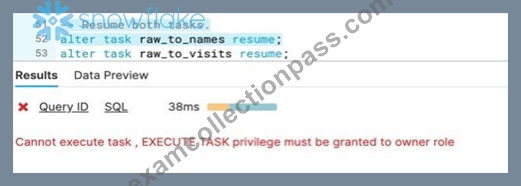
Steps to be followed to get this error
-- Create a landing table to store raw JSON data.
-- Snowpipe could load data into this table. create or replace table raw (var variant);
-- Create a stream to capture inserts to the landing table.
-- A task will consume a set of columns from this stream. create or replace stream rawstream1 on table raw;
-- Create a second stream to capture inserts to the landing table.
-- A second task will consume another set of columns from this stream. create or replace stream rawstream2 on table raw;
-- Create a table that stores the names of office visitors identified in the raw data. create or replace table names (id int, first_name string, last_name string);
-- Create a table that stores the visitation dates of office visitors identified in the raw data.
create or replace table visits (id int, dt date);
-- Create a task that inserts new name records from the rawstream1 stream into the names table
-- every minute when the stream contains records.
-- Replace the 'mywh' warehouse with a warehouse that your role has USAGE privilege on. create or replace task raw_to_names
warehouse = etl_wh
schedule = '1 minute'
when
system$stream_has_data('rawstream1')
as
merge into names n
using (select var:id id, var:fname fname, var:lname lname from rawstream1) r1 on n.id = to_number(r1.id)
when matched then update set n.first_name = r1.fname, n.last_name = r1.lname
when not matched then insert (id, first_name, last_name) values (r1.id, r1.fname, r1.lname)
;
-- Create another task that merges visitation records from the rawstream1 stream into the visits table
-- every minute when the stream contains records.
-- Records with new IDs are inserted into the visits table;
-- Records with IDs that exist in the visits table update the DT column in the table.
-- Replace the 'mywh' warehouse with a warehouse that your role has USAGE privilege on. create or replace task raw_to_visits
warehouse = etl_wh schedule = '1 minute' when
system$stream_has_data('rawstream2') as
merge into visits v
using (select var:id id, var:visit_dt visit_dt from rawstream2) r2 on v.id = to_number(r2.id) when matched then update set v.dt = r2.visit_dt
when not matched then insert (id, dt) values (r2.id, r2.visit_dt);
-- Resume both tasks.
alter task raw_to_names resume;
- A. The role used to resume the task does not have EXECUTE TASK privilege. Only TASK OWNER can provide that privilege to the role.
- B. The role used to resume the task does not have EXECUTE TASK privilege. Only ACCOUNTADMIN can provide that privilege to the role.
- C. The role used to resume the task does not have EXECUTE TASK privilege. Both SECURITYADMIN and ACCOUNTADMIN can provide that privilege to the role.
Answer: B
NEW QUESTION # 93
Create a task and a stream following the below steps. So, when the
system$stream_has_data('rawstream1') condition returns false, what will happen to the task ?
-- Create a landing table to store raw JSON data.
-- Snowpipe could load data into this table. create or replace table raw (var variant);
-- Create a stream to capture inserts to the landing table.
-- A task will consume a set of columns from this stream. create or replace stream rawstream1 on table raw;
-- Create a second stream to capture inserts to the landing table.
-- A second task will consume another set of columns from this stream. create or replace stream rawstream2 on table raw;
-- Create a table that stores the names of office visitors identified in the raw data. create or replace table names (id int, first_name string, last_name string);
-- Create a table that stores the visitation dates of office visitors identified in the raw data.
create or replace table visits (id int, dt date);
-- Create a task that inserts new name records from the rawstream1 stream into the names table
-- every minute when the stream contains records.
-- Replace the 'etl_wh' warehouse with a warehouse that your role has USAGE privilege on. create or replace task raw_to_names
warehouse = etl_wh schedule = '1 minute' when
system$stream_has_data('rawstream1') as
merge into names n
using (select var:id id, var:fname fname, var:lname lname from rawstream1) r1 on n.id = to_number(r1.id)
when matched then update set n.first_name = r1.fname, n.last_name = r1.lname
when not matched then insert (id, first_name, last_name) values (r1.id, r1.fname, r1.lname)
;
-- Create another task that merges visitation records from the rawstream1 stream into the visits table
-- every minute when the stream contains records.
-- Records with new IDs are inserted into the visits table;
-- Records with IDs that exist in the visits table update the DT column in the table.
-- Replace the 'etl_wh' warehouse with a warehouse that your role has USAGE privilege on. create or replace task raw_to_visits
warehouse = etl_wh schedule = '1 minute' when
system$stream_has_data('rawstream2') as
merge into visits v
using (select var:id id, var:visit_dt visit_dt from rawstream2) r2 on v.id = to_number(r2.id) when matched then update set v.dt = r2.visit_dt
when not matched then insert (id, dt) values (r2.id, r2.visit_dt)
;
-- Resume both tasks.
alter task raw_to_names resume;
alter task raw_to_visits resume;
-- Insert a set of records into the landing table. insert into raw
select parse_json(column1) from values
('{"id": "123","fname": "Jane","lname": "Smith","visit_dt": "2019-09-17"}'),
('{"id": "456","fname": "Peter","lname": "Williams","visit_dt": "2019-09-17"}');
-- Query the change data capture record in the table streams select * from rawstream1;
select * from rawstream2;
- A. Task will be executed but no rows will be merged
- B. Task will return an warning message
- C. Task will be skipped
Answer: C
NEW QUESTION # 94
Which SQL ALTER command will MAXIMIZE memory and compute resources for a Snowpark stored procedure when executed on the snowpark_opt_wh warehouse?
- A. ALTER WAREHOUSE snowpark_opt_wh SET MAX_CONCURRENCY_LEVEL = 8;
- B. ALTER WAREHOUSE snowpark_opt_wh SET MAX_CONCURRENCY_LEVEL = 2;
- C. ALTER WAREHOUSE snowpark_opt_wh SET MAX_CONCURRENCY_LEVEL = 16;
- D. ALTER WAREHOUSE snowpark_opt_wh SET MAX_CONCURRENCY_LEVEL = 1;
Answer: D
Explanation:
Snowpark workloads are often memory- and compute-intensive, especially when executing complex transformations, large joins, or machine learning logic inside stored procedures. In Snowflake, the MAX_CONCURRENCY_LEVEL warehouse parameter controls how many concurrent queries can run on a single cluster of a virtual warehouse. Lowering concurrency increases the amount of compute and memory available to each individual query.
Setting MAX_CONCURRENCY_LEVEL = 1 ensures that only one query can execute at a time on the warehouse cluster, allowing that query to consume the maximum possible share of CPU, memory, and I/O resources. This is the recommended configuration when the goal is to optimize performance for a single Snowpark job rather than maximizing throughput for many users. Higher concurrency levels would divide resources across multiple queries, reducing per-query performance and potentially causing spilling to remote storage.
For SnowPro Architect candidates, this question reinforces an important cost and performance tradeoff:
concurrency tuning is a powerful lever. When running batch-oriented or compute-heavy Snowpark workloads, architects should favor lower concurrency to maximize per-query resources, even if that means fewer concurrent workloads.
=========
NEW QUESTION # 95
An Architect uses COPY INTO with the ON_ERROR=SKIP_FILE option to bulk load CSV files into a table called TABLEA, using its table stage. One file named file5.csv fails to load. The Architect fixes the file and re-loads it to the stage with the exact same file name it had previously.
Which commands should the Architect use to load only file5.csv file from the stage? (Choose two.)
- A. COPY INTO tablea FROM @%tablea NEW_FILES_ONLY = TRUE;
- B. COPY INTO tablea FROM @%tablea RETURN_FAILED_ONLY = TRUE;
- C. COPY INTO tablea FROM @%tablea MERGE = TRUE;
- D. COPY INTO tablea FROM @%tablea;
- E. COPY INTO tablea FROM @%tablea FORCE = TRUE;
- F. COPY INTO tablea FROM @%tablea FILES = ('file5.csv');
Answer: D,F
Explanation:
* Option A (RETURN_FAILED_ONLY) will only load files that previously failed to load. Since file5.
csv already exists in the stage with the same name, it will not be considered a new file and will not be loaded.
* Option D (FORCE) will overwrite any existing data in the table. This is not desired as we only want to load the data from file5.csv.
* Option E (NEW_FILES_ONLY) will only load files that have been added to the stage since the last COPY command. This will not work because file5.csv was already in the stage before it was fixed.
* Option F (MERGE) is used to merge data from a stage into an existing table, creating new rows for any data not already present. This is not needed in this case as we simply want to load the data from file5.
csv.
Therefore, the architect can use either COPY INTO tablea FROM @%tablea or COPY INTO tablea FROM
@%tablea FILES = ('file5.csv') to load only file5.csv from the stage. Both options will load the data from the specified file without overwriting any existing data or requiring additional configuration
NEW QUESTION # 96
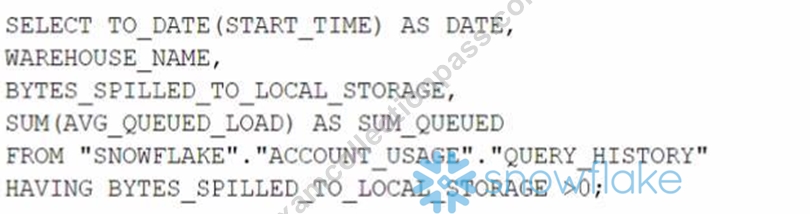
Which query will identify the specific days and virtual warehouses that would benefit from a multi-cluster warehouse to improve the performance of a particular workload?
- A. A close up of a message Description automatically generated
- B. A white background with black text Description automatically generated
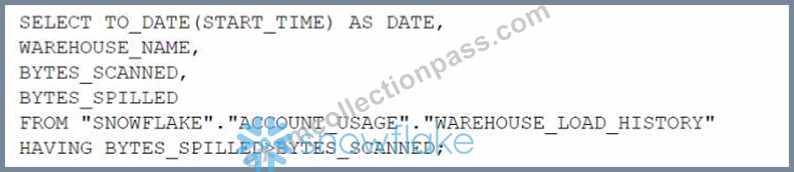
- C. A screen shot of a computer Description automatically generated
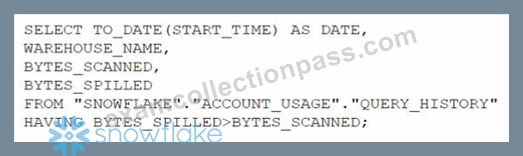
- D. A white background with black text Description automatically generated
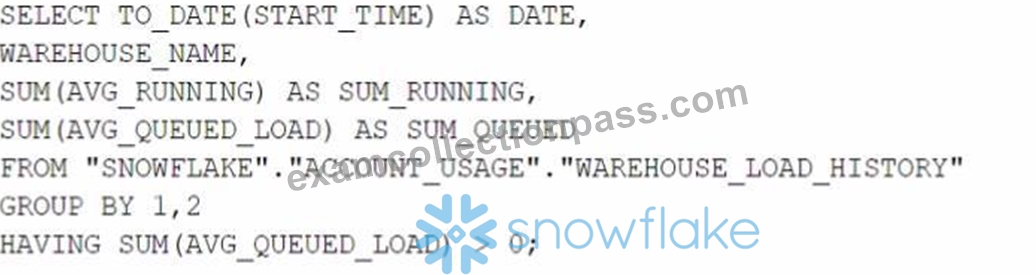
Answer: B
Explanation:
A multi-cluster warehouse is a virtual warehouse that can scale compute resources by adding or removing clusters based on the workload demand. A multi-cluster warehouse can improve the performance of a particular workload by reducing the query queue time and the data spillage to local storage. To identify the specific days and virtual warehouses that would benefit from a multi-cluster warehouse, you need to analyze the query history and look for the following indicators:
* High average queued load: This metric shows the average number of queries waiting in the queue for each warehouse cluster. A high value indicates that the warehouse is overloaded and cannot handle the concurrency demand.
* High bytes spilled to local storage: This metric shows the amount of data that was spilled from memory to local disk during query processing. A high value indicates that the warehouse size is too small and cannot fit the data in memory.
* High variation in workload: This metric shows the fluctuation in the number of queries submitted to the warehouse over time. A high variation indicates that the workload is unpredictable and dynamic, and requires a flexible scaling policy.
The query in option C is the best one to identify these indicators, as it selects the date, warehouse name, bytes spilled to local storage, and sum of average queued load from the query history table, and filters the results where bytes spilled to local storage is greater than zero. This query will show the days and warehouses that experienced data spillage and high queue time, and could benefit from a multi-cluster warehouse with auto-scale mode.
The query in option A is not correct, as it only selects the date and warehouse name, and does not include any metrics to measure the performance of the workload. The query in option B is not correct, as it selects the date, warehouse name, and average execution time, which is not a good indicator of the need for a multi-cluster warehouse. The query in option D is not correct, as it selects the date, warehouse name, and average credits used, which is not a good indicator of the need for a multi-cluster warehouse either.
References: Multi-cluster Warehouses, Query History View, Reducing Queues
NEW QUESTION # 97
A user needs access to create materialized view on a shema mydb.myschema.
What is the appropriate command to provide the access?
- A. GRANT ROLE MYROLE TO USER USER1; GRANT CREATE MATERIALIZED VIEW ON SCHEMA MYDB.MYSCHEMA TO MYROLE;
- B. GRANT CREATE MATERIALIZED VIEW ON SCHEMA MYDB.MYSCHEMA TO USER1;
- C. GRANT CREATE MATERIALIZED VIEW ON SCHEMA MYDB.MYSCHEMA TO USER USER1;
Answer: A
NEW QUESTION # 98
An Architect has chosen to separate their Snowflake Production and QA environments using two separate Snowflake accounts.
The QA account is intended to run and test changes on data and database objects before pushing those changes to the Production account. It is a requirement that all database objects and data in the QA account need to be an exact copy of the database objects, including privileges and data in the Production account on at least a nightly basis.
Which is the LEAST complex approach to use to populate the QA account with the Production account's data and database objects on a nightly basis?
- A. 1) Create a share in the Production account for each database2) Share access to the QA account as a Consumer3) The QA account creates a database directly from each share4) Create clones of those databases on a nightly basis5) Run tests directly on those cloned databases
- B. 1) Create a stage in the Production account2) Create a stage in the QA account that points to the same external object-storage location3) Create a task that runs nightly to unload each table in the Production account into the stage4) Use Snowpipe to populate the QA account
- C. 1) Enable replication for each database in the Production account2) Create replica databases in the QA account3) Create clones of the replica databases on a nightly basis4) Run tests directly on those cloned databases
- D. 1) In the Production account, create an external function that connects into the QA account and returns all the data for one specific table2) Run the external function as part of a stored procedure that loops through each table in the Production account and populates each table in the QA account
Answer: C
Explanation:
This approach is the least complex because it uses Snowflake's built-in replication feature to copy the data and database objects from the Production account to the QA account. Replication is a fast and efficient way to synchronize data across accounts, regions, and cloud platforms. It also preserves the privileges and metadata of the replicated objects. By creating clones of the replica databases, the QA account can run tests on the cloned data without affecting the original data. Clones are also zero-copy, meaning they do not consume any additional storage space unless the data is modified. This approach does not require any external stages, tasks, Snowpipe, or external functions, which can add complexity and overhead to the data transfer process.
Introduction to Replication and Failover
Replicating Databases Across Multiple Accounts
Cloning Considerations
NEW QUESTION # 99
An Architect runs the following SQL query: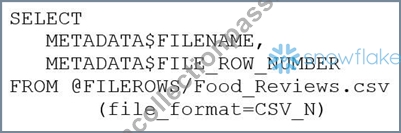
How can this query be interpreted?
- A. FILEROWS is a file. FILE_ROW_NUMBER is the file format location.
- B. FILERONS is the file format location. FILE_ROW_NUMBER is a stage.
- C. FILEROWS is a stage. FILE_ROW_NUMBER is line number in file.
- D. FILEROWS is the table. FILE_ROW_NUMBER is the line number in the table.
Answer: C
NEW QUESTION # 100
An Architect uses COPY INTO with the ON_ERROR=SKIP_FILE option to bulk load CSV files into a table called TABLEA, using its table stage. One file named file5.csv fails to load. The Architect fixes the file and re-loads it to the stage with the exact same file name it had previously.
Which commands should the Architect use to load only file5.csv file from the stage? (Choose two.)
- A. COPY INTO tablea FROM @%tablea NEW_FILES_ONLY = TRUE;
- B. COPY INTO tablea FROM @%tablea RETURN_FAILED_ONLY = TRUE;
- C. COPY INTO tablea FROM @%tablea MERGE = TRUE;
- D. COPY INTO tablea FROM @%tablea;
- E. COPY INTO tablea FROM @%tablea FORCE = TRUE;
- F. COPY INTO tablea FROM @%tablea FILES = ('file5.csv');
Answer: D,F
NEW QUESTION # 101
An Architect is troubleshooting a query with poor performance using the QUERY_HIST0RY function. The Architect observes that the COMPILATIONJHME is greater than the EXECUTIONJTIME.
What is the reason for this?
- A. The query is processing a very large dataset.
- B. The query is queued for execution.
- C. The query has overly complex logic.
- D. The query is reading from remote storage.
Answer: C
Explanation:
Compilation time is the time it takes for the optimizer to create an optimal query plan for the efficient execution of the query. It also involves some pruning of partition files, making the query execution efficient2 If the compilation time is greater than the execution time, it means that the optimizer spent more time analyzing the query than actually running it. This could indicate that the query has overly complex logic, such as multiple joins, subqueries, aggregations, or expressions. The complexity of the query could also affect the size and quality of the query plan, which could impact the performance of the query3 To reduce the compilation time, the Architect can try to simplify the query logic, use views or common table expressions (CTEs) to break down the query into smaller parts, or use hints to guide the optimizer. The Architect can also use the EXPLAIN command to examine the query plan and identify potential bottlenecks or inefficiencies4 References:
1: SnowPro Advanced: Architect | Study Guide 5
2: Snowflake Documentation | Query Profile Overview 6
3: Understanding Why Compilation Time in Snowflake Can Be Higher than Execution Time 7
4: Snowflake Documentation | Optimizing Query Performance 8
SnowPro Advanced: Architect | Study Guide
Query Profile Overview
Understanding Why Compilation Time in Snowflake Can Be Higher than Execution Time Optimizing Query Performance
NEW QUESTION # 102
What built-in Snowflake features make use of the change tracking metadata for a table? (Choose two.)
- A. The UPSERT command
- B. The CHANGES clause
- C. The MERGE command
- D. A STREAM object
- E. The CHANGE_DATA_CAPTURE command
Answer: B,D
Explanation:
The built-in Snowflake features that make use of the change tracking metadata for a table are the CHANGES clause and a STREAM object. The CHANGES clause enables querying the change tracking metadata for a table or view within a specified interval of time without having to create a stream with an explicit transactional offset1. A STREAM object records data manipulation language (DML) changes made to tables, including inserts, updates, and deletes, as well as metadata about each change, so that actions can be taken using the changed data. This process is referred to as change data capture (CDC)2. The other options are incorrect because they do not make use of the change tracking metadata for a table. The MERGE command performs insert, update, or delete operations on a target table based on the results of a join with a source table3. The UPSERT command is not a valid Snowflake command. The CHANGE_DATA_CAPTURE command is not a valid Snowflake command. Reference: CHANGES | Snowflake Documentation, Change Tracking Using Table Streams | Snowflake Documentation, MERGE | Snowflake Documentation
NEW QUESTION # 103
Refer to the exhibit.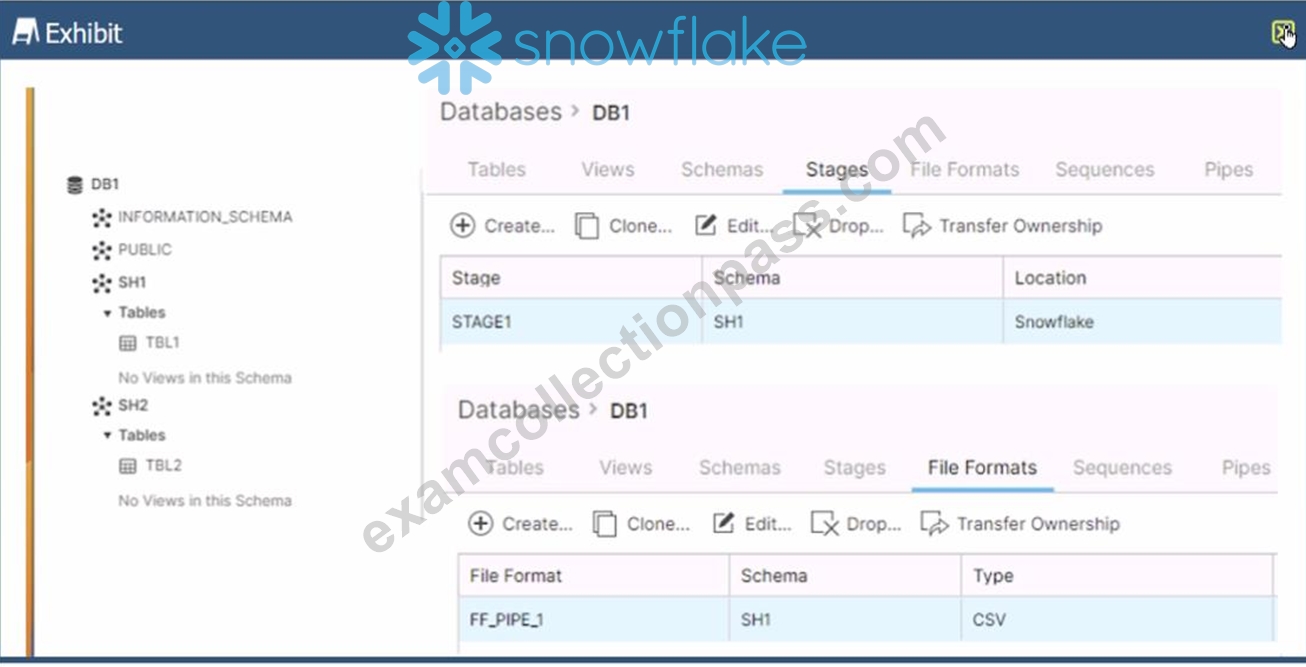
Based on the architecture in the image, how can the data from DB1 be copied into TBL2? (Select TWO).
- A.
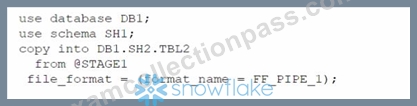
- B.

- C.
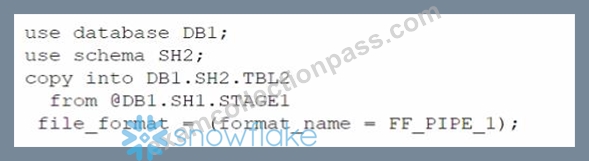
- D.
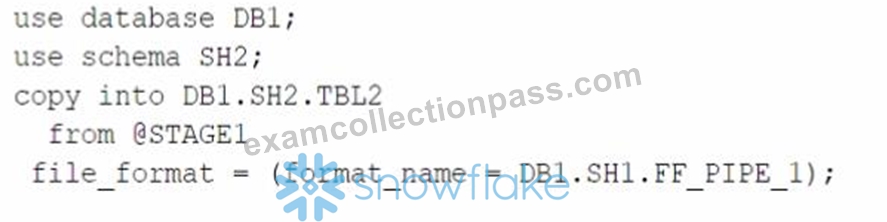
- E.
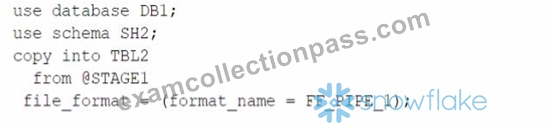
Answer: C,E
NEW QUESTION # 104
Based on the Snowflake object hierarchy, what securable objects belong directly to a Snowflake account? (Select THREE).
- A. Stage
- B. Table
- C. Warehouse
- D. Role
- E. Database
- F. Schema
Answer: C,D,E
Explanation:
A securable object is an entity to which access can be granted in Snowflake. Securable objects include databases, schemas, tables, views, stages, pipes, functions, procedures, sequences, tasks, streams, roles, warehouses, and shares1.
The Snowflake object hierarchy is a logical structure that organizes the securable objects in a nested manner. The top-most container is the account, which contains all the databases, roles, and warehouses for the customer organization. Each database contains schemas, which in turn contain tables, views, stages, pipes, functions, procedures, sequences, tasks, and streams. Each role can be granted privileges on other roles or securable objects. Each warehouse can be used to execute queries on securable objects2.
Based on the Snowflake object hierarchy, the securable objects that belong directly to a Snowflake account are databases, roles, and warehouses. These objects are created and managed at the account level, and do not depend on any other securable object. The other options are not correct because:
Schemas belong to databases, not to accounts. A schema must be created within an existing database3.
Tables belong to schemas, not to accounts. A table must be created within an existing schema4.
Stages belong to schemas or tables, not to accounts. A stage must be created within an existing schema or table.
Reference:
1: Overview of Access Control | Snowflake Documentation
2: Securable Objects | Snowflake Documentation
3: CREATE SCHEMA | Snowflake Documentation
4: CREATE TABLE | Snowflake Documentation
[5]: CREATE STAGE | Snowflake Documentation
NEW QUESTION # 105
How is the change of local time due to daylight savings time handled in Snowflake tasks? (Choose two.)
- A. A task will move to a suspended state during the daylight savings time change.
- B. A task schedule will follow only the specified time and will fail to handle lost or duplicated hours.
- C. A frequent task execution schedule like minutes may not cause a problem, but will affect the task history.
- D. A task scheduled in a UTC-based schedule will have no issues with the time changes.
- E. Task schedules can be designed to follow specified or local time zones to accommodate the time changes.
Answer: D,E
Explanation:
According to the Snowflake documentation1 and the web search results2, these two statements are true about how the change of local time due to daylight savings time is handled in Snowflake tasks. A task is a feature that allows scheduling and executing SQL statements or stored procedures in Snowflake. A task can be scheduled using a cron expression that specifies the frequency and time zone of the task execution.
A task scheduled in a UTC-based schedule will have no issues with the time changes. UTC is a universal time standard that does not observe daylight savings time. Therefore, a task that uses UTC as the time zone will run at the same time throughout the year, regardless of the local time changes1.
Task schedules can be designed to follow specified or local time zones to accommodate the time changes. Snowflake supports using any valid IANA time zone identifier in the cron expression for a task. This allows the task to run according to the local time of the specified time zone, which may include daylight savings time adjustments. For example, a task that uses Europe/London as the time zone will run one hour earlier or later when the local time switches between GMT and BST12.
Reference:
Snowflake Documentation: Scheduling Tasks
Snowflake Community: Do the timezones used in scheduling tasks in Snowflake adhere to daylight savings?
NEW QUESTION # 106
......
Get Ready with ARA-C01 Exam Dumps (2026): https://www.examcollectionpass.com/Snowflake/ARA-C01-practice-exam-dumps.html
Realistic ARA-C01 Dumps are Available for Instant Access: https://drive.google.com/open?id=110sfo6t-LwoWJbZmR4MCQNayjZDa-jrP