
Exam Name: Developing Solutions for Microsoft Azure (AZ-204 Deutsch Version)
Certification Provider: Microsoft
Corresponding Certification: Microsoft Azure

Over 62899+ Satisfied Customers
Instant Download Microsoft : AZ-204 Deutsch

Check Updated on: Nov 18, 2026
No. of Questions: 655 Questions & Answers with Exam Engine
Download Limit: Unlimited
Instant Download: Upon successful payment, Our systems will automatically send the product you have purchased to your mailbox by email. (If not received within 12 hours, please contact us. Note: don't forget to check your spam.)
100% Money Back Guarantee
ExamcollectionPass has an unprecedented 99.6% first time pass rate among our customers.  We're so confident of our products that we provide no hassle product exchange.
- Best exam practice material
- Three formats are optional
- 10+ years of excellence
- 365 Days Free Updates
- Learn anywhere, anytime
- 100% Safe shopping experience
AZ-204 Deutsch Desktop Test Engine
- Installable Software Application
- Simulates Real AZ-204 Deutsch Exam Environment
- Builds AZ-204 Deutsch Exam Confidence
- Supports MS Operating System
- Two Modes For AZ-204 Deutsch Practice
- Practice Offline Anytime
- Software Screenshots
- Total Questions: 655
- Updated on: Nov 18, 2026
- Price: $79.98
AZ-204 Deutsch PDF Practice Q&A's
- Printable AZ-204 Deutsch PDF Format
- Prepared by Microsoft Experts
- Instant Access to Download AZ-204 Deutsch PDF
- Study Anywhere, Anytime
- 365 Days Free Updates
- Free AZ-204 Deutsch PDF Demo Available
- Download Q&A's Demo
- Total Questions: 655
- Updated on: Nov 18, 2026
- Price: $79.98
AZ-204 Deutsch Online Test Engine
- Online Tool, Convenient, easy to study.
- Instant Online Access AZ-204 Deutsch Dumps
- Supports All Web Browsers
- AZ-204 Deutsch Practice Online Anytime
- Test History and Performance Review
- Supports Windows / Mac / Android / iOS, etc.
- Try Online Engine Demo
- Total Questions: 655
- Updated on: Nov 18, 2026
- Price: $79.98
We have to admit that the processional certificates are very important for many people to show their capacity in the highly competitive environment. If you have the Microsoft certification, it will be very easy for you to get a promotion. If you hope to get a job with opportunity of promotion, it will be the best choice chance for you to choose the AZ-204 Deutsch study question from our company. Because our study materials have the enough ability to help you improve yourself and make you more excellent than other people. The AZ-204 Deutsch learning materials from our company have helped a lot of people get the certification and achieve their dreams. Now you also have the opportunity to contact with the Developing Solutions for Microsoft Azure (AZ-204 Deutsch Version) test guide from our company.
Develop for Azure Storage: 10-15%
- Developing Solutions with Cosmos DB Storage: this topic area requires that the students have ability to choose the relevant API for solutions; implement the partitioning schemes; interact with data with the use of relevant SDK; set the relevant level of consistency for operations; develop Cosmos DB containers; implement service-side programming, which includes stored procedures, change feed notifications, and triggers. It also requires one’s expertise in implementing scaling, which covers containers and partitions.
- Developing Solutions with Blob Storage: this requires skills in moving items within Blob storage in storage account and containers; setting and retrieving metadata and properties; interacting with data with the use of relevant SDK; implementing cold, hot, and archive storage; implementing data retention and archiving.
Microsoft AZ-204 is the only qualifying exam for the Microsoft Certified: Azure Developer Associate certification. Although this test has no prerequisite, it is recommended that you first take Microsoft AZ-900 and earn the associated credential to get an idea of what Microsoft Azure is. This is especially helpful if you do not have any knowledge or experience in Cloud-based solutions or Azure. The foundational-level badge will prepare you for the AZ-204 exam and increase your chance of success in it. Of course, if you already have some prior knowledge, you may not start with Microsoft AZ-900 and just go for Microsoft AZ-204.
The AZ-204 certification exam is designed for the individuals with expertise in building, designing, maintaining, and testing Cloud services and applications on Microsoft Azure. The potential candidates for the test are the Azure developers or individuals looking to take up this job role. The responsibilities of these professionals include taking part in each phase of Cloud development. This covers the phases from defining requirements to developing, deploying, maintaining, monitoring, and performance tuning. These specialists should be able to collaborate with the Cloud DBAs, Cloud solution architects, Cloud administrators, as well as clients to implement the developed solutions.
Reference: https://docs.microsoft.com/en-us/learn/certifications/exams/az-204
A convenient tool for studying
The AZ-204 Deutsch learning materials from our company are very convenient for all people, including the convenient buying process, the download way and the study process and so on. Upon completion of your payment, you will receive the email from us in several minutes, and then you will have the right to use the Developing Solutions for Microsoft Azure (AZ-204 Deutsch Version) test guide from our company. In addition, there are three different versions for all people to choose. According to your actual situation, you can choose the suitable version from our AZ-204 Deutsch study question. We believe that the suitable version will help you improve your learning efficiency. It will be very easy for you to pass the exam and get the certification. More importantly, your will spend less time on preparing for AZ-204 Deutsch exam than other people.
The newest information about the exam
As is known to us, getting the newest information is very important for all people to pass the exam and get the certification in the shortest time. In order to help all customers gain the newest information about the AZ-204 Deutsch exam, the experts and professors from our company designed the best Developing Solutions for Microsoft Azure (AZ-204 Deutsch Version) test guide. The experts will update the system every day. If there is new information about the exam, you will receive an email about the newest information about the AZ-204 Deutsch learning materials. We can promise that you will never miss the important information about the exam.
Implement Azure Security: 15-20%
- Implementing User Authorization and Authentication: the test takers should be able to implement OAuth2 authentication; develop and implement shared access signatures; register applications and utilize Azure AD to authenticate the users; control access to available resources through the use of RBAC 9role-based access controls.
- Implementing Secure Cloud Solutions: this entails securing app configuration data with the use of KeyVault API and App Configuration; managing keys, certificates, and secrets with the use of KeyVault API; implementing Managed Identities for available Azure resources.
Responsible company
In order to meet the demands of all customers, our company has a complete set of design, production and service quality guarantee system, the Developing Solutions for Microsoft Azure (AZ-204 Deutsch Version) test guide is perfect. We can promise that quality first, service upmost. If you buy the AZ-204 Deutsch learning materials from our company, we are glad to provide you with the high quality AZ-204 Deutsch study question and the best service. The philosophy of our company is "quality is life, customer is god". We can promise that our company will provide all customers with the perfect quality guarantee system and sound management system. It is not necessary for you to have any worry about the quality and service of the AZ-204 Deutsch learning materials from our company. We can make sure that our company will be responsible for all customers. If you decide to buy the AZ-204 Deutsch study question from our company, you will receive a lot beyond your imagination. So hurry to buy our products, it will not let you down.
Microsoft AZ-204 Deutsch Exam Syllabus Topics:
| Section | Weight | Objectives |
|---|---|---|
| Develop for Azure storage | 15–20% | - Work with storage tables and queues
|
| Implement Azure security | 15–20% | - Secure solutions using Key Vault
|
| Monitor, troubleshoot, and optimize Azure solutions | 5–10% | - Optimize performance and scalability
|
| Develop Azure compute solutions | 25–30% | - Implement containerized solutions
|
| Connect to and consume Azure services and third-party services | 20–25% | - Implement API Management
|
Microsoft Developing Solutions for Microsoft Azure (AZ-204 Deutsch Version) Sample Questions:
Sie entwickeln eine Python-Anwendung für das Rendern von Bildern, die GPU-Ressourcen verwendet, um Rendering-Prozesse zu optimieren. Sie stellen die Anwendung in einem Linux-Container von Azure Container Instances (ACI) bereit.
Die Anwendung erfordert, dass ein geheimer Wert übergeben wird, wenn der Container gestartet wird. Auf den Wert darf nur innerhalb des Containers zugegriffen werden.
Sie müssen den geheimen Wert übergeben.
Welche zwei Möglichkeiten gibt es, um dieses Ziel zu erreichen? Jede richtige Antwort stellt eine vollständige Lösung dar.
HINWEIS: Jede richtige Auswahl ist einen Punkt wert.
- A. Fügen Sie den geheimen Wert zum Container-Image hinzu. Verwenden Sie eine verwaltete Identität.
- B. Hängen Sie ein geheimes Volume ein, das den geheimen Wert in einer geheimen Datei enthält.
- C. Fügen Sie den geheimen Wert einem Azure Blob Storage-Konto hinzu. Generieren Sie ein SAS-Token.
- D. Erstellen Sie eine Umgebungsvariable Legen Sie die Eigenschaft secureValue auf den geheimen Wert fest.
- E. Fügen Sie den geheimen Wert zum Anwendungscode hinzu. Legen Sie den Befehl zum Starten des Containers fest.
Correct Answer: B,D 🗳️
Explanation: Only visible for ExamcollectionPass members. You can sign-up / login (it's free).
Fallstudie 5 – Wide World Importers
Hintergrund
Wide World Importers migriert alle seine Rechenzentren zu Azure. Das Unternehmen hat mehrere Anwendungen und Dienste zur Unterstützung seiner Lieferkettenprozesse entwickelt und möchte, wo immer möglich, serverloses Computing nutzen.
Aktuelles Umfeld
Virtuelle Maschine von Windows Server 2016
Diese virtuelle Maschine (VM) führt BizTalk Server 2016 aus. Die VM führt die folgenden Workflows aus:
* Seetransport – Dieser Workflow erfasst und validiert Containerinformationen, einschließlich
Containerinhalte und Ankunftsmeldungen in verschiedenen Verschiffungshäfen.
* Binnentransport – Dieser Workflow erfasst und validiert Lkw-Transportinformationen, einschließlich Kraftstoffdaten.
Nutzung, Anzahl der Haltestellen und Routen.
Die VM unterstützt die folgenden REST-API-Aufrufe:
* Container-API – Diese API liefert Containerinformationen wie Gewicht, Inhalt und andere Daten.
Attribute.
* Standort-API – Diese API liefert Standortinformationen zu Verschiffungshäfen und LKWs.
hält an.
* Versand-REST-API – Diese API stellt Versandinformationen zur Verwendung und Anzeige auf der Website bereit.
Versandwebsite.
Versanddaten
Die Anwendung nutzt die MongoDB JSON-Dokumentendatenbank zur Speicherung aller Container- und Transportinformationen.
Versand-Website
Die Website zeigt Informationen zur Sendungsverfolgung und zum Inhalt von Versandcontainern an. Sie ist unter http://shipping.wideworldimporters.com erreichbar. Vorgeschlagene Lösung: Die lokale Versandanwendung muss nach Azure migriert werden. Die VM wurde mithilfe von Azure Site Recovery auf eine neue Azure-VM vom Typ Standard_D16s_v3 migriert und muss weiterhin in Azure ausgeführt werden, um die Migration der BizTalk-Komponenten abzuschließen. Sie erstellen eine Azure-VM vom Typ Standard_D16s_v3, um den BizTalk Server zu hosten. Das Azure-Architekturdiagramm für die vorgeschlagene Lösung ist unten dargestellt.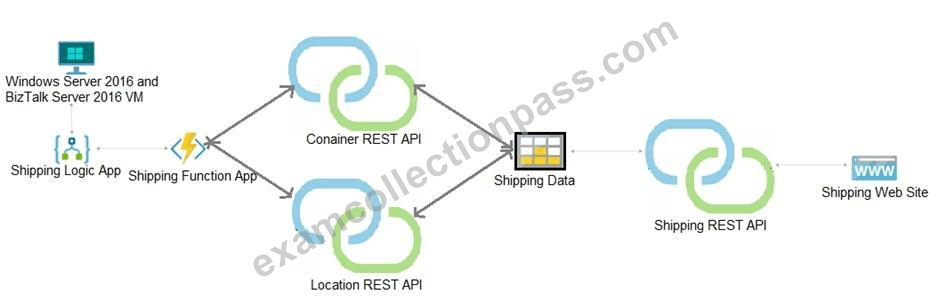
Versandlogik-App
Die Shipping Logic App muss folgende Anforderungen erfüllen:
* Unterstützen Sie die Arbeitsabläufe im See- und Binnentransport mithilfe einer Logic App.
* Unterstützung des branchenüblichen Protokolls X12 für das Nachrichtenformat verschiedener Formate, einschließlich Schiffsnachrichten
Inhaltsdetails und Ankunftshinweise.
* Sichern Sie Ressourcen im Unternehmens-VNet und nutzen Sie dedizierte Speicherressourcen mit festem
Kostenmodell.
* Aufrechterhaltung der lokalen Konnektivität zur Unterstützung älterer Anwendungen und der finalen BizTalk-Migrationen.
Versandfunktions-App
Implementieren Sie sichere Funktionsendpunkte durch die Verwendung von Sicherheitsfunktionen auf Anwendungsebene und binden Sie Azure Active Directory (Azure AD) ein.
REST-APIs
Die REST-APIs, die die Lösung unterstützen, müssen folgende Anforderungen erfüllen:
* Sichere Ressourcen für das Unternehmens-VNet.
* Ermöglicht die Bereitstellung an einem Teststandort innerhalb von Azure, ohne zusätzliche Kosten zu verursachen.
* Automatische Skalierung auf die doppelte Kapazität während der Versandspitzenzeiten, ohne die Anwendung zu beeinträchtigen
Ausfallzeit.
* Minimieren Sie die Kosten bei der Auswahl eines Azure-Zahlungsmodells.
Versanddaten
Bei der Datenmigration von lokalen Systemen zu Azure müssen Kosten und Ausfallzeiten minimiert werden.
Versand-Website
Nutzen Sie das Azure Content Delivery Network (CDN) und gewährleisten Sie maximale Leistung für dynamische Inhalte bei gleichzeitiger Minimierung von Latenz und Kosten.
Probleme
Windows Server 2016 VM
Die VM weist hohe Netzwerklatenz, Jitter und eine hohe CPU-Auslastung auf. Die VM ist geschäftskritisch und wurde bisher nicht gesichert. Sie muss eine schnelle Wiederherstellung aus einem 7-Tage-Snapshot ermöglichen, einschließlich der direkten Wiederherstellung der Festplatten im Fehlerfall.
Versandwebsite und REST-APIs
Beim Testen der Website wird folgende Fehlermeldung angezeigt:
Hotspot-Frage
Um den Testfehler zu beheben, müssen die APIs aktualisiert werden.
Wie sollte der Azure CLI-Befehl vollständig ausgeführt werden? Wählen Sie dazu die entsprechenden Optionen im Antwortbereich aus.
HINWEIS: Jede richtige Auswahl zählt als ein Punkt.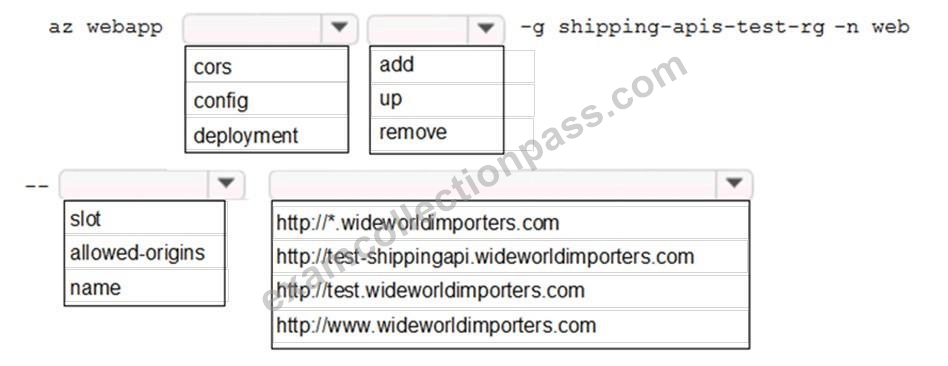
Correct Answer:
Explanation:
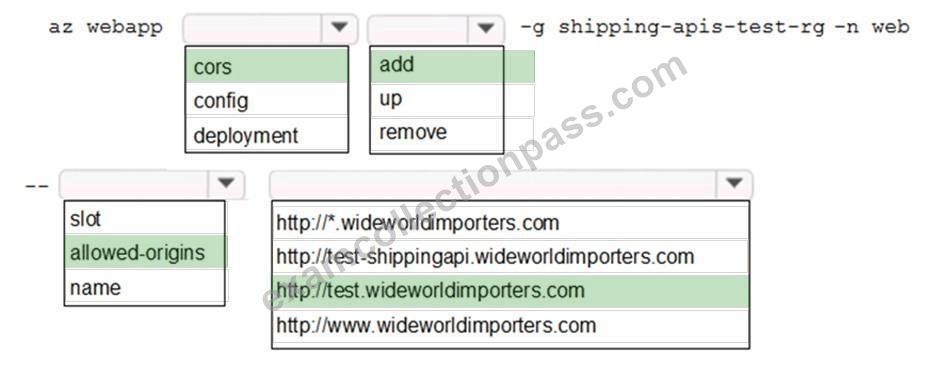
Enable Cross-Origin Resource Sharing (CORS) on your Azure App Service Web App. Enter the full URL of the site you want to allow to access your WEB API or * to allow all domains.
Box 1: cors
Box 2: add
Box 3: allowed-origins
Box 4: http://testwideworldimporters.com/
References:
http://donovanbrown.com/post/How-to-clear-No-Access-Control-Allow-Origin-header-error-with-Azure-AppService
Drag-and-Drop-Frage
Sie sind Entwickler bei einem SaaS-Unternehmen (Software as a Service), das eine Azure-Funktion zur Auftragsabwicklung nutzt. Die Azure-Funktion läuft aktuell in einer Azure-Funktions-App, die durch eine Azure-Speicherwarteschlange ausgelöst wird.
Sie bereiten die Migration der Azure-Funktion zu Kubernetes mithilfe von Kubernetes-basiertem ereignisgesteuertem Autoscaling (KEDA) vor.
Sie müssen Kubernetes Custom Resource Definitions (CRD) für die Azure-Funktion konfigurieren.
Welche CRDs sollten Sie konfigurieren? Ziehen Sie dazu die entsprechenden CRD-Typen an die richtigen Stellen. Jeder CRD-Typ kann einmal, mehrmals oder gar nicht verwendet werden. Gegebenenfalls müssen Sie die Trennlinie zwischen den Bereichen verschieben oder scrollen, um alle Inhalte anzuzeigen.
HINWEIS: Jede richtige Auswahl zählt als ein Punkt.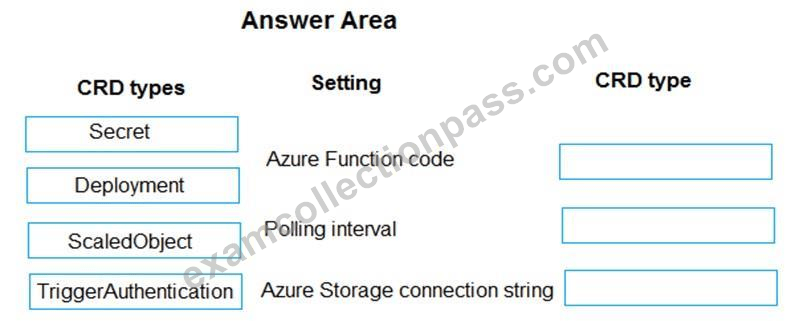
Correct Answer:
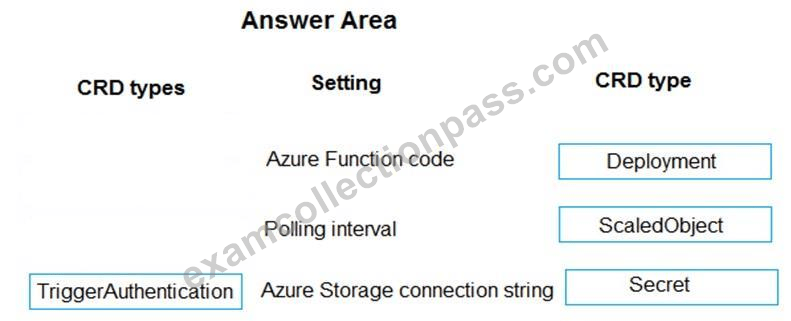
Explanation:
Box 1: Deployment
To deploy Azure Functions to Kubernetes use the func kubernetes deploy command has several attributes that directly control how our app scales, once it is deployed to Kubernetes.
Box 2: ScaledObject
With --polling-interval, we can control the interval used by KEDA to check Azure Service Bus Queue for messages.
Example of ScaledObject with polling interval
apiVersion: keda.k8s.io/v1alpha1
kind: ScaledObject
metadata:
name: transformer-fn
namespace: tt
labels:
deploymentName: transformer-fn
spec:
scaleTargetRef:
deploymentName: transformer-fn
pollingInterval: 5
minReplicaCount: 0
maxReplicaCount: 100
Box 3: Secret
Store connection strings in Kubernetes Secrets.
Example: to create the Secret in our demo Namespace:
# create the k8s demo namespace
kubectl create namespace tt
# grab connection string from Azure Service Bus
KEDA_SCALER_CONNECTION_STRING=$(az servicebus queue authorization-rule keys list \ -g
$RG_NAME \
--namespace-name $SBN_NAME \
--queue-name inbound \
-n keda-scaler \
--query "primaryConnectionString" \
-o tsv)
# create the kubernetes secret
kubectl create secret generic tt-keda-auth \
--from-literal KedaScaler=$KEDA_SCALER_CONNECTION_STRING \
--namespace tt
Reference:
https://www.thinktecture.com/en/kubernetes/serverless-workloads-with-keda/
Hotspot-Frage
Sie entwickeln eine Python-Anwendung zur Bildwiedergabe. Die Anwendung nutzt GPU-Ressourcen, um die Rendering-Prozesse zu optimieren.
Sie haben folgende Anforderungen:
Die Anwendung muss in einem Linux-Container bereitgestellt werden.
- Der Container muss gestoppt werden, sobald das Rendern des Bildes abgeschlossen ist.
Die Lösung muss die Kosten minimieren.
Sie müssen die Anwendung in Azure bereitstellen.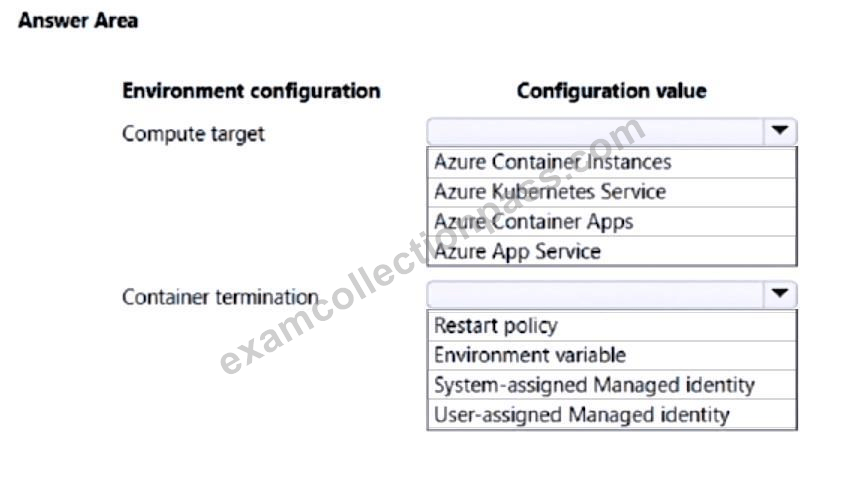
Correct Answer:
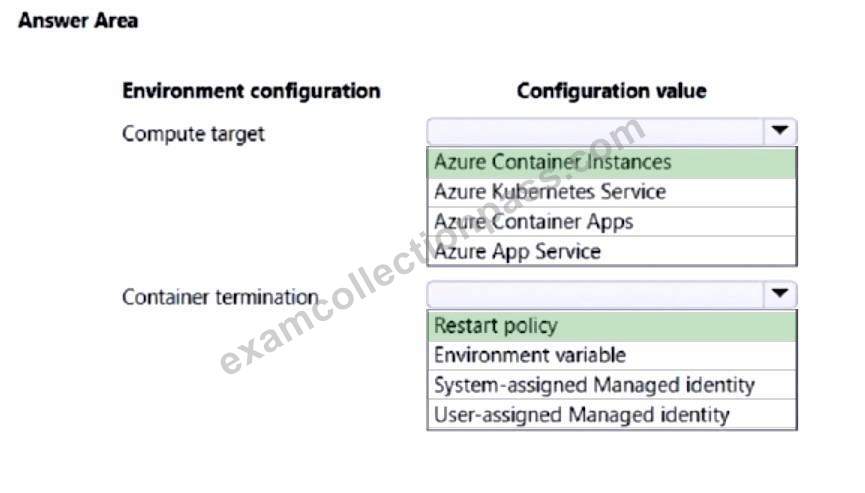
Explanation:
Box 1: Azure Container Instances
Kubernetes can manage ACIs but is not a 'compute target' and it will increment the cost.
The container instances in the group can access one or more NVIDIA Tesla GPUs while running container workloads such as CUDA and deep learning applications.
https://learn.microsoft.com/en-us/azure/container-instances/container-instances-gpu Box 2: Restart Policy To stop the container after the execution (In fact is avoiding to restart it after a succeeded execution) Set an appropriate restart policy for the container instance, depending on whether the command- line specifies a long-running task or a run-once task. For example, a restart policy of Never or OnFailure is recommended for a run-once task.
https://learn.microsoft.com/en-us/azure/container-instances/container-instances-start-command#command-line-guidelines
Fallstudie 8 – VanArsdel, Ltd.
Hintergrund
VanArsdel, Ltd. ist ein weltweit tätiges Büroartikelunternehmen. Das Unternehmen hat seinen Hauptsitz in Kanada und betreibt Filialen rund um den Globus. VanArsdel entwickelt verschiedene Cloud-basierte Lösungen zur Unterstützung seiner Filialen, Vertriebspartner, Lieferanten und Lieferdienste.
Aktuelles Umfeld
Unternehmenswebsite
Das Unternehmen bietet eine öffentliche Website unter http://www.vanarsdelltd.com an. Die Website besteht aus einer React JavaScript-Benutzeroberfläche, HTML, CSS, Bildmaterial und mehreren APIs, die in Azure Functions gehostet werden.
Standorte der Einzelhandelsgeschäfte
Das Unternehmen betreut weltweit Tausende von Filialen. Diese senden stündlich Daten an ein Azure Blob Storage-Konto, um Bestands-, Einkaufs- und Lieferdienste zu unterstützen.
Jeder Datensatz enthält eine Standortkennung und Informationen zur Verkaufstransaktion.
Anforderungen
Die Anwendungskomponenten müssen folgende Anforderungen erfüllen:
Unternehmenswebsite
- Sichern Sie die Website durch die Verwendung von SSL.
- Minimierung der Kosten für Datenspeicherung und Hosting.
- Implementierung nativer GitHub-Workflows für Continuous Integration und Continuous Deployment (CI/CD).
- Die Website-Inhalte sollen weltweit zur lokalen Nutzung verbreitet werden.
- Implementieren Sie die Überwachung mithilfe von Application Insights und Verfügbarkeitstests, einschließlich der Überprüfung der SSL-Zertifikatgültigkeit und der benutzerdefinierten Headerwerte.
Die Website muss eine Verfügbarkeit von 99,95 Prozent aufweisen.
Standorte von Einzelhandelsgeschäften
Azure Functions müssen Daten sofort verarbeiten, sobald diese in den Blob-Speicher hochgeladen werden. Azure Functions müssen Azure Cosmos DB mithilfe von SQL-Abfragen in nativer Sprache aktualisieren.
- Tägliche Prüfung der Verkaufstransaktionsinformationen des Ladens zur Datenvalidierung, Verarbeitung der Verkaufsfinanzen und Abgleich des Lagerbestands.
Lieferdienste
- Speichern Sie Service-Telemetriedaten in Azure Cosmos DB mithilfe einer Azure-Funktion. Die Daten müssen eine Artikel-ID, das Kennzeichen des Lieferfahrzeugs, die Ladekapazität des Fahrzeugs und die aktuellen Standortkoordinaten des Fahrzeugs enthalten.
- Speichern von Fahrerprofilinformationen in Azure Active Directory (Azure AD) mithilfe einer Azure-Funktion, die von der Unternehmenswebsite aufgerufen wird.
Inventardienstleistungen
Das Unternehmen hat einen Drittanbieter mit der Entwicklung einer API für die Bestandsverarbeitung beauftragt, die für drei Monate Zugriff auf einen bestimmten Blob innerhalb des Speicherkontos des Einzelhandelsgeschäfts erfordert, einschließlich eines reinen Lesezugriffs auf die Daten.
Sicherheit
- Alle Azure Functions müssen die Verwaltung und Verteilung von Konfigurationsdaten für verschiedene Umgebungen und Regionen zentralisieren, wobei die Daten mit einem vom Unternehmen bereitgestellten RSA-HSM-Schlüssel verschlüsselt werden.
- Authentifizierung und Autorisierung müssen über Azure AD erfolgen, und Dienste müssen nach Möglichkeit verwaltete Identitäten verwenden.
Probleme
Standorte der Einzelhandelsgeschäfte
- Sie müssen eine Wiederherstellung der Standortdaten des Einzelhandelsgeschäfts zu einem bestimmten Zeitpunkt durchführen, da Daten unerwartet und versehentlich gelöscht wurden.
- Die Azure Cosmos DB-Abfragen der Azure Function weisen eine hohe Nutzung von Anforderungseinheiten (RU) auf und enthalten mehrere komplexe Abfragen, die bei der Skalierung der Funktions-App eine hohe Leselatenz für große Elemente aufweisen.
Frage
Hotspot-Frage
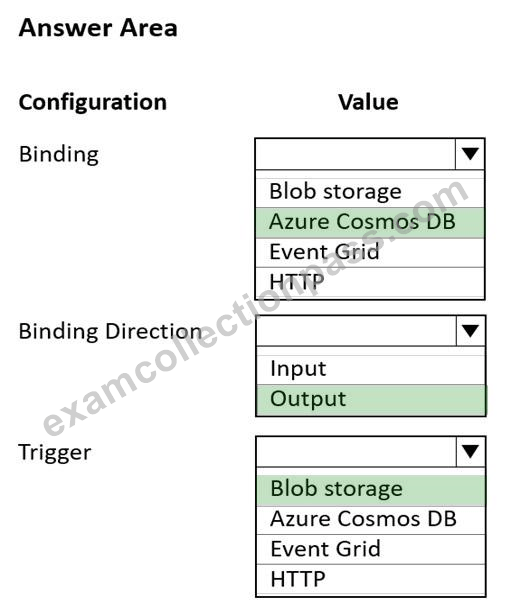
Sie müssen die Azure-Funktion für den Standort des Einzelhandelsgeschäfts implementieren.
Wie sollten Sie die Lösung konfigurieren? Wählen Sie dazu die entsprechenden Optionen im Antwortbereich aus.
HINWEIS: Jede richtige Auswahl zählt als ein Punkt.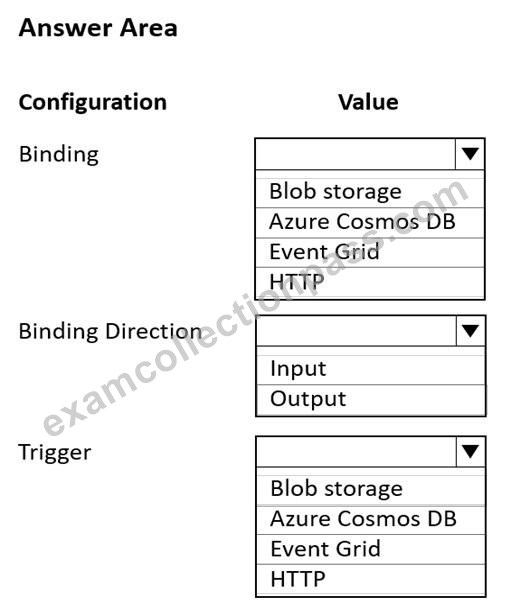
Correct Answer:
Explanation:
Scenario: Retail store locations: Azure Functions must process data immediately when data is uploaded to Blob storage.
Box 1: Azure Cosmos DB
Box 2: Output
Box 3: Blob storage
The Blob storage trigger starts a function when a new or updated blob is detected.
Azure Functions integrates with Azure Storage via triggers and bindings. Integrating with Blob storage allows you to build functions that react to changes in blob data as well as read and write values.
Reference:
https://docs.microsoft.com/en-us/azure/azure-functions/functions-bindings-storage-blob-trigger
Viewing page 1 out of 131 pages.
Viewing questions 1-5 out of 655 questions.
 0 Customer Reviews
